
In the world of precision manufacturing, size introduces a entirely new dimension of complexity. Large part CNC machining represents the pinnacle of engineering capability—where components weighing several tons must be machined to tolerances measured in thousandths of an inch.
From the wing spars that keep commercial aircraft aloft to the turbine housings that power cities, these massive precision components form the backbone of modern industry.
Unlike conventional machining operations, working with large-scale parts presents unique challenges that test the limits of equipment, tooling, and engineering expertise.
How do you fixture a 10-ton workpiece without inducing distortion? How do you maintain micron-level accuracy across a 20-meter machining envelope? How do you manage thermal growth when cutting forces generate significant heat over hours-long operations?
This comprehensive guide answers these questions and more. We’ll explore the specialized equipment required for large part machining, examine critical applications across key industries, and provide practical insights into process optimization, quality control, and cost management.
Whether you’re a design engineer specifying large components or a procurement professional evaluating manufacturing partners, this resource will help you navigate the complexities of large-scale precision machining with confidence.
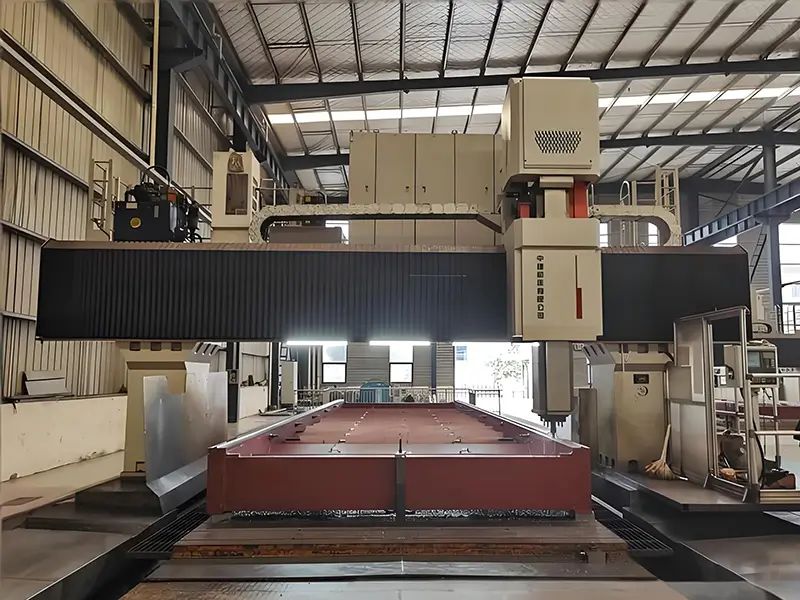
What Defines Large Part CNC Machining?
Large part CNC machining refers to the precision material removal process applied to components that exceed the capacity of standard machining equipment. While definitions vary by industry and facility, parts requiring specialized large-scale machinery
typically those with dimensions exceeding 2 meters in any direction or weighing over 1,000 kilograms—fall into this category.
Key Characteristics
- Exceptional dimensions: Parts requiring extended axis travel beyond conventional machining centers
- Substantial mass: Workpieces weighing hundreds to tens of thousands of kilograms
- Tight tolerances: Precision requirements often exceeding 0.01mm despite part scale
- Complex geometries: Multi-axis features requiring sophisticated programming
- Critical applications: Components where failure is not an option
The Scale Challenge
The fundamental difficulty in large part machining lies in the inverse relationship between part size and achievable precision. Thermal expansion, cutting forces, material stress relief, and machine deflection all scale with part dimensions, making tolerance maintenance exponentially more difficult as part size increases.
Large Part CNC Machining Equipment: Machines, Tooling & Workholding
Manufacturing large precision components requires equally substantial capital equipment. Understanding the capabilities and limitations of each machine type is essential for proper process selection.
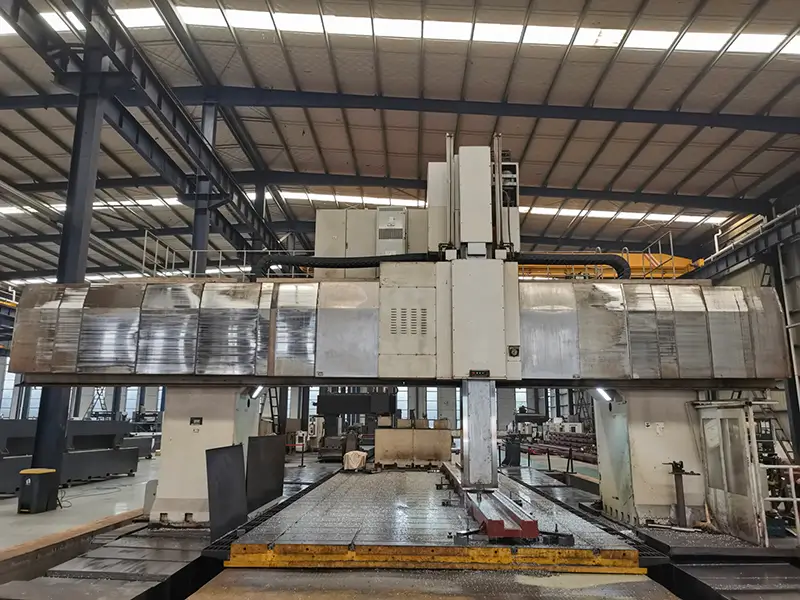
Primary Machine Tool Categories
| Machine Type | Typical Travel Range | Key Advantages | Common Applications |
|---|---|---|---|
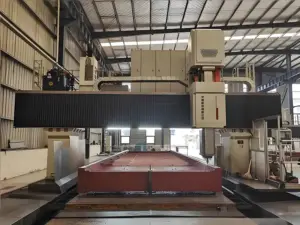
| Gantry Machining Centers | X: 3-30m, Y: 2-6m, Z: 1-3m | Excellent rigidity, multiple spindle options | Aerospace structures, large molds, heavy fabrication |
| Floor-Type Boring Mills | X: 4-20m+, Y: 3-8m, W: 1-3m | Unlimited table capacity, deep boring capability | Power generation, oil & gas, heavy equipment |
| Vertical Turning Lathes | Swing: 2-10m+ | Superior for large diameter rotational parts | Wind energy, bearings, flanges, large gears |
| Horizontal Machining Centers | X: 2-6m, Y: 1.5-3m, Z: 1.5-3m | Multi-face machining, pallet systems | Construction equipment, pump housings, gearboxes |
Specialized Tooling Systems
Large part machining demands tooling engineered for extended reach and vibration dampening:
- Anti-vibration boring bars: Tuned mass dampers or composite construction for L:D ratios exceeding 6:1
- Modular tooling systems: Allows tool assembly optimization while maintaining rigidity
- High-feed milling cutters: Maximize material removal while minimizing cutting forces
- Large diameter face mills: 80-315mm diameter for efficient surface generation
- Extended length drills: Specialized geometries for deep hole applications
Workholding Solutions
Securing massive workpieces presents unique fixturing challenges:
- Modular fixture systems: Reconfigurable support structures for varied part geometries
- Vacuum chucking: Ideal for large thin-wall plate components
- Magnetic chucks: Electromagnetic or permanent magnet systems for ferrous materials
- Hydraulic clamping: Programmable clamping force with position feedback
- Custom fixturing: Purpose-built solutions for complex production parts
Industries and Applications for Large Part CNC Machining
Large precision components serve as the structural and mechanical foundation for virtually every heavy industry.
Aerospace & Defense
The aerospace industry demands large, monolithic structures that maximize strength while minimizing weight:
- Wing spars and ribs: Aluminum or titanium extrusions requiring complex pocketing
- Bulkheads and frames: Primary structural elements for fuselage integrity
- Engine components: Casing sections, turbine disks, compressor housings
- Landing gear structures: High-strength steel components subjected to extreme loads
- Satellite structures: Large, lightweight panels with precision mounting features
Power Generation & Energy
Energy sector components must withstand extreme pressures, temperatures, and cyclic loading:
- Wind turbine components: Hubs, main shafts, nacelle frames, gearbox housings
- Gas and steam turbines: Rotors, casings, diaphragms, valve bodies
- Hydroelectric equipment: Turbine runners, wicket gates, head covers
- Nuclear components: Reactor vessel heads, steam generator parts, pump casings
- Oil and gas equipment: Blowout preventers, Christmas trees, manifold blocks
Heavy Machinery & Construction
Off-highway and construction equipment relies on large machined components for durability:
- Excavator components: Booms, arms, turntable bearings, track frames
- Mining equipment: Crusher housings, mill ends, gearboxes, haul truck components
- Crane structures: Telescopic booms, turntables, outrigger housings
- Agricultural machinery: Transmission housings, chassis components, implement frames
Marine & Offshore
Marine environments demand corrosion-resistant materials and robust construction:
- Propulsion components: Propeller shafts, stern tubes, rudder stocks
- Engine room equipment: Large diesel engine blocks, cylinder heads, bedplates
- Deck machinery: Winch drums, mooring equipment, crane pedestals
- Subsea components: Manifolds, connector bodies, ROV tooling
Tooling & Heavy Equipment Manufacturing
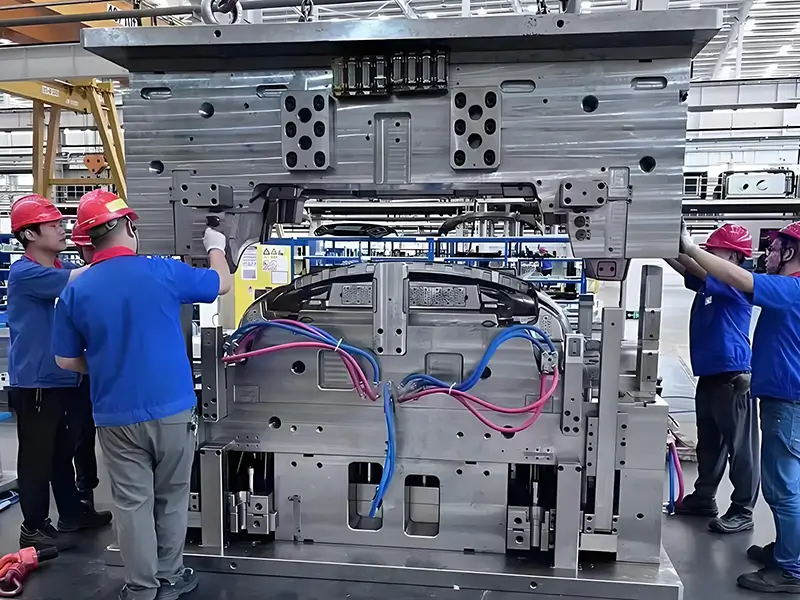
Large molds and dies enable mass production of consumer and industrial goods:
- Automotive stamping dies: Complete die sets for body panels
- Injection molds: Large plastic components for automotive and appliance industries
- Compression molds: Tire molds, composite forming tools
- Patterns and fixtures: Foundry tooling and assembly fixtures
Materials Commonly Machined in Large Part Applications
Material selection significantly impacts machining strategy, tooling requirements, and final part performance.
| Material | Common Grades | Machining Characteristics | Typical Applications |
|---|---|---|---|
| Aluminum | 6061-T6, 6061-T651, 7075-T6, 5083-H32 | Excellent machinability, requires stress relief | Aerospace structures, molds, tooling plates |
| Steel | A36, 1018, 1045, 4140, 4340 | High cutting forces, heat treatable | Machine bases, structural components, shafts |
| Stainless Steel | 304/L, 316/L, 17-4PH | Work hardening, high cutting forces | Food processing, marine, medical equipment |
| Tool Steel | P20, H13, D2 | Hardness variations, abrasive | Injection molds, die casting dies |
| Cast Iron | Gray iron, ductile iron | Abrasive chips, good damping | Machine tool components, housings |
| Titanium | Ti6Al4V | Poor thermal conductivity, springback | Aerospace, medical implants, marine |
| Engineering Plastics | Nylon, UHMW, PEEK | Thermal sensitivity, chip control | Wear components, liners, chemical handling |
Material Selection Considerations
- Availability in required sizes: Large plate, bar, or forging availability
- Machinability index: Expected tool life and cutting parameters
- Heat treatment requirements: Pre-machining vs. post-machining heat treat
- Residual stress levels: Material stability during and after machining
- Cost per kilogram: Material cost impact on overall part value
Quality Control and Inspection for Large Machined Parts
Traditional metrology approaches often prove impractical for large components, requiring specialized inspection strategies.
Measurement Technologies
| Technology | Accuracy | Range | Best Application |
|---|---|---|---|
| Portable CMM Arms | ±0.025mm | Up to 4m | On-machine verification, complex features |
| Laser Trackers | ±0.015mm + 0.006mm/m | Up to 80m | Large assembly alignment, long dimensions |
| Photogrammetry | ±0.1mm at 10m | Unlimited | Rapid surface scanning, large volume mapping |
| Laser Scanners | ±0.05mm | Up to 10m | Surface profile, reverse engineering |
| In-process Probing | Machine-dependent | Machine envelope | On-machine feature verification |
Key Inspection Considerations
- Temperature normalization: Allow parts to reach equilibrium before final measurement
- Datuming strategy: Establish and maintain consistent reference throughout inspection
- Feature prioritization: Focus on critical-to-function dimensions and tolerances
- Documentation requirements: First article reports, capability studies, certification packages
- Non-destructive testing: Ultrasonic, magnetic particle, or dye penetrant as required
Selecting a Large Part CNC Machining Partner
Choosing the right manufacturing partner is critical for project success. Evaluate potential suppliers against these criteria:
Equipment Capabilities
- Machine envelope: Does available travel accommodate your part dimensions?
- Spindle options: Adequate power and speed range for your materials?
- Multi-axis capability: 3+2 or 5-axis positioning for complex features?
- Capacity availability: Current backlog and scheduling flexibility?
Technical Expertise
- Similar part experience: Have they machined comparable components?
- Material knowledge: Familiarity with your specified materials?
- Tolerance achievement: Demonstrated ability to hold required precision?
- Problem-solving approach: How do they address unexpected challenges?
Quality Systems
- Certifications: ISO 9001, AS9100, ISO 13485 as applicable
- Inspection capabilities: Metrology equipment appropriate for your parts
- Documentation practices: Traceability, reporting, certification
- Continuous improvement: Evidence of process refinement and lessons learned
Project Management
- Communication: Clear reporting and responsiveness
- Supply chain integration: Raw material sourcing and management
- Schedule adherence: Track record of on-time delivery
- Cost transparency: Clear quotation and change order process
FAQ About Large Part CNC Machining
What defines a “large part” in CNC machining?
Generally, components exceeding 2 meters in any dimension or weighing over 1,000 kilograms, requiring specialized large-format equipment rather than standard machining centers.
What tolerances can be achieved on large machined parts?
Typical machining tolerances range from ±0.05mm to ±0.5mm depending on feature size, material, and part geometry. Precision large parts can achieve IT6-IT7 grades with proper temperature control and machine capability.
How do you prevent distortion when machining large thin-wall components?
Through strategic fixturing (vacuum or magnetic chucking), optimized toolpaths (trochoidal milling, high-speed machining), stress-relief cycles between operations, and careful management of cutting temperatures.
Can large parts be machined from castings versus solid blocks?
Yes. Castings offer near-net shapes that reduce machining time and material cost. However, castings require careful consideration of porosity, inclusions, and residual stress patterns.
What is the typical lead time for large part machining?
Lead times vary significantly based on complexity, material availability, and current shop capacity. Simple large parts might require 2-4 weeks, while complex components can take 8-12 weeks or longer.
How are extremely large parts (beyond machine capacity) handled?
Options include:
- Sectional machining with subsequent assembly
- On-site machining using portable equipment
- Specialized contract manufacturers with ultra-large capacity
- Alternative manufacturing methods (fabrication, casting)
What certifications are typically required for medical or aerospace large parts?
Aerospace typically requires AS9100 certification and often NADCAP approvals for special processes. Medical device components require ISO 13485 and may require FDA registration and cleanroom processing.