
I used to think gates were just… gates. A small feature. Nothing to worry about.
Until I got the bill for a mold rework.
It turned out that one small gate decision led to warping, poor venting, and hand-trimming every part. It slowed production to a crawl. After that, I made it my mission to actually understand how gate types affect part design and performance.
If you’re reading this, you’re probably asking:
What gate type should I use? And why does it even matter?
This article will give you a clear answer. You’ll learn the most common injection molding gate types, what they do, and how they affect flow, part appearance, and production results.
Whether you’re designing the part, sourcing the mold, or managing the output—this guide will help you choose the gate that works.
Let’s start!
Quick Injection Molding Gate Reference
I know gate selection can feel like a guessing game. So here’s a cheat sheet to help you sort it out fast before we dig into the specifics of each option.
| Gate Type | Best For | Pros | Cons | Trimming Method | Visible Gate Mark | Works Well With | Avoid With |
| Edge Gate | Flat or wide parts | Simple design, easy to trim, low cost | Visible mark, weld lines possible | Manual | Yes | ABS, Polypropylene | Glass-filled resins |
| Submarine Gate | High-volume, hidden gates | Automatic trimming, minimal gate mark | Harder to machine, not for thick parts | Automatic | No | ABS, flexible plastics | Stiff or filled materials |
| Direct/Sprue Gate | Large, thick-walled parts | Strong flow, fewer fill issues | Large gate vestige, manual trim | Manual | Yes | Nylon, Polycarbonate | Brittle or cosmetic parts |
| Pin Gate | Hot runner systems | No visible mark, no runner waste | Expensive mold, more setup | Automatic (valve) | No | ABS, Polyethylene | Burn-prone or hard-to-control materials |
| Fan Gate | Large flat parts | Smooth flow, low stress, prevents warping | Visible mark, needs more space | Manual | Yes | HDPE, flexible plastics | Small or thick parts |
| Tab Gate | Weld line control, impact parts | Better weld lines, reduces stress | Larger gate, manual trim | Manual | Yes | ABS, impact plastics | Soft or cosmetic parts |
| Diaphragm Gate | Round, hollow parts (cups, tubes) | Even flow, strong welds, great balance | Hard to trim, large gate area | Manual or tool-assisted | Yes (inner surface) | Nylon, PP, glass-filled | Brittle plastics |
| Cashew Gate | Parts needing hidden gates | Hidden mark, automatic trimming | Mold wear, hard to clean | Automatic | No | ABS, HIPS | Glass-filled or high-viscosity resins |
| Ring Gate | Circular, load-bearing parts | Uniform fill, no weld lines | Gate ring visible, tricky to trim | Manual or tool-assisted | Yes | Acetal, Nylon, structural plastics | Thin-wall or brittle parts |
1. Edge Gate
An edge gate is one of the most common gate types used in injection molding. It’s placed right on the edge of the part, letting molten plastic flow in from the side. The shape is simple: just a small rectangular channel between the runner and the part.
You’ll usually find this gate used on flat or wide parts where the flow needs to spread evenly. If you’re working on a design with a consistent wall thickness and no fancy features, this gate might be a good place to start.
But how do you know if it’s the right choice for your project?
That brings us to how it actually works.
How It Works
The edge gate connects directly to the part’s outer edge. During molding, melted plastic travels through the runner, enters the gate, and fills the part from the side. Once it cools, the gate is trimmed off usually by hand or with a simple tool.
It’s easy to set up, and it doesn’t need expensive tooling changes. That’s why mold makers often suggest it for prototypes or parts that don’t have strict cosmetic demands.
Still, it’s not always a perfect fit.
Pros & Cons
Pros
- Simple to machine
- Easy to trim
- Works well for basic shapes
Cons
- Leaves a visible mark on the part edge
- Might cause weld lines if the flow has to wrap around a feature
- Trimming may not be clean if the material is brittle
Compatible Materials
Edge gates work with a wide range of plastics. But in my experience:
- They work best with materials that are easy to trim, like ABS or polypropylene.
- They don’t do well with glass-filled materials or hard resins. You might get rough edges or cracks during trimming.
Things to Watch Out For
If you’re using this gate type, keep an eye on:
- Where the weld lines form
- Whether the part will be visible in a final product
- How much trimming is needed per part
The first time I used an edge gate on a visible housing, I didn’t think the mark would matter. The customer noticed. That mistake taught me to always think about gate marks up front.
2. Submarine Gate (a.k.a. Tunnel Gate)
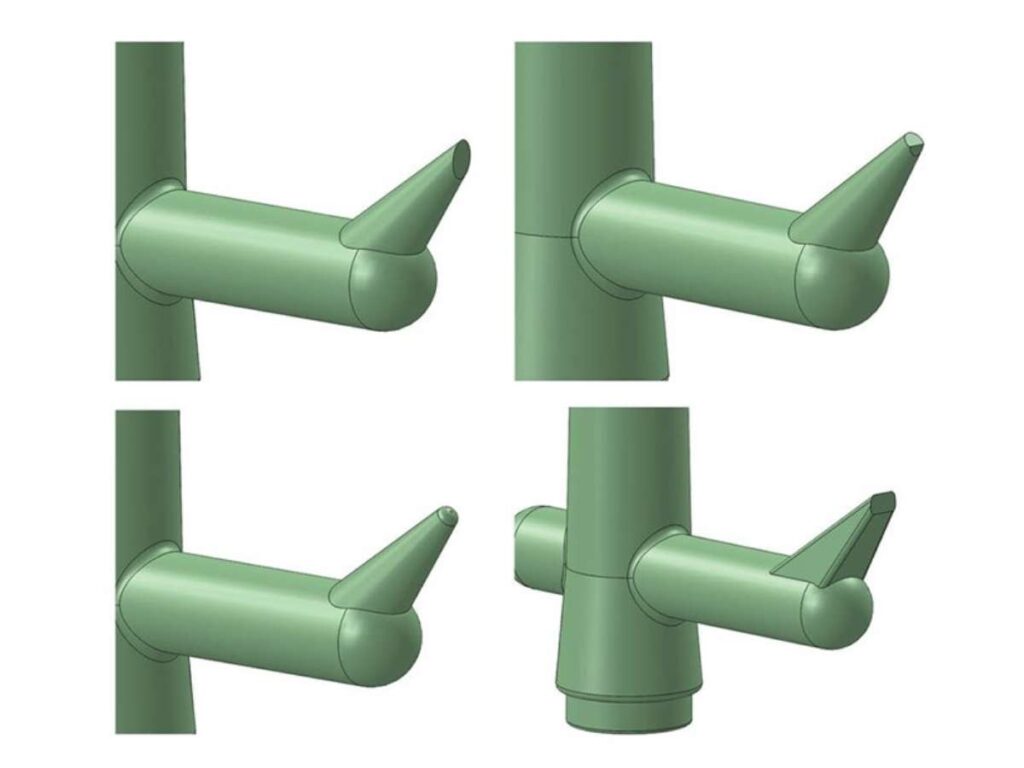
A submarine gate, also called a tunnel gate, enters the part from underneath or at an angle. It’s hidden below the parting line, which means the gate vestige (or leftover mark) is out of sight.
This gate is great for automatic systems where you want the parts to drop clean with no manual trimming. If you’re producing high volumes and want a cleaner look, this gate might be the right fit.
But how does it really work behind the scenes?
How It Works
The gate travels at an angle under the part and breaks off as the mold opens. That makes trimming automatic. It’s shaped like a small tunnel narrow, angled, and tucked below the part.
You won’t need to trim it by hand, and the part can be ejected smoothly.
Pros & Cons
Pros
- Leaves little to no visible mark
- Trims automatically during ejection
- Speeds up cycle time in high-volume jobs
Cons
- Not ideal for thick parts
- Harder to machine into the mold
- Can clog with some materials
Compatible Materials
Best for
- ABS
- Polypropylene
- Most flexible thermoplastics
Can cause issues with:
- Glass-filled materials
- Stiff or brittle plastics
Things to Watch Out For
Here’s what I’ve learned the hard way:
- Don’t use this gate if your part is too thick
- Clogs happen fast if your material burns easily
- If your ejector system isn’t aligned right, parts may stick
Is the part cosmetic?
Do you need it to drop without touch?
If yes, the submarine gate could save you hours of trimming time.
3. Direct/Sprue Gate
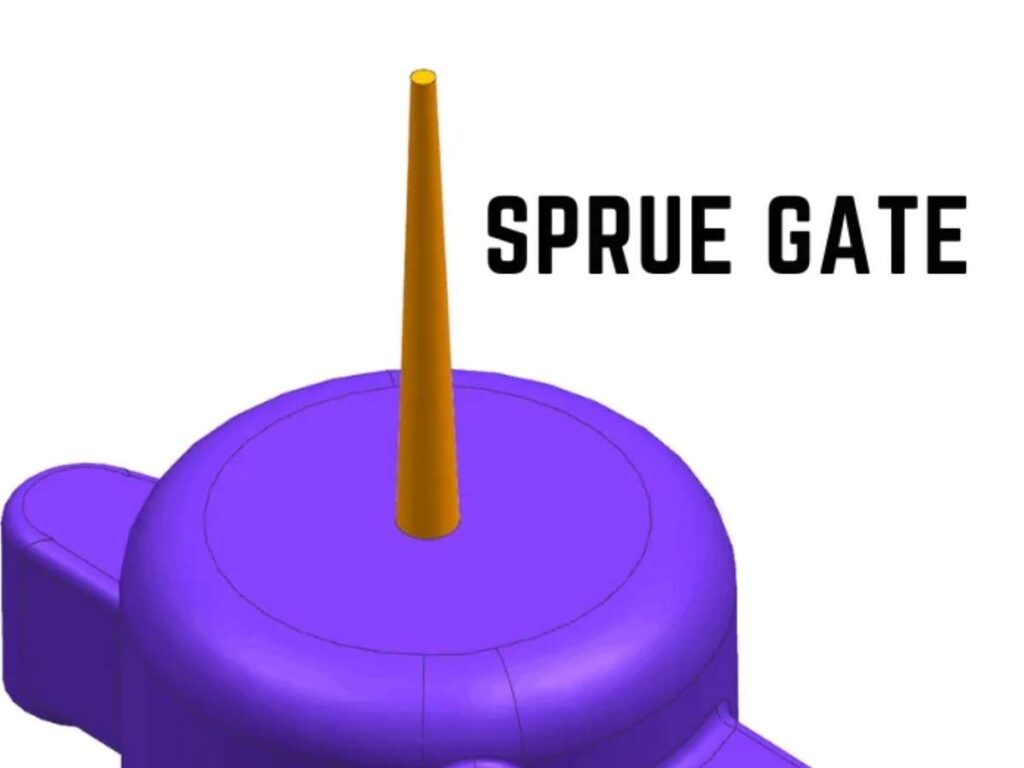
The direct gate connects straight from the sprue to the part. No runners. No turns. Just direct flow. It’s often used in single-cavity molds or parts with thick walls.
It gives you a strong flow of material, perfect for big parts or large-volume shots.
Let’s look at how it functions inside the mold.
How It Works
The molten plastic travels through the sprue and enters the part without any runner system in between. This setup reduces resistance and allows for a high-pressure fill.
But once cooled, the gate can leave a noticeable mark. Trimming is often manual and needs care to avoid damaging the part.
Pros & Cons
Pros
- Great for large parts
- High-pressure fill with fewer flow issues
- Simple mold design
Cons
- Leaves a noticeable gate mark
- Slower cycle times due to larger mass
- Manual trimming required
Compatible Materials
Best for:
- Polycarbonate
- Nylon
- Materials that benefit from high-pressure fill
Use caution with:
- Brittle plastics
- Parts where cosmetics matter
Things to Watch Out For
I’ve used this gate on thick industrial parts, it worked well, but trimming always took time.
Watch for:
- Sink marks near the gate
- Uneven cooling
- Long cycle times
Is your part thick or built for strength? If so, the direct gate could give you better fill control.
4. Pin Gate (for Hot Runner Systems)
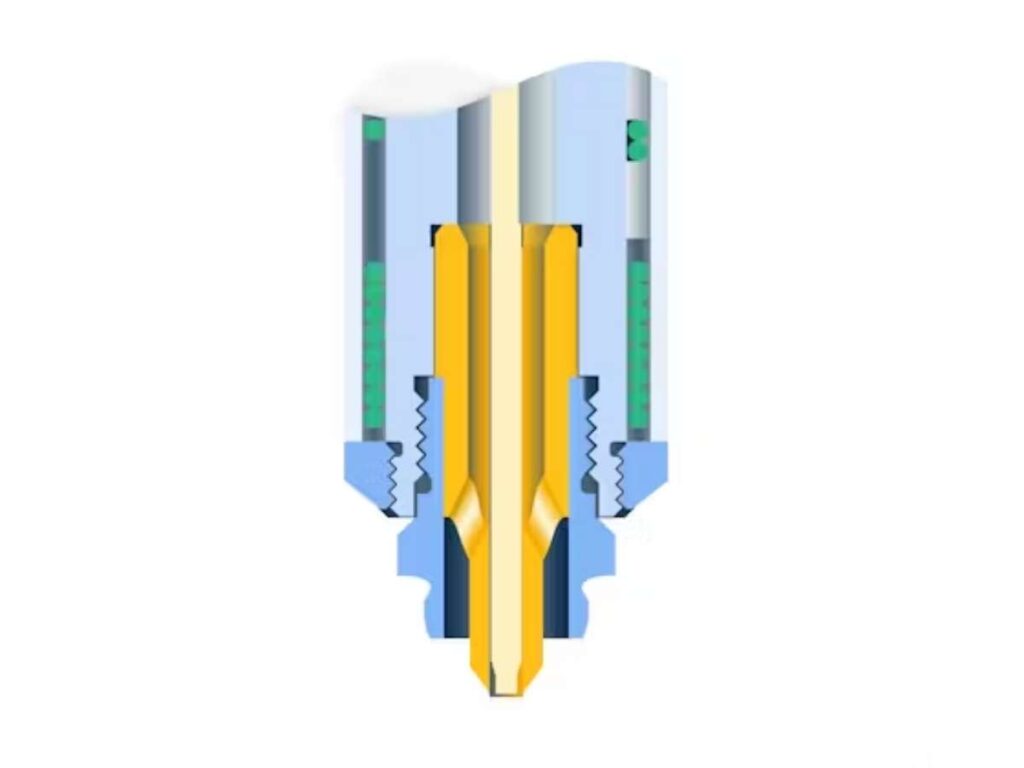
A pin gate is used in hot runner molds. It’s small, round, and placed directly on the part. This gate type allows for automatic, clean trimming and is usually invisible on finished parts.
If you’re building a hot runner system, this is one of the most common gates you’ll come across.
But what makes it work so cleanly?
How It Works
The molten plastic is kept hot all the way to the gate. A pin retracts just before injection, then pops back to seal the gate as the mold opens. No cold runners. No trimming.
The result: smooth parts with little waste.
Pros & Cons
Pros
- No visible gate vestige
- No runners to recycle
- Clean and consistent part finish
Cons
- Requires hot runner tooling
- Higher mold cost
- More setup and maintenance
Compatible Materials
Works well with:
- ABS
- Polyethylene
- Materials that run clean at high temps
Trouble with:
- Materials prone to stringing or burning
- Resins with narrow processing windows
Things to Watch Out For
One time, we ran this gate with the wrong temperature settings. The result? Stringing, flash, and stuck parts.
Check:
- Valve timing
- Temperature zones
- Parting line sealing
If you’re working with hot runner systems or need high-precision tooling for a project like this, you need a partner who’s done it before. MachMaster specializes in tight-tolerance injection molding, delivering precision parts with ±0.01mm accuracy for global industries.
5. Fan Gate
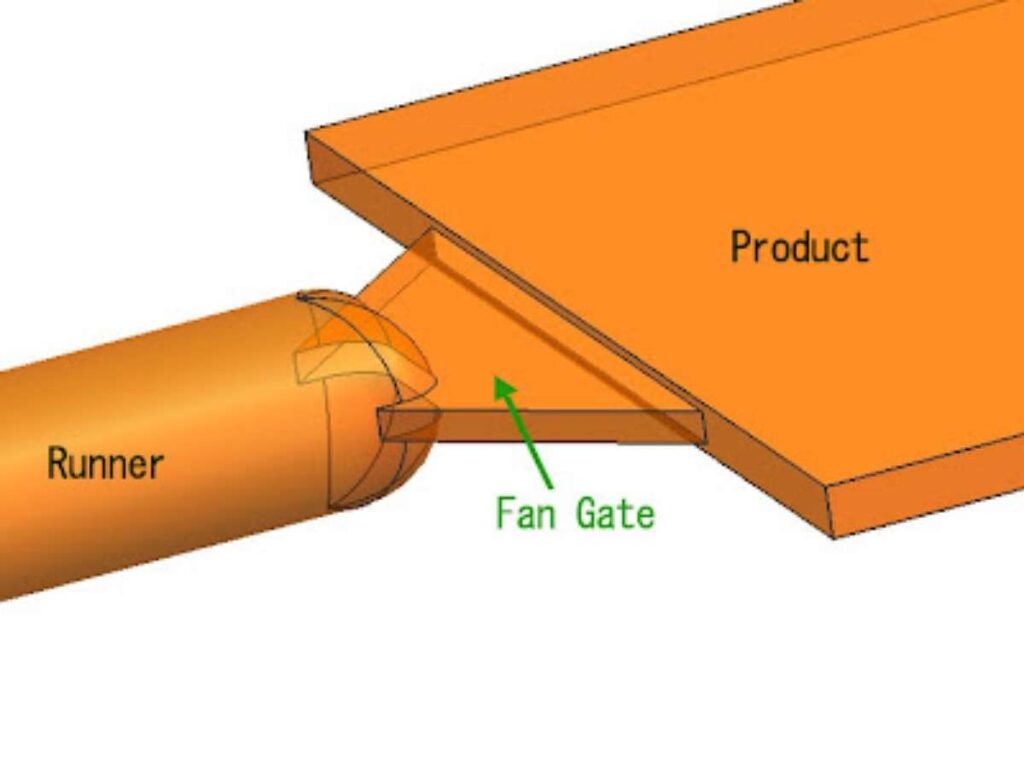
A fan gate spreads the molten plastic over a wide area. Instead of a single point, it creates a “fan-like” flow into the part. This helps reduce shear stress and gives better fill in large or flat parts.
If you’re molding something long and thin, like a panel or cover, this gate gives more control.
Let’s walk through how it actually spreads the flow.
How It Works
The gate gradually widens from the runner into the part. As plastic enters, it spreads evenly like a curtain. This reduces pressure spikes and avoids jetting or sudden flow bursts.
After molding, trimming is usually done by hand.
Pros & Cons
Pros
- Good for large, flat parts
- Reduces internal stress
- Helps prevent warping
Cons
- Visible gate vestige
- Slower fill in small parts
- Needs space on the part edge
Compatible Materials
Ideal for:
- Polypropylene
- HDPE
- Flexible materials
More difficult with:
- High-viscosity plastics
- Materials that cool too fast
Things to Watch Out For
I once used a fan gate on a small cap. Big mistake. The wide flow area made the part overflow and warp.
Avoid:
- Using this on tiny or thick parts
- Ignoring cooling times
- Placing it on parts that need a clean finish
Is your part wide and shallow?
Then this gate might give you the smoothest results.
6. Tab Gate
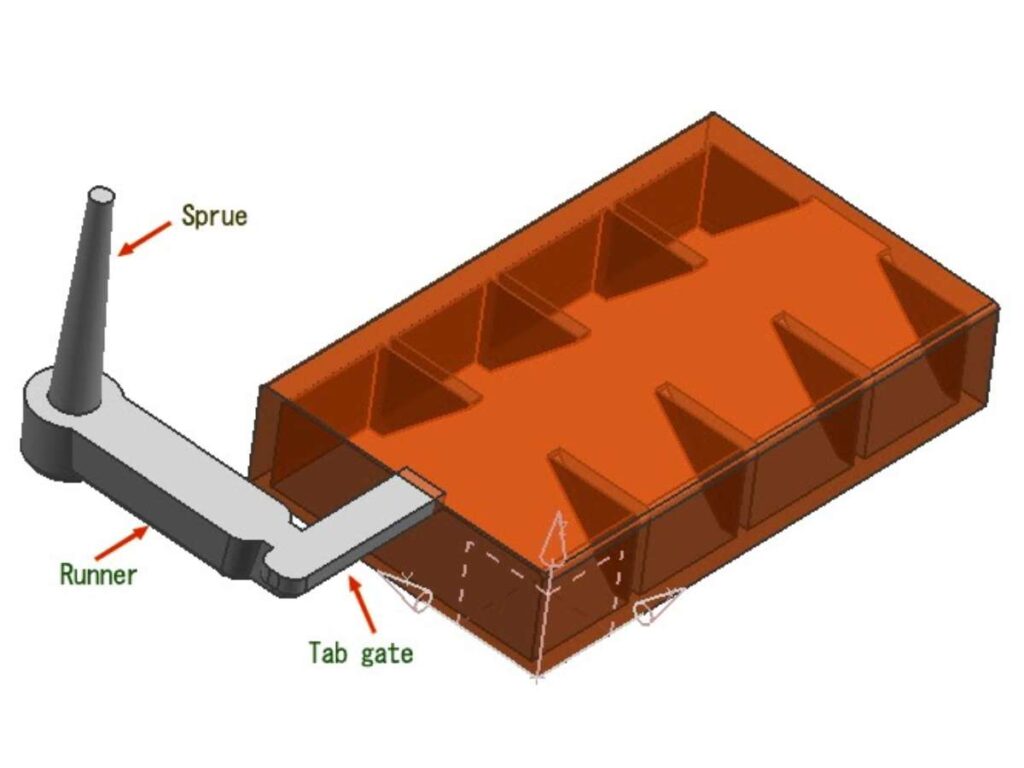
A tab gate is like an edge gate, but with a twist. It has a wider connection between the runner and the part. This “tab” helps absorb stress and control how the molten plastic flows in.
If your part has tricky weld lines or is prone to stress marks, this gate helps spread the flow better.
Next, let’s look at how that wider flow path works.
How It Works
The tab is a rectangular extension between the runner and the part. As the plastic enters, the gate slows down the flow just enough to reduce shear stress. That’s the force that builds up when plastic moves too fast and hits a wall or corner.
After molding, the gate is trimmed usually by hand.
Pros & Cons
Pros
- Helps reduce stress marks
- Better weld line strength
- Simple to add to an edge gate design
Cons
- Leaves a bigger mark than standard gates
- May require more space on the part edge
- Not suited for cosmetic surfaces
Compatible Materials
Works well with:
- ABS
- Polycarbonate
- High-impact resins
Not ideal for:
- Very soft or flexible materials
Things to Watch Out For
One time, I used a tab gate on a small part. It worked, but the tab left a visible chunk on the edge.
Think about:
- Will the gate mark bother your end-user?
- Can you trim the tab without cracking the part?
If your part needs strong weld lines and can hide the gate, the tab gate could be a smart pick.
7. Diaphragm Gate
The diaphragm gate is used when you need even, centered flow. It’s a circular gate that surrounds a core, often found in cup- or tube-shaped parts. The plastic enters all around at once.
If you need balanced filling without weld lines, this might be your answer.
Now let’s break down how it achieves that even flow.
How It Works
This gate surrounds the center of a part like a ring. During injection, the melt flows evenly from all directions toward the middle. That reduces internal stress and avoids weld lines that could weaken the part.
Trimming usually needs a blade or special tool.
Pros & Cons
Pros
- Great for symmetrical, hollow parts
- Excellent weld line control
- Balanced fill from all sides
Cons
- Leaves a gate mark on the entire inner surface
- Not for small or cosmetic parts
- Harder to trim
Compatible Materials
Best with:
- Polypropylene
- Nylon
- Glass-filled plastics
Can be tricky with:
- Brittle materials that crack easily during trimming
Things to Watch Out For
I once ran this gate on a short-run project. The balance was great, but trimming took way more time than I expected.
Ask yourself:
- Is even flow more important than fast trimming?
- Will the gate mark affect your part’s function?
If flow control matters more than finish, the diaphragm gate delivers.

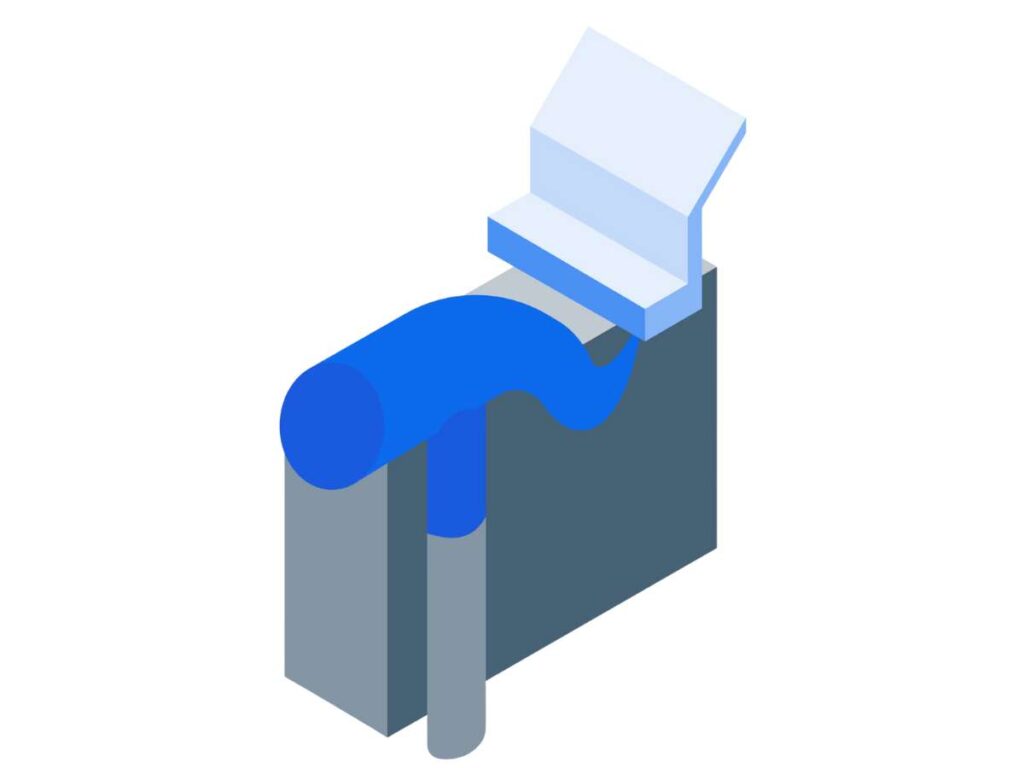
8. Cashew Gate
The cashew gate has a curved path like the shape of a cashew nut. It connects below the parting line and curves up into the part.
This gate is useful when you need the gate to be hidden, but the layout doesn’t allow a straight tunnel like the submarine gate.
Let’s look at how this curve changes the way it flows.
How It Works
The plastic travels in a curved path under the part and pops up into it. This keeps the gate out of sight. It’s often used when there’s limited space for a gate on the part face.
Trimming is automatic during ejection, but mold machining is more complex.
Pros & Cons
Pros
- Hidden gate mark
- Automatic trimming
- Ideal for complex or angled parts
Cons
- Difficult to machine into the mold
- Harder to clean and maintain
- May limit material flow
Compatible Materials
Works with:
- ABS
- HIPS (High-Impact Polystyrene)
- Other mid-viscosity thermoplastics
Can struggle with:
- Glass-filled or stiff materials
Things to Watch Out For: One mold I used had cashew gates. The parts looked great—but cleaning those curved channels between runs was a pain.
Consider:
- Will the flow path support your material choice?
- Are you okay with a more expensive mold build?
For parts that need clean looks and tight space, the cashew gate works—if you’re ready for the extra tooling cost.
9. Ring Gate
The ring gate is exactly what it sounds like: a ring-shaped gate that surrounds a core pin or circular feature. It’s designed for parts like cylinders or gears where you need even flow from all sides.
It creates a uniform fill, especially in symmetrical, round parts.
Let’s look at how this ring helps balance flow.
How It Works
Plastic flows evenly through the ring and into the part. This helps avoid weld lines and stress that can form when flow comes from a single direction. It’s great for structural parts that need even strength.
The gate is trimmed later, often requiring special tools.
Pros & Cons
Pros
- Uniform flow
- No weld lines
- Strong center part fill
Cons
- Leaves a ring mark
- Requires trimming all around
- Needs careful mold setup
Compatible Materials
Best with:
- Nylon
- Acetal
- Structural plastics
Less effective with:
- Brittle resins
- Thin-wall parts
Things to Watch Out For
I used a ring gate on a gear mold once. The strength was solid but the trimming took two steps, and alignment had to be perfect.
Ask yourself:
- Does your part need even strength from all sides?
- Can you trim the gate cleanly?
If so, the ring gate gives you balanced performance just be ready for a bit more cleanup.
Conclusion
Gate selection used to confuse me.
Now, it’s one of the first things I look at because it affects everything: flow, cooling, part quality, and even your timeline.
In this guide, you’ve seen what each injection molding gate type does, where it fits best, and what can go wrong.
So what’s next?
Use this knowledge, build smarter, and ask better questions.
Contact us today! We’ll help you make the right choice from the start.
Dive Deeper Into Our Resources
If you’re looking for more insights, we’ve put together a list of helpful articles that you might enjoy:
Still haven’t found what you’re looking for? Don’t hesitate to contact us. We’re available around the clock to assist you.