
Are you trying to choose the right material, design, and supplier for a CNC machined metal enclosure? The right early decisions can save time, reduce cost, and prevent production issues.
In simple terms, choose a suitable material, keep the design easy to machine, and use tight tolerances only where they are needed. Your production volume should also guide the manufacturing approach.
As the Founder and Chief Designer of MachMaster, I have worked with custom parts across electronics and industrial applications. That hands-on experience has shown me which design choices tend to work well and which ones often create extra cost or delays.
This guide will help you compare materials, improve enclosure design, understand costs, choose finishes, and evaluate suppliers. Use it as a practical reference before you move into prototyping or production.
1. Best Materials for CNC Machined Metal Enclosures
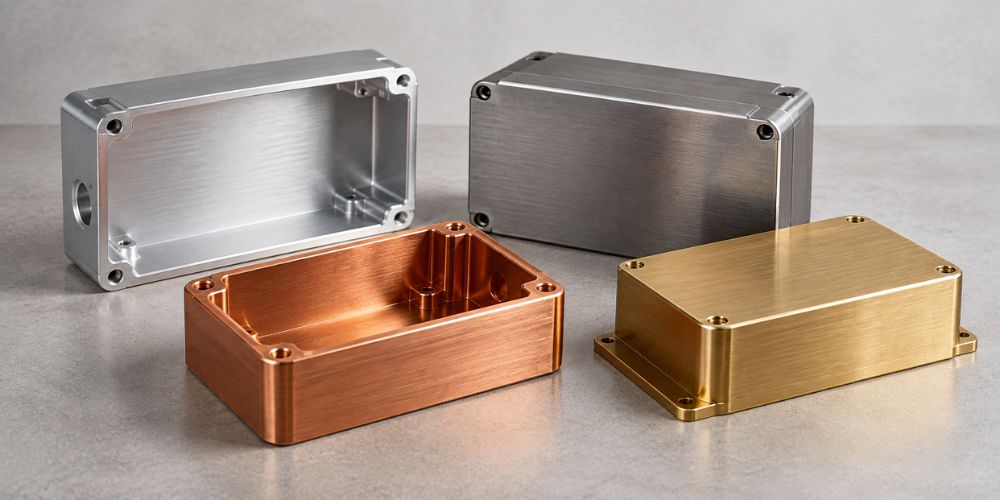
Material choice affects weight, strength, corrosion resistance, machining time, finish options, and total cost. Start with the conditions your enclosure will face, then compare the properties that matter to the product.
| Material | Main Benefits | Common Uses | Cost Level |
| Aluminum 6061 | Lightweight, machinable, corrosion resistant | Electronics, instruments, housings | Low to Medium |
| Aluminum 7075 | Higher strength than 6061 | Industrial and mechanical products | Medium to High |
| Stainless Steel | Strong, corrosion resistant | Medical, outdoor, food equipment | High |
| Carbon Steel | Strong and economical | Machinery, industrial controls | Low to Medium |
| Brass | Good conductivity and appearance | Electrical and specialty products | High |
| Copper | Excellent thermal and electrical conductivity | Heat management, electronics | High |
For many enclosure projects, 6061 aluminum is a sensible starting point. Hydro describes 6061 as a heat-treatable magnesium-silicon alloy that is commonly used where machining is required.
It also keeps enclosure weight down and works with finishes such as anodizing and powder coating.
Need more corrosion resistance? Stainless steel may make more sense, particularly where the enclosure faces moisture, cleaning chemicals, or outdoor exposure.
For reference, Outokumpu lists Type 304 stainless steel as roughly 18% chromium and 8% nickel and notes its good corrosion resistance across a wide range of applications. Copper and brass, on the other hand, are usually selected when electrical, thermal, or appearance requirements justify the higher material cost.
2. How to Design a CNC Machined Metal Enclosure
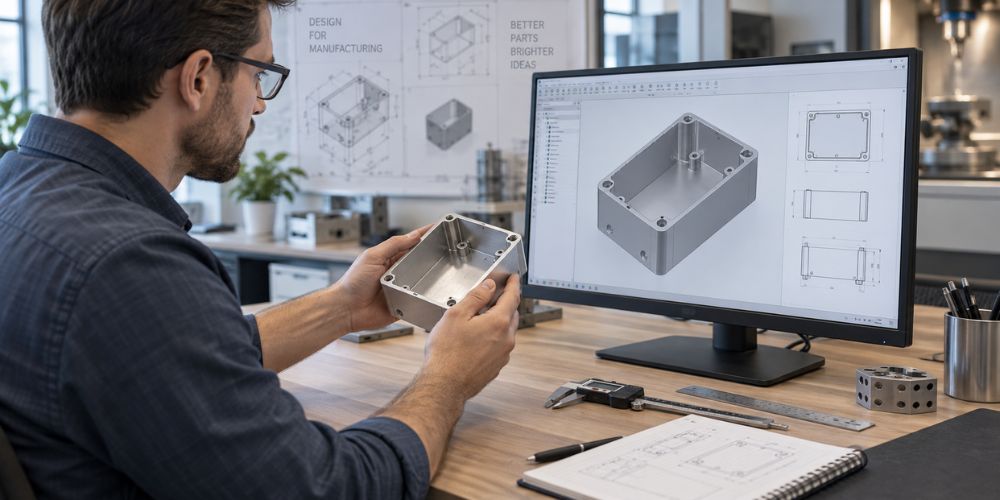
A good enclosure protects the components inside without making machining harder than it needs to be. Small CAD decisions can change tool access, machining time, part stability, and your final quotation.
Here is why this matters: a feature that looks simple on screen may need a smaller cutter, longer tool, slower feed rate, or another machine setup. Those extra steps add up.
Choose Practical Wall Thickness
Very thin walls can move or vibrate while material is being removed. Very thick walls add weight, raw material, and cutting time.
Your ideal wall thickness depends on enclosure size, metal type, loading, and internal structure. For aluminum enclosures, start with a practical wall section and make areas thinner only where space or weight calls for it.
I often see designers thin every wall to save a few grams. In practice, keeping more material in selected areas can make machining more stable and simplify mounting features.
Plan Internal Cavities and Corner Radii
Can a CNC mill make a perfectly sharp internal corner? Normally, no. The cutter is round, so your inside geometry needs to account for the tool radius.
Autodesk explains that cutter engagement increases as a milling tool enters an internal corner, which raises cutting forces and can contribute to tool deflection, poor surface finish, or tool damage. Its internal corner machining guide even gives a practical rule of thumb: use a tool radius around 80% of the minimum concave radius being machined.
Deep and narrow cavities create another issue. Sandvik Coromant notes that deep or extended features may require longer tool overhangs, which increases the need to manage cutting forces and vibration.
So if a deep pocket serves no real function, removing it may shorten machining time and simplify production.
Design Holes, Threads, and Mounting Features Carefully
Think about PCB mounting points, connectors, cable openings, switches, ventilation, screws, and assembly access before releasing the drawing. Standard drill sizes and common thread specifications are usually easier and less expensive to process.
Leave enough material around threaded holes and mounting bosses too. Features placed very close to a thin wall can create weak areas and make machining less stable.
A useful question is simple: Does every hole and pocket have a job? If the answer is no, consider removing it before you request production pricing.
Set Tolerances Based on Function
Tighter tolerances require more machine control, inspection, and production time. Apply close tolerances to dimensions that affect fit, sealing, alignment, or assembly, rather than placing them across the entire drawing.
This is backed by Autodesk’s tolerance analysis guidance, which notes that tolerance analysis before production can save cost and time by avoiding excessive machining operations for unnecessarily tight limits.
At MachMaster, we review dimensions, tolerances, material choices, tool access, and machining features through DFM support before production. Our CNC capabilities include 3-axis, 4-axis, and 5-axis milling, which gives us more options when an enclosure has features on several faces.
Planning a custom enclosure? Send your CAD requirements for a manufacturing review before locking the design so you can compare material, tolerance, and machining options early.
3. Surface Finishing Options
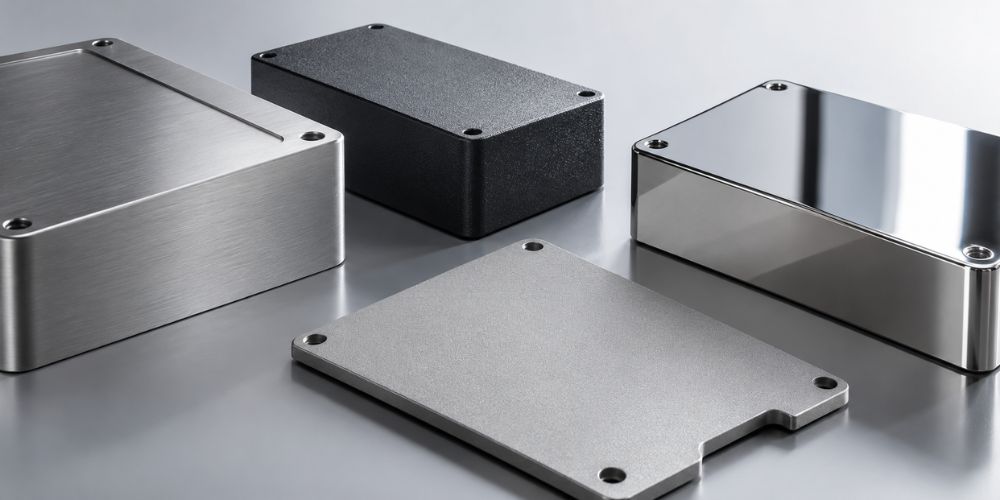
Surface finishing does more than change how an enclosure looks. It can also affect corrosion protection, wear, electrical behavior, texture, and branding.
Think about where the enclosure will be used before choosing the finish. A decorative indoor electronics housing and an outdoor machine enclosure may need very different surface treatments.
- Anodizing: Anodizing is widely used for aluminum enclosures because it forms an anodic coating on the aluminum surface and offers several appearance options. The U.S. Department of Defense’s active MIL-PRF-8625 specification covers six types and two classes of anodic coatings for aluminum and aluminum alloys in non-architectural applications.
- Powder Coating: Powder coating creates a thicker exterior coating and gives you many color choices. It is commonly considered for aluminum and steel enclosures where appearance and exterior protection both matter.
- Electroplating: Nickel, chrome, zinc, and other plating processes may be selected for corrosion protection, conductivity, appearance, or wear behavior. The right plating process depends on the base metal and the job the enclosure needs to perform.
- Bead Blasting And Polishing: Bead blasting gives the enclosure a clean matte texture and can make machining marks less noticeable. Polishing creates a smoother and more reflective surface where visual appearance carries more weight.
4. What Affects CNC Metal Enclosure Costs?
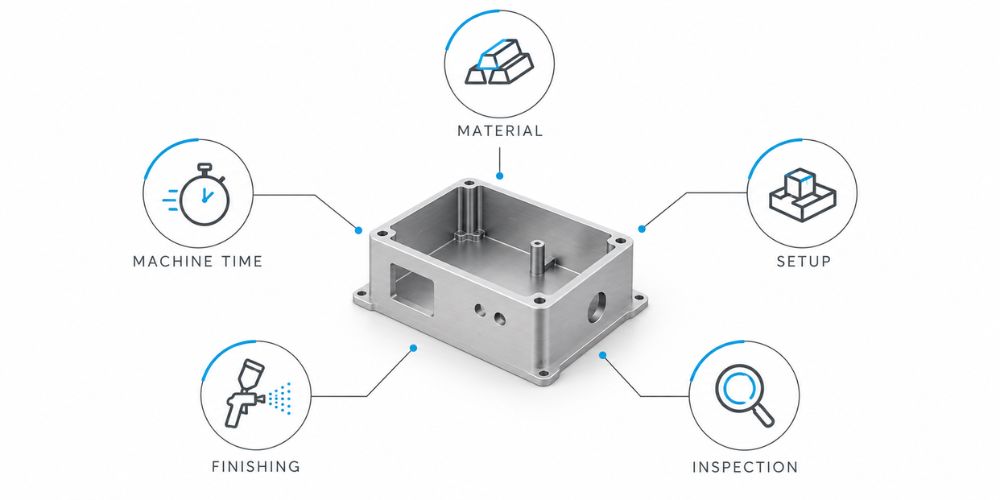
What are you really paying for? Mostly material, machine time, setups, finishing, inspection, and the difficulty of geometry.
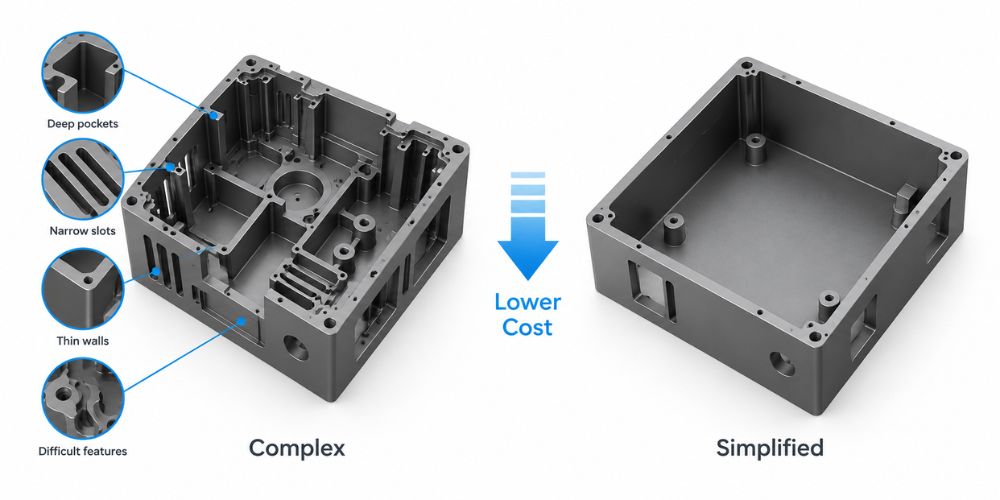
Deep cavities, thin walls, close tolerances, small internal radii, and features on several faces can extend machining time. Material matters too: aluminum is generally easier to machine than many stainless steels, while copper and specialty alloys can carry higher material or processing costs.
Order quantity also changes the picture. Setup and programming costs are spread across more parts as production volume increases.
At MachMaster, we review prototype and production projects with these cost drivers in mind, rather than looking at material price alone. If you want to compare processes before committing to volume, upload your enclosure design for a manufacturing assessment and review the available production routes.
5. Prototype vs Production CNC Enclosures
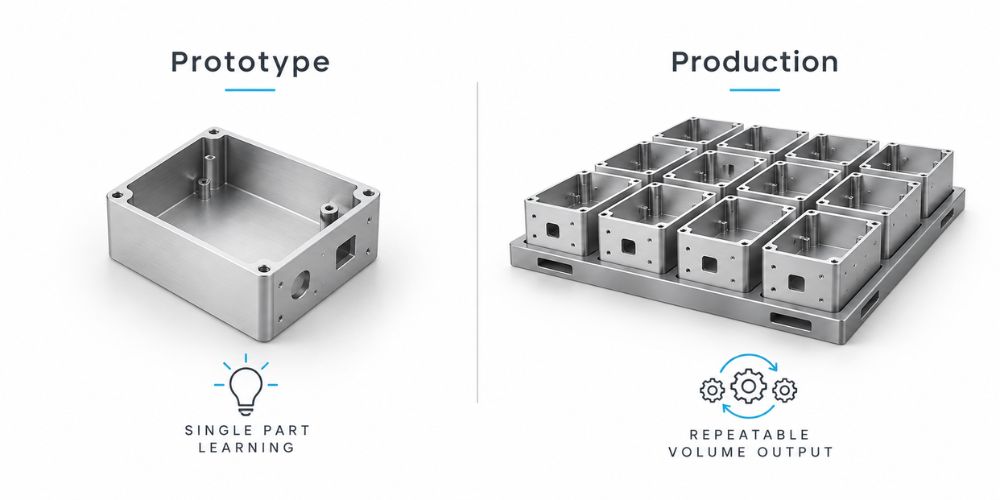
CNC machining can support both prototypes and low to medium production volumes. What changes is the priority: prototypes focus on learning quickly, while production focuses more heavily on repeatability and process efficiency.
Here is a simple comparison.
| Factor | Prototype CNC Enclosures | Production CNC Enclosures |
| Quantity | Usually 1 to 20 pieces | Tens to hundreds or more |
| Main Goal | Test fit and function | Repeatable production |
| Design Changes | Easy to revise | Design should be stable |
| Unit Cost | Higher | Can decrease with volume |
| Lead Time Focus | Speed | Process efficiency |
| Inspection | Key dimensions | Defined QC plan |
| Best Use | Testing and validation | Commercial production |
Prototyping gives you a chance to check connector positions, assembly clearance, wall strength, appearance, and component fit. Finding a misplaced connector opening in five parts is much easier to deal with than finding it after a larger production run.
But should you keep CNC machining forever? Maybe, maybe not.
For higher volumes, compare CNC machining with sheet metal fabrication, die casting, or other processes. The best choice depends on enclosure geometry, tolerance requirements, annual quantity, tooling budget, and product life cycle.
6. How to Reduce CNC Enclosure Costs
Lower cost does not always require a full redesign. A few practical changes can reduce tool paths, machining time, setups, material use, and special tooling.
Ask one question as you review the model: What can I simplify without changing how the enclosure works?
- Simplify Internal Geometry: Avoid unnecessary deep pockets, very narrow slots, and hard-to-reach internal details. Better tool access can allow shorter tools and fewer machining operations.
- Use Functional Tolerances: Do not apply the same tight tolerance to every dimension. Reserve close limits for mating surfaces, bearing positions, component locations, sealing areas, and other features that directly affect function.
- Use Standard Features: Standard threads, hole sizes, corner radii, and available material thicknesses are generally easier to process. They can also reduce the need for special cutters and extra machining steps.
I have seen designs become much easier to produce after only a few small changes to radii and tolerance callouts. You do not always need to redesign the enclosure; sometimes you just need to stop asking the machine to do work the product does not need.
7. How to Choose a CNC Metal Enclosure Supplier
The lowest quotation is easy to compare, but it does not tell you the full story. Machining capability, inspection, engineering feedback, communication, capacity, and secondary processes can affect the total project result.
A good supplier should be able to explain how your enclosure will be made, not simply give you a price.
Check Machining and Material Capabilities
Your supplier should have equipment that matches the size and geometry of your enclosure. Ask whether 3-axis, 4-axis, or 5-axis machining is available if several faces or difficult angles need machining.
Also ask about experience with your chosen metal. Regular experience with aluminum, stainless steel, copper, brass, and engineering plastics gives the supplier more room to suggest practical alternatives if your design changes.
One useful test: send a real drawing and see what questions come back. A technical supplier should notice difficult pockets, close tolerances, unusual threads, and features that may require another setup.
Review Quality Control and Production Capacity
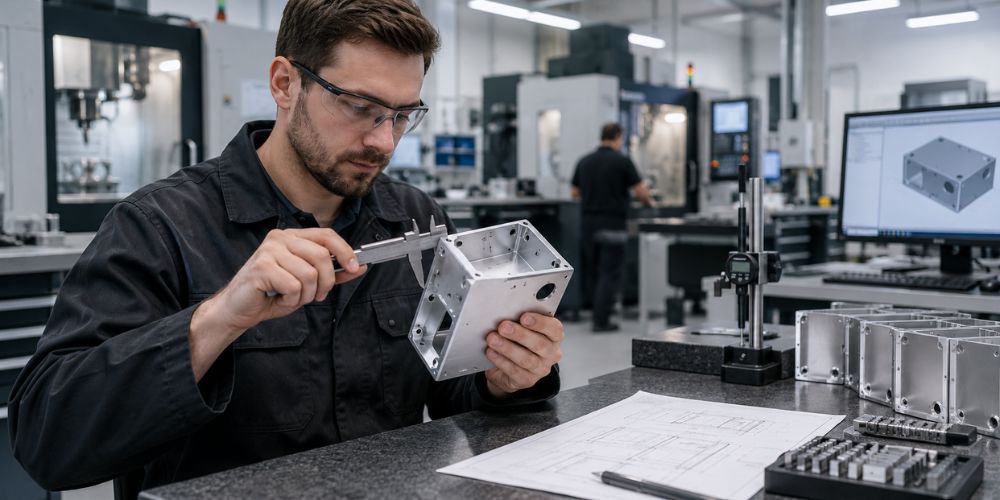
Ask how dimensions are inspected, which measuring tools are available, and whether inspection reports can be supplied. For close-tolerance interfaces, define the inspection requirements before placing a larger order.
ISO 9001:2015 sets requirements for establishing, maintaining, and continually improving a quality management system, including areas such as operational control, performance evaluation, documented information, and improvement.
At MachMaster, we follow an ISO 9001:2015 quality system and use inspection methods including VMM optical measurement, pin and plug gauges, and hardness testing. Our published inspection ranges include calipers up to 1000 mm and pin and plug gauges covering 0.5 to 100 mm, depending on gauge type.
We also support CNC machining, sheet metal fabrication, DFM review, and quality inspection. That can make project coordination simpler when your product uses more than one manufacturing process.
Compare Communication, Lead Time, and Engineering Support
A capable supplier should be able to read your 3D files, 2D drawings, material specifications, finish requirements, and inspection notes without creating repeated delays. You should also receive clear feedback if a feature adds cost or creates manufacturing risk.
In my experience, the questions asked before quoting tell you a lot. Questions about tolerances, assembly, surface requirements, critical dimensions, and order quantity usually mean someone is actually reviewing how the part will be produced.
Before requesting a quote, prepare:
- 3D CAD file
- 2D technical drawing
- Material grade
- Order quantity
- Surface finish
- Tolerance requirements
- Thread specifications
- Inspection requirements
The better your information is at the quoting stage, the fewer assumptions the supplier has to make.
Share your enclosure files and production requirements if you want to compare machining options before moving forward.
Conclusion
A good CNC machined metal enclosure comes down to a few practical choices: the right material, machinable geometry, functional tolerances, and a suitable finish. Get these basics right, and you can avoid many common cost and production problems.
Your supplier matters just as much as your design. Look for clear engineering feedback, reliable inspection, and enough production capability to support both prototypes and larger orders.
If you already have a CAD file or drawing, MachMaster can review your project and help you compare CNC machining options. Share your requirements and take the next step toward a production-ready enclosure.