
When you order custom CNC machined parts, production involves more than loading a material block into a machine and cutting it to shape. The manufacturer needs to review your drawings, select the right machining method, prepare tools and fixtures, run the machining program, and inspect the finished parts.
Understanding this process helps engineers prepare better designs and gives purchasing teams a clearer idea of what happens after they submit an RFQ.
Here is how a typical CNC machining order moves from design to finished parts.
1. CAD Drawings and 3D Models: Defining the Part
Every CNC machining project starts with a part design. Engineers usually provide a 3D CAD model, a 2D engineering drawing, or both.
A 3D model defines the geometry of a part, including surfaces, holes, recesses, slots, and other features. 2D drawings convey manufacturing requirements that the model may not fully define, such as tolerances, surface roughness, thread specifications, and other information.
Before sending files to a manufacturer, check that they include:
- Overall dimensions and critical feature dimensions
- Dimensional and geometric tolerances
- Material grade and specification
- Thread sizes and hole requirements
- Surface finish and treatment requirements
- Important notes about fit, function, or assembly
For manufacturer’s , complete drawings make it easier to receive accurate quotations and avoid repeated clarification during production.
2. DFM Review: Checking Whether the Part Can Be Machined Efficiently
After receiving the design files, the manufacturer’s engineering team reviews the part before production.
This is commonly called a Design for Manufacturability (DFM) review. The purpose is to identify design features that may affect machining difficulty, cost, quality, or production time.
Typical review points include:
- Wall thickness: Thin walls may deform under cutting forces, especially when machining certain metals and plastics.
- Deep pockets: Deep cavities may require longer tools, additional setups, or special machining strategies.
- Internal corners: The cutting tool has a radius, so perfectly sharp internal corners may not be achievable through conventional milling.
- Holes and threads: Hole depth, diameter, thread size, and access for cutting tools all affect the process.
- Tolerances: Tight tolerances may require additional machining operations and inspection.
- Surface finish: Functional or cosmetic requirements may call for additional finishing work.
If a design creates manufacturing challenges, the engineering team can discuss possible adjustments before production starts.
The goal is not to change your design unnecessarily. It is to find a practical way to manufacture the part while maintaining its required function and specifications.
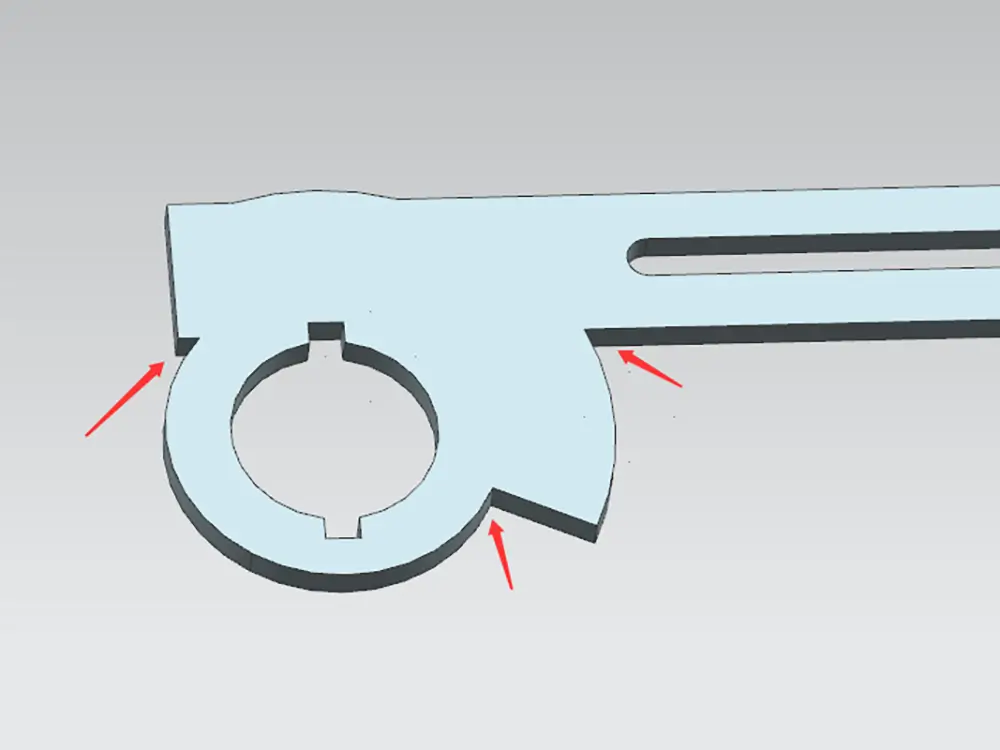
3. Process Planning: Selecting the Right CNC Machining Method
Once the design is reviewed, the manufacturer determines how to machine the part.
The choice depends on the part’s geometry, material, dimensions, tolerances, and production quantity.
CNC Milling
CNC milling uses rotating cutting tools to remove material from a workpiece. It is suitable for parts with flat surfaces, pockets, slots, holes, contours, and complex profiles.
You can consider rectangular parts to be suitable for CNC milling.
Common examples include mounting brackets, housings, fixtures, and equipment components.
CNC Turning
CNC turning rotates the workpiece while a cutting tool removes material. It is commonly used for cylindrical parts such as shafts, bushings, sleeves, spacers, and threaded components.
5-Axis CNC Machining
5-axis machining allows the cutting tool and workpiece to move across multiple axes, making it possible to machine complex surfaces and features from different angles.
It can reduce the number of setups required for certain parts and help maintain the relationship between features.
Not every part needs 5-axis machining. For simpler geometries, conventional milling or turning may be more economical.
Learn more about our CNC machining services, CNC milling, and CNC turning.
4. CAM Programming and Machine Setup
After process planning, the manufacturing team prepares the machining program.
CAM software converts the part geometry and machining strategy into tool paths. These paths are then translated into machine instructions, commonly using G-code.
The program defines important machining movements and parameters, such as:
- Tool paths and cutting directions
- Cutting depth and machining sequence
- Spindle speed and feed rate
- Tool changes
- Workpiece positioning and machine movements
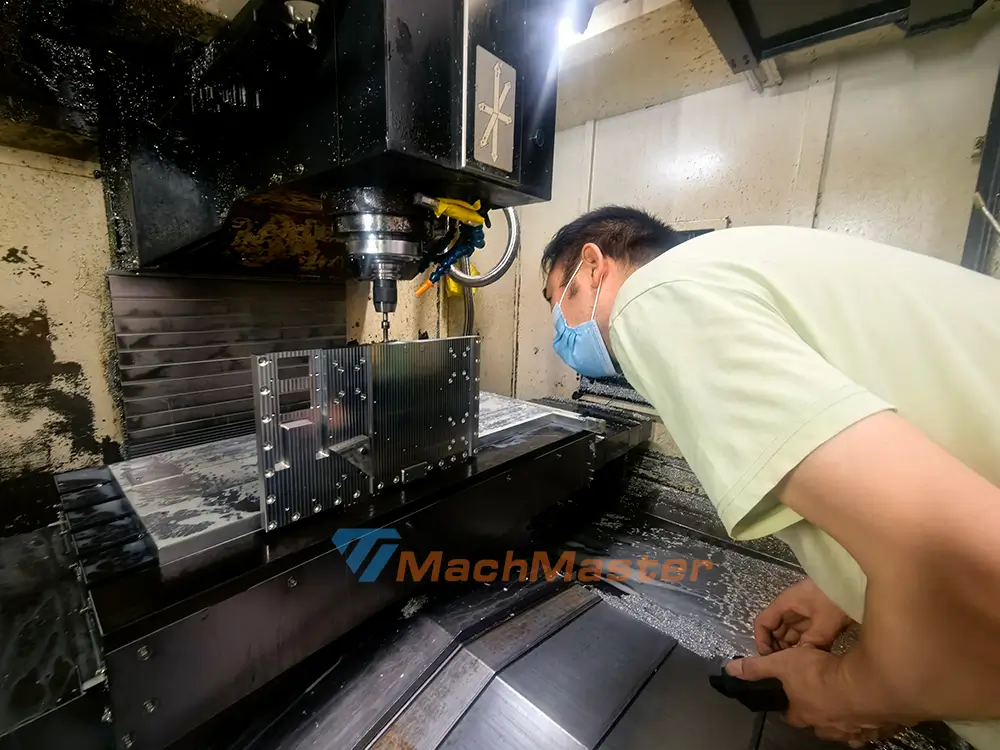
Before machining begins, the operator prepares the machine.
This setup may include installing cutting tools, securing the raw material, positioning fixtures, setting work coordinates, and checking the machining program.
Proper setup is important because the workpiece must remain stable throughout machining. Incorrect positioning or inadequate clamping can affect dimensions and part quality.
For complex parts or production orders, setup planning also helps determine whether multiple operations or machining stages are needed.
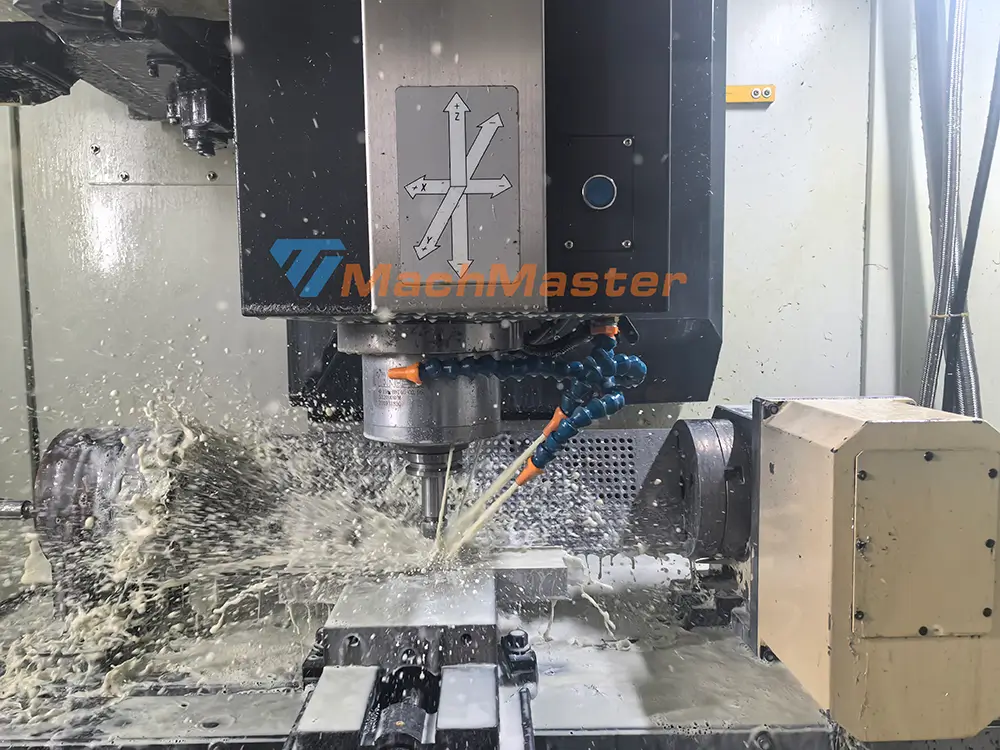
5. CNC Machining: Turning Raw Material into Parts
Once the machine is set up and the program is ready, machining can begin.
The cutting tool removes material from the workpiece according to the programmed tool paths. Depending on the design, the part may require several operations, such as milling, drilling, boring, tapping, or turning.
Some parts can be completed in one setup. Others need to be repositioned or transferred between machines to reach all required features.
The machining strategy depends on the material and part geometry.
For example:
- Aluminum is commonly selected for lightweight housings, brackets, and structural components.
- Stainless steel is used when strength and corrosion resistance are important.
- Brass and copper are suitable for certain fittings, connectors, and electrical components.
- Engineering plastics such as POM, ABS, and PEEK are used for components with specific weight, insulation, wear, or chemical-resistance requirements.
During production, operators monitor the machining process and check for issues such as tool wear, vibration, material movement, and dimensional variation.
For repeat orders, the manufacturer also needs to maintain consistent setup and process conditions.
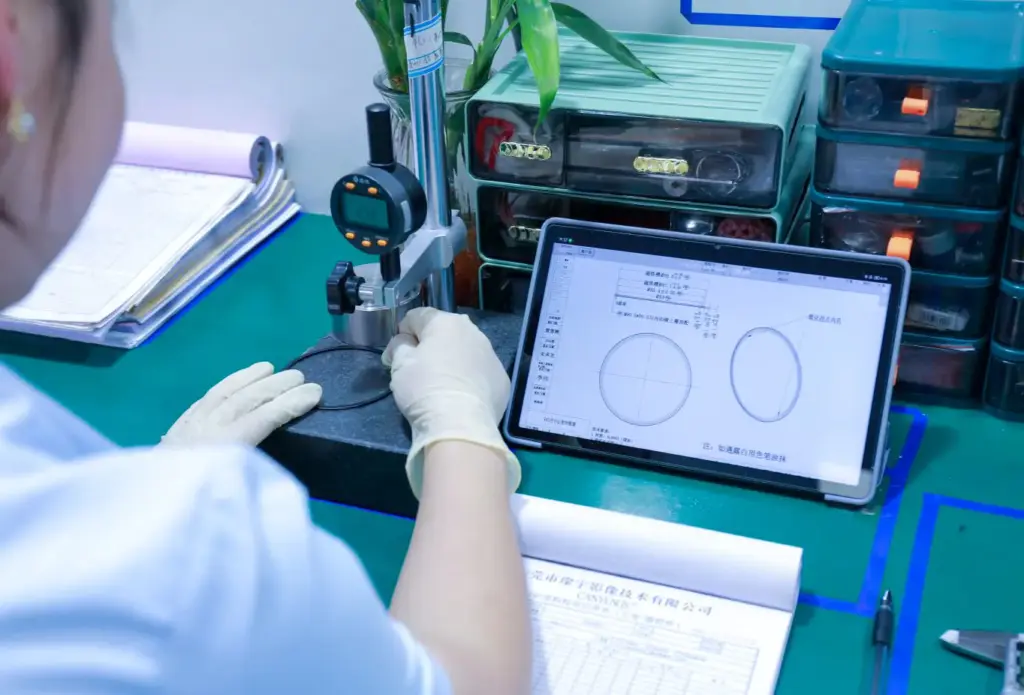
6. Inspection: Checking Parts Against the Drawing
Machining is not complete simply because the machine has finished cutting the part. The finished components must be checked against the engineering requirements.
Inspection may cover:
- Overall dimensions
- Hole diameters and positions
- Thread specifications
- Critical tolerances
- Flatness and other geometric requirements
- Surface condition and visible defects
The inspection method depends on the feature being measured and the tolerance specified on the drawing.
Common inspection equipment includes digital calipers, micrometers, height gauges, thread gauges, and optical measurement systems.
For engineers, it is important to identify critical dimensions clearly on the drawing. This helps the manufacturer understand which features need particular attention during production and inspection.
If a dimension is important for assembly or product performance, communicate its functional requirement instead of applying unnecessarily tight tolerances to every feature.
7. Surface Finishing and Secondary Operations
Some CNC machined parts are ready for use after machining and inspection. Others require additional processing to meet functional or appearance requirements.
Depending on the material and application, finishing options may include:
- Anodizing for aluminum parts
- Alodine or chemical conversion coating for aluminum
- Bead blasting
- Brushing
- Polishing
- Plating
- Powder coating
- Other specified surface treatments
Additional operations may also include deburring, cleaning, assembly, and packaging.
Surface treatment should be specified before production whenever possible. The selected finish can affect dimensions, appearance, corrosion resistance, electrical properties, and the final cost.
For example, if a machined aluminum part has tight mating dimensions, the manufacturer should consider the effect of anodizing when planning the machining allowance.

8. Final Quality Check, Packaging, and Delivery
After machining, inspection, and finishing are completed, the parts go through final checks before shipment.
The manufacturer confirms that the order meets the agreed requirements, including part quantity, specifications, surface condition, and packaging instructions.
Depending on the project, packaging may include individual protection, compartmentalized trays, labels, or bulk packaging.
If the parts are going directly to an assembly facility or another production location, packaging requirements should be discussed when requesting a quotation.
Clear packaging instructions help reduce handling issues and make receiving and assembly easier for your team.
What Should You Prepare Before Requesting CNC Machining?
Providing complete project information helps the manufacturer evaluate the design and prepare a more accurate quotation.
| Information | What to provide |
|---|---|
| 3D CAD file | STEP, STP, or another commonly supported CAD format |
| 2D drawing | PDF or engineering drawing with dimensions and tolerances |
| Material | Material name, grade, and any required specification |
| Quantity | Prototype quantity and expected production volume |
| Tolerances | General tolerances and clearly identified critical dimensions |
| Surface finish | Anodizing, polishing, blasting, plating, or other requirements |
| Application | How the part will be used and whether it needs to fit other components |
| Delivery requirements | Target delivery schedule and packaging instructions |
If you do not have every detail finalized, you can still send the available design files and explain which requirements are not yet confirmed. The engineering team can review the information and identify what needs clarification.
How to Choose a CNC Machining Manufacturer for Your Project
The manufacturing process may look similar from one supplier to another, but actual production capabilities can vary significantly.
Before placing an order, consider the following:
1. Equipment and process capability
Check whether the manufacturer has the machines and processes needed for your part geometry. A supplier with milling, turning, and multi-axis machining capabilities may be able to handle a wider range of components.
2. Material experience
Ask whether the manufacturer regularly machines your specified material. Different metals and plastics require different cutting tools, machining parameters, and handling methods.
3. Engineering support
A capable supplier should be able to review drawings, identify manufacturing concerns, and discuss practical solutions before production.
4. Quality control
Ask what inspection equipment and procedures are used to verify finished parts. Make sure the supplier understands your critical dimensions and quality requirements.
5. Production capacity
Consider whether the manufacturer can support both your initial order and potential repeat or larger-volume production. Capacity and process consistency matter when your project moves beyond prototyping.
6. Communication and order support
Clear communication is important when drawings, specifications, or delivery requirements need clarification. Choose a supplier that can respond to technical and purchasing questions throughout the project.
CNC Machining at Machmaster
Machmaster provides custom CNC machining and manufacturing support for customers developing prototypes, custom components, and production parts.
Based in Xiamen, China, we have 20 years of manufacturing experience and operate 40+ CNC machines, including equipment for milling, turning, and 5-axis machining.
Our capabilities include:
- CNC milling, turning, and 5-axis machining
- Machining of aluminum, stainless steel, brass, copper, titanium, and engineering plastics
- In-house anodizing and surface treatment
- ISO 9001 quality management
- In-house plastic injection molding
- Assembly and finished-goods packaging
Our manufacturing engineers review project requirements, while our sales team helps coordinate quotations and order communication. You can expect a professional sales response within 24 hours.
If you have a drawing or 3D model ready, send it to us for a manufacturing review and quotation.
Frequently Asked Questions
How long does the CNC machining process take?
The production time depends on part geometry, material availability, machining operations, quantity, finishing requirements, and inspection needs. A simple prototype and a complex production order can have very different schedules. Provide your drawings and quantity so the manufacturer can evaluate the project.
Does every CNC machined part need 5-axis machining?
No. Many parts can be produced efficiently with conventional CNC milling or turning. 5-axis machining is useful when a part has complex angles, multiple machining faces, or features that are difficult to reach with fewer axes. The appropriate process depends on the design.
What file formats should I send for a CNC machining quote?
A 3D CAD file, such as STEP or STP, is useful for evaluating part geometry. A 2D engineering drawing is also important when you need to specify dimensions, tolerances, threads, materials, and surface finishes.
Can CNC machining be used for both prototypes and production?
Yes. CNC machining is suitable for prototypes, low-volume orders, and larger production runs. The most appropriate manufacturing approach depends on part design, quantity, material, and cost requirements.
How can I reduce CNC machining costs?
Start by reviewing whether all specified tolerances and surface finishes are necessary for the part’s function. Avoid unnecessary design complexity, provide complete drawings, and discuss material and process options with the manufacturer. Ordering quantities together may also help reduce repeated setup costs. For more information, please refer to “Factors Affecting CNC Machining Costs.”
What happens if my part design is difficult to machine?
The manufacturer can review the design and identify features that may increase machining time or affect quality. Depending on the application, possible solutions include adjusting wall thickness, changing internal corner radii, improving tool access, or selecting a different machining strategy. Any design change should be agreed upon before production.