
Are you deciding between die casting and CNC machining for your telecom enclosure? The right choice can affect cost, quality, and production speed.
CNC machining is usually better for prototypes, lower volumes, and precision parts. Die casting is often more cost-effective for stable designs produced in larger quantities.
As the Founder and Chief Designer of MachMaster, I have more than 15 years of hands-on manufacturing experience. I have worked with projects from early prototypes to large production runs, so I understand where each process makes the most sense.
This guide compares both options by cost, volume, tolerances, design flexibility, EMI protection, and environmental performance. Use it to quickly decide which process fits your production needs.
1. What Are Die-Cast Telecom Enclosures?
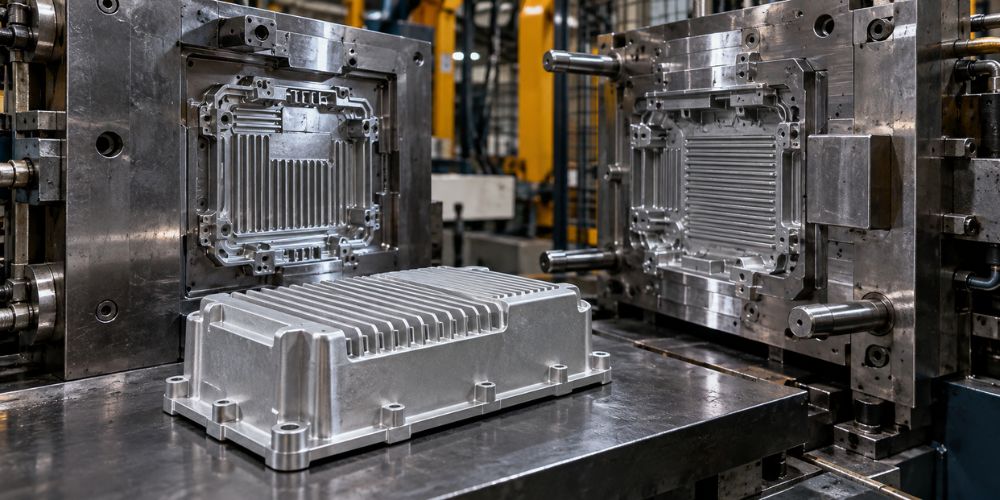
A die-cast telecom enclosure is produced by injecting liquid metal into a reusable steel die under pressure. Aluminum and zinc are two commonly used die-casting metals, and telecom is one of the industries listed by the North American Die Casting Association as a major user of die-cast parts.
The metal cools inside the die and takes the shape of the enclosure. After casting, manufacturers can add trimming, drilling, tapping, finishing, or CNC machining where tighter dimensional control is needed.
According to NADCA, conventional die casting uses high pressure to inject liquid metal into a reusable steel die. Modern high-pressure casting processes can operate at pressures above 4,500 psi, or about 31 MPa.
2. What Are CNC Machined Telecom Enclosures?
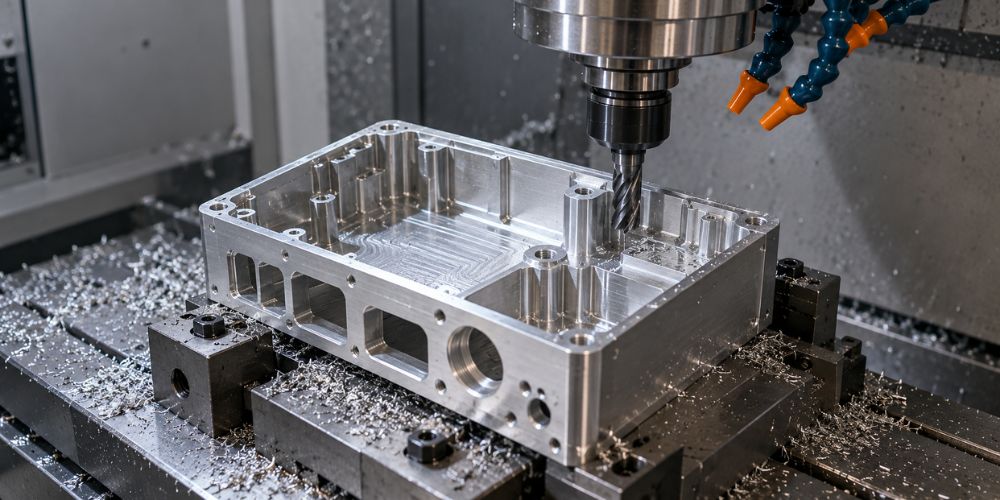
A CNC machined telecom enclosure usually starts from a solid metal block, plate, or billet. Computer-controlled cutting tools remove material to create the housing, internal pockets, mounting surfaces, ports, holes, and threads.
This approach works particularly well when your enclosure is still being developed. You can modify the CAD model, change the machining program, and manufacture another version without building a new casting die.
The important point is simple: the best process can change as your product matures. A housing that makes sense to CNC machine during development may later become a good die-casting candidate.
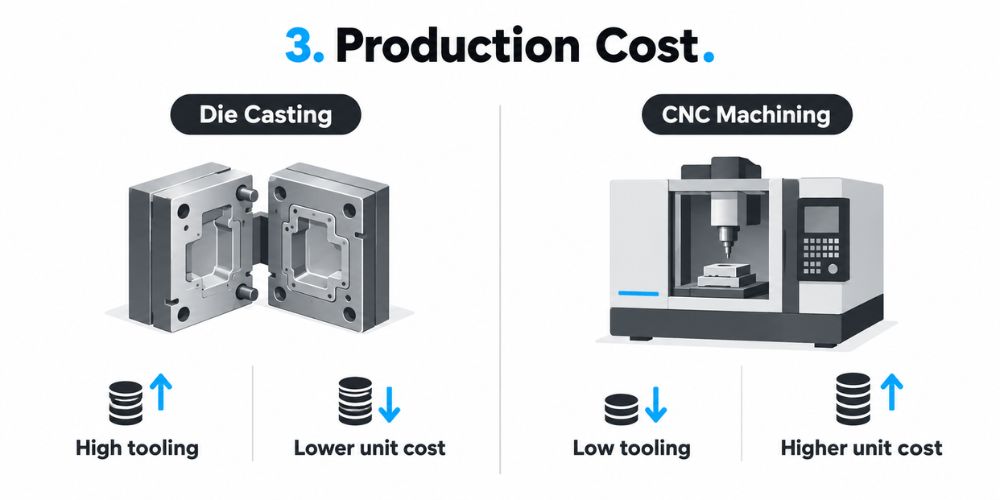
3. Production Cost
Cost is usually the first question procurement teams ask. But you need to separate upfront investment from cost per finished part or the comparison can be misleading.
Die-Cast
- Higher Tooling Investment: A dedicated metal die must be designed and manufactured before full production begins. That means mold engineering, machining, testing, and possible revisions become part of your initial project cost.
- Lower Cost Potential at Volume: After the tooling is built, the same die can repeatedly produce the enclosure geometry. NADCA notes that high-pressure die casting can produce hundreds of thousands of identical castings before additional tooling is required, although actual tool life depends on alloy, design, operating conditions, and die maintenance.
- Secondary Operations Still Matter: Casting the housing does not mean every feature comes out finished. Threads, connector openings, gasket faces, tight-tolerance holes, and surface treatments may still add cost.
Here is why this matters: a low casting price per piece can look attractive until tooling and post-machining are added.
At MachMaster, we look at the complete production route before recommending casting for a telecom housing. Our review can include the die-cast body, CNC post-machining, inspection, and finishing so you can compare the full cost instead of one process in isolation.
If your volume is already high enough to consider tooling, you can review our die casting capabilities alongside your current production quantity.
CNC Machined
- Lower Upfront Tooling Cost: CNC machining does not require a dedicated production die. You mainly need a manufacturable CAD model, suitable raw material, cutting tools, machine setup, and an inspection plan.
- Higher Cost Per Part at Scale: Every enclosure still requires machine time. Large internal cavities, deep pockets, thin walls, multiple setups, and significant material removal can push machining time higher.
- Lower Revision Risk During Development: If a connector location moves or an internal pocket changes, you can revise the design without replacing a casting die. That flexibility can save money when the product is still going through testing.
So which one is cheaper?
For 10 development housings, CNC machining may make much more sense. For a mature design ordered repeatedly in much larger quantities, die casting may spread the tooling expense across enough units to reduce long-term unit cost.
4. Production Volume
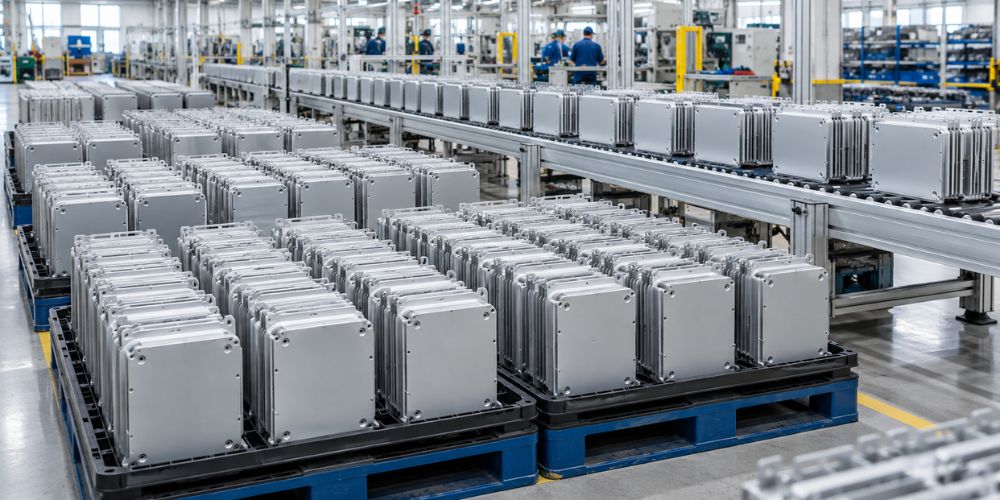
Production volume can quickly narrow the choice. CNC machining gives you flexibility at smaller quantities, while die casting becomes easier to justify as repeat demand rises.
Die-Cast
- Built for Repeat Production: Once the die is completed and the process is stable, the same geometry can be produced repeatedly. NADCA specifically describes high-speed production as one of the main advantages of high-pressure die casting.
- Tooling Cost Gets Spread Across More Parts: A $30,000 tool divided across 100 parts represents $300 of tooling per enclosure before production costs. The same hypothetical tool divided across 30,000 parts represents $1 per enclosure, which shows why projected lifetime quantity matters so much.
- Stable Designs Make More Sense: Major enclosure changes may affect the die itself. That is why locking connector locations, wall geometry, mounting features, and internal clearance before tooling is a sensible approach.
The $30,000 example above is simply arithmetic, not a standard mold price. Your actual tooling cost depends on enclosure size, cavity count, die steel, sliders, cores, expected tool life, and other manufacturing factors.
CNC Machined
- Strong for Prototypes: You can machine one enclosure or a small test batch without paying for a production mold. This works well for assembly tests, connector checks, thermal testing, and engineering validation.
- Practical for Low to Medium Volumes: CNC machining can support repeat production while letting you revise the enclosure between batches. This can be useful for specialized telecom products with relatively limited annual demand.
- Easy to Scale During Development: You might start with five prototypes, move to 50 validation units, and then order several hundred parts. You can delay the tooling decision until demand and product geometry become more predictable.
I often see teams discuss die casting while the product is still changing every few weeks. In that situation, machining the early batches can give your engineers room to catch problems before those problems become mold modifications.
5. Precision and Tolerances
Telecom housings can contain connector openings, PCB mounts, gasket grooves, threaded ports, mating faces, heat-transfer surfaces, and internal component locations. Some dimensions may need close control while the rest of the housing can use wider manufacturing tolerances.
Die-Cast
- Good Repeatability for General Geometry: Once the mold and process are stable, casting can repeatedly form the same housing shape. NADCA’s 2024 Product Specification Standards for Die Castings cover standard and precision tolerances, GD&T, alloy properties, tooling, and quality requirements.
- Precision Areas Can Be Machined After Casting: Connector interfaces, threaded holes, gasket surfaces, and locating features can be CNC machined after the body is cast. This lets you avoid machining the entire enclosure from solid stock.
- Do Not Tighten Every Dimension Without a Reason: A tighter tolerance usually needs greater process control and inspection. Put your strictest requirements on dimensions that affect sealing, fit, alignment, assembly, or function.
CNC Machined
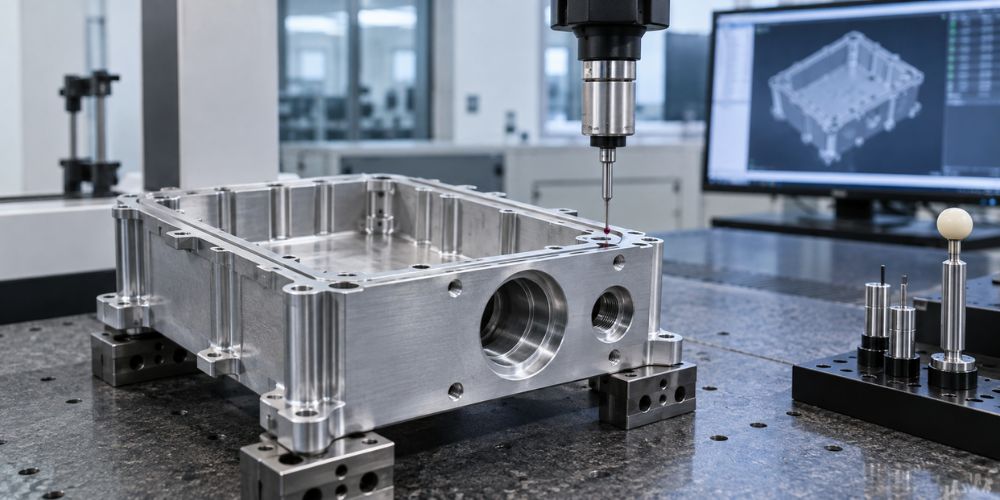
- Good Control of Functional Features: CNC machining can directly produce holes, grooves, pockets, mating faces, and threads from the CAD model. At MachMaster, we support machining tolerances down to ±0.01 mm for suitable parts, while the actual achievable tolerance depends on geometry, size, setup, and inspection requirements.
- Precision Is Still Process-Dependent: CNC does not mean every dimension automatically holds an extremely tight tolerance. Tool wear, temperature, workholding, machine condition, material behavior, and measurement all affect the finished part.
- Inspection Matters: NIST research continues to study machine-tool error and measurement because thermal deformation can significantly affect part quality.
That NIST finding is worth paying attention to. It shows why precision machining is about much more than entering a tolerance in a drawing.
If your enclosure has a few dimensions that truly need close control, identify those dimensions clearly. Our CNC machining service provides a useful reference for supported tolerances, materials, and machining capabilities.
6. Design Flexibility
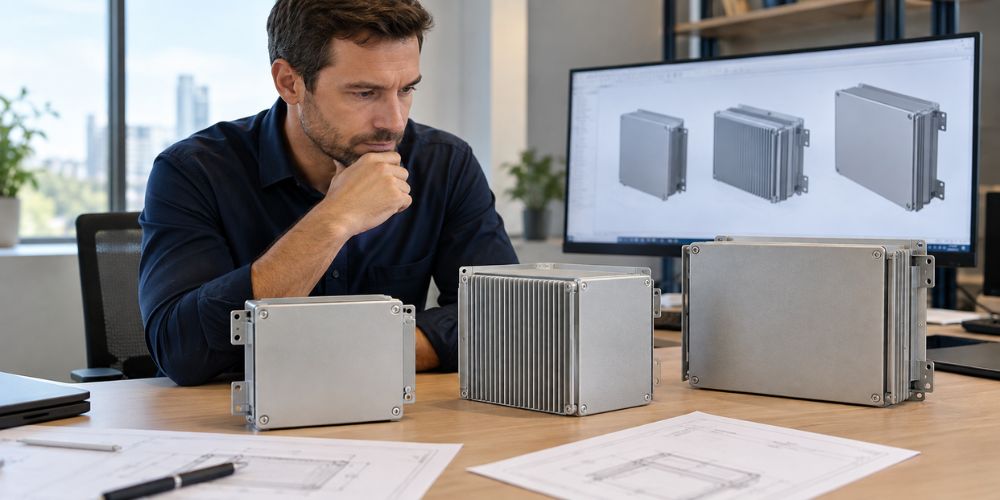
Design flexibility matters most before your enclosure is fully proven. CNC machining lets you revise the CAD model and manufacture another version without rebuilding a casting tool.
With CNC machining, those revisions can usually be made in the model and machining program. That makes CNC a practical choice for engineering samples, pilot production, and products that change often.
Die casting asks you to think further ahead.
According to NADCA’s die-casting design guidance, die-cast parts benefit from uniform wall thickness, sufficient draft for part removal, and radiused edges. Die design also needs to account for metal flow, venting, cooling, and ejection.
Why does that matter to you?
A change that looks small in CAD may affect the mold cavity, slider arrangement, cooling layout, ejection, or metal flow. This is why DFM work before tooling can save you from expensive revisions later.
If your design is still moving, a CNC machined prototype gives you a physical part for checking assembly, dimensions, connector positions, and functional interfaces before you commit to a production die.
7. EMI and Environmental Protection
Telecom electronics may need protection from electromagnetic interference, dust, moisture, vibration, and outdoor exposure. Neither die casting nor CNC machining automatically solves those problems by itself.
Die-Cast
- Metal Can Support EMI Shielding: Aluminum and zinc housings provide conductive enclosure material around the electronics. The final shielding result still depends on openings, seams, joints, grounding, fasteners, coatings, and contact between enclosure sections.
- Features Can Be Integrated Into the Housing: Ribs, bosses, mounting points, and wall structures can be cast as part of the enclosure. This can reduce the number of separate mechanical components in a repeat-production design.
CNC Machined
- Precision Helps at Sealing Interfaces: O-ring grooves, gasket seats, mating surfaces, and threaded features can be machined to controlled dimensions. That can be helpful when your sealing design depends on specific groove geometry or gasket compression.
- A Solid Metal Housing Can Support Shielding: A CNC-machined aluminum enclosure can create a conductive body around sensitive electronics. You still need to pay attention to lids, openings, connectors, surface finishes, and electrical bonding.
- Finishes Need to Match Your EMI Plan: Anodizing, powder coating, plating, or other surface treatments can change electrical contact at mating surfaces. Specify conductive contact areas clearly if your shielding design depends on metal-to-metal continuity.
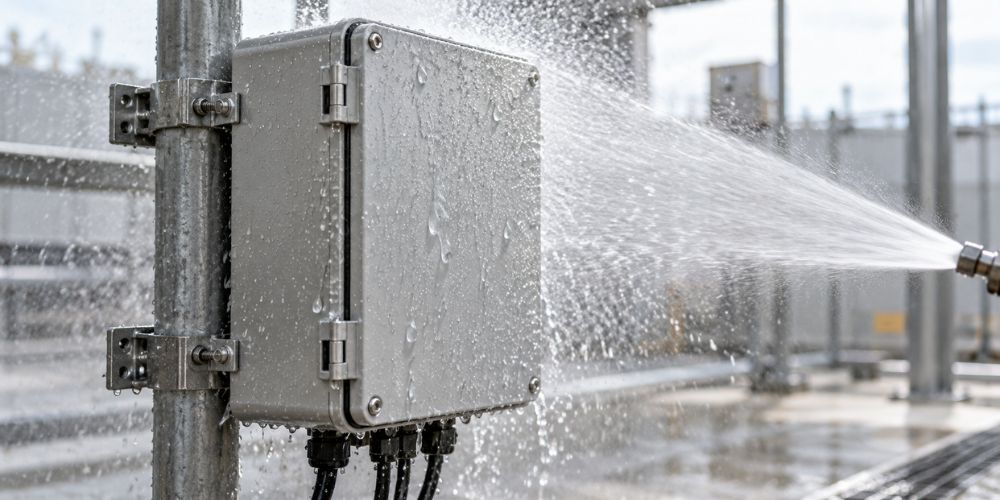
For environmental protection, the IEC 60529 IP system uses two numerals. The first runs from 0 to 6 for protection against solid objects, while the second runs from 0 to 9 for protection against liquids.
For products subject to U.S. FCC requirements, enclosure design may also play a role in controlling radiated emissions. For example, current 47 CFR §15.109 sets these radiated emission limits for unintentional radiators other than Class A digital devices at a 3-meter measurement distance.
| Reference Point | Published Requirement or Value | Why It Matters to the Enclosure |
| IEC IP first numeral | 0 to 6 | Rates protection against solid-object ingress |
| IEC IP second numeral | 0 to 9 | Rates protection against liquid ingress |
| FCC 30 to 88 MHz | 100 µV/m at 3 m | EMI control may influence seams, openings, and bonding |
| FCC 88 to 216 MHz | 150 µV/m at 3 m | Enclosure shielding can be part of the overall EMC strategy |
| FCC 216 to 960 MHz | 200 µV/m at 3 m | Connector openings and joints deserve attention |
| FCC above 960 MHz | 500 µV/m at 3 m | Final compliance must be checked on the complete device |
These FCC values are regulatory emission limits for applicable devices, not enclosure specifications by themselves.
What should you take from this?
Do not select an enclosure process based on an IP label or the assumption that “metal equals EMI protection.” Design the body, joints, seals, openings, coatings, and assembly method as one system.
8. Which Option Is Better for Your Production?
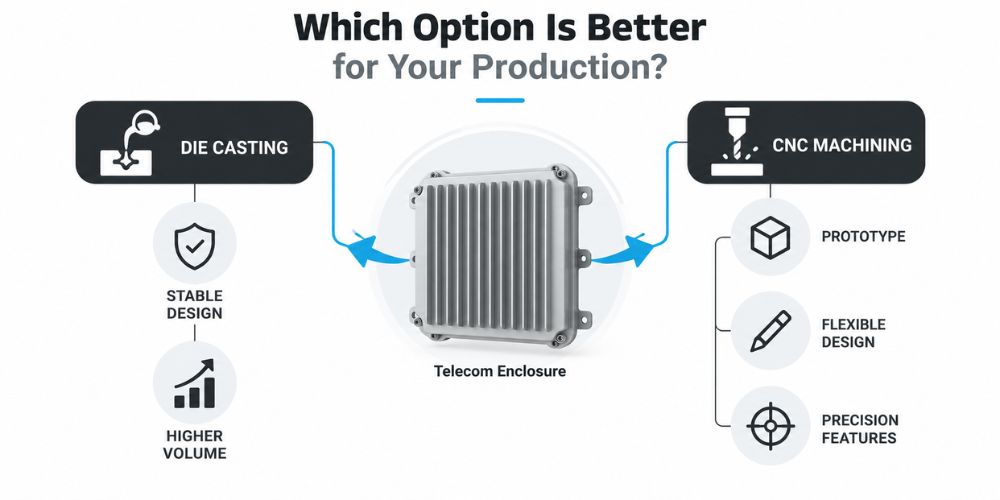
There is no single winner for every telecom enclosure. Your expected lifetime quantity, design maturity, tolerance requirements, tooling budget, and product life should drive the decision.
Choose Die Casting for Stable, Higher-Volume Products
Die casting becomes more attractive when you expect repeat production and the enclosure geometry is already stable. The upfront die investment becomes easier to justify because you can spread it across a larger number of units.
It can also be a strong choice when bosses, ribs, mounting structures, and other features can be formed directly into the casting.
You may still machine selected sealing surfaces, threaded holes, and precision interfaces afterward.
Choose CNC Machining for Flexible or Precision-Driven Projects
CNC machining is usually easier to justify if you need prototypes, one-off housings, smaller production quantities, frequent revisions, or close control over functional features. There is no dedicated production mold tying you to one enclosure geometry.
This is useful for new products that may change after assembly, thermal, ingress, or EMC testing. You can machine a new revision and test again before committing to larger tooling costs.
The trade-off is that each additional enclosure still requires machining time and raw materials. That is why it is worth reviewing your manufacturing strategy again when demand grows.
Consider a Hybrid Production Strategy
You do not always need to force the entire enclosure into one process. You can die-cast the basic housing and CNC machine only the connector holes, threaded ports, sealing surfaces, datums, or other precision features.
At MachMaster, we often look at this hybrid route when the general housing geometry suits casting, but several interfaces still need tighter machining control. Our goal is to put machining time where it adds functional value rather than machining every surface from billet.
Already have a CAD model? You can upload your drawings and production quantity for a manufacturing review and compare CNC machining, die casting, and combined production routes using the same design.
Conclusion
CNC machining is usually the better choice for prototypes, lower volumes, and tight-tolerance features. Die casting makes more sense when your design is stable and production volume can justify the tooling investment.
Your decision should consider more than unit price. Look at tooling, machining time, secondary operations, tolerances, finishing, inspection, and expected production volume before choosing a process.
At MachMaster, we support both CNC machining and die casting, including post-machining and finishing for production projects. If you already have a CAD model, send us your project details to compare which production route fits your enclosure.
Explore More of Our Resources
If you’re searching for more choices, explore our full collection of products. We’ve picked out some great options for you:
- CNC Machining for the Telecommunications Industry
- CNC Machining for Automotive Parts
- Cnc Machining Service
Want to learn more? Here are some articles filled with valuable tips and information to guide you further:
- 10 Leading Metal CNC Machining Manufacturers for Custom Industrial Components
- ABS vs ASA for CNC Machined Parts: Machinability, Durability and Cost
Still haven’t found what you’re looking for? Don’t hesitate to contact us. We’re available around the clock to assist you.