
Are you comparing CNC lathe suppliers and seeing the same promises everywhere? The real question is whether they can meet your quality, tolerance, cost, and delivery needs.
A good supplier should have the right machines, strong quality control, clear pricing, and reliable production capacity. These are the areas you should compare first.
With more than 15 years of machining experience, I have worked on projects from early prototypes to repeat production. That hands-on experience has shown me what buyers should check before trusting a supplier with an important order.
This guide will help you evaluate CNC lathe suppliers based on capabilities, quality, pricing, lead times, and engineering support. Use it as a simple checklist before you make your decision.
1. Define Your CNC Lathe Project Requirements
A supplier cannot build a useful process plan from incomplete information. The clearer your RFQ is, the easier it becomes to compare quotations on equal terms.
Start with your 2D drawing, 3D CAD file, material grade, quantity, surface finish, tolerance requirements, and delivery target. If geometric controls matter, use a recognized drawing system such as ASME Y14.5 for dimensioning and tolerancing, which provides a common language for communicating design intent.
What should you mark first? Identify the dimensions that directly affect fit, movement, sealing, alignment, or assembly.
Do not automatically apply the tightest tolerance to every feature. Tight control on a nonfunctional surface can add machine time and inspection work without improving the part.
| RFQ Item | What You Should Provide | Why It Matters |
| Part files | 2D drawing and 3D CAD model | Helps engineering review geometry and dimensions |
| Material | Exact alloy or plastic grade | Affects tooling, speeds, availability, and cost |
| Tolerances | Critical and general tolerances | Defines machining and inspection requirements |
| Quantity | Prototype and expected production volume | Affects setup cost and production planning |
| Finish | As-machined, anodized, plated, polished, etc. | Adds processing steps and lead time |
| Delivery | Required date and destination | Helps suppliers plan manufacturing and shipping |
2. Check the Supplier’s CNC Lathe Capabilities
“CNC turning available” tells you very little on its own. You need to know what the machines can do with your particular geometry, material, and volume.
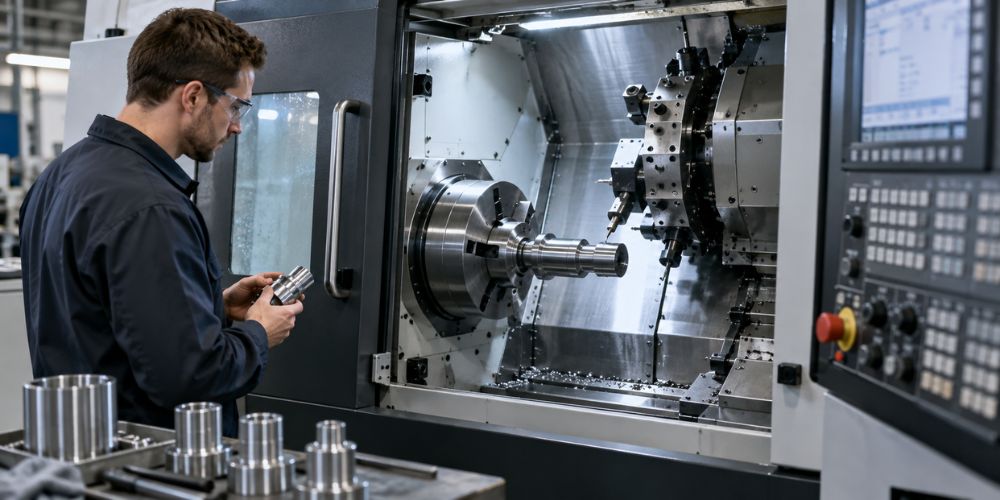
- CNC Lathe Equipment: Check whether the factory uses horizontal lathes, vertical lathes, turning centers, or machines with live tooling. Live tooling can be useful when a turned component also needs flats, cross holes, slots, or other secondary features.
- Part Size Range: Ask for maximum turning diameter, maximum length, and minimum feature size. A machine shop may be very capable but still be the wrong fit for an oversized shaft or very small precision component.
- Material Capability: Confirm that the shop regularly cuts your required aluminum, stainless steel, brass, copper, titanium, engineering plastic, or other material. Different materials affect tool wear, cutting parameters, surface quality, and cycle time.
- Production Flexibility: Ask whether the factory supports prototypes, small batches, and larger repeat orders. MachMaster works across prototype development and production, which lets us review a part with both immediate manufacturing and later volume requirements in mind.
Here is why this matters. A supplier that can make ten pieces is not automatically prepared to make 10,000 pieces on your required schedule.
If you want to compare your drawing against actual manufacturing limits, review our CNC Turning Services and check the listed size, material, tolerance, and production capabilities.
3. Evaluate Machining Quality
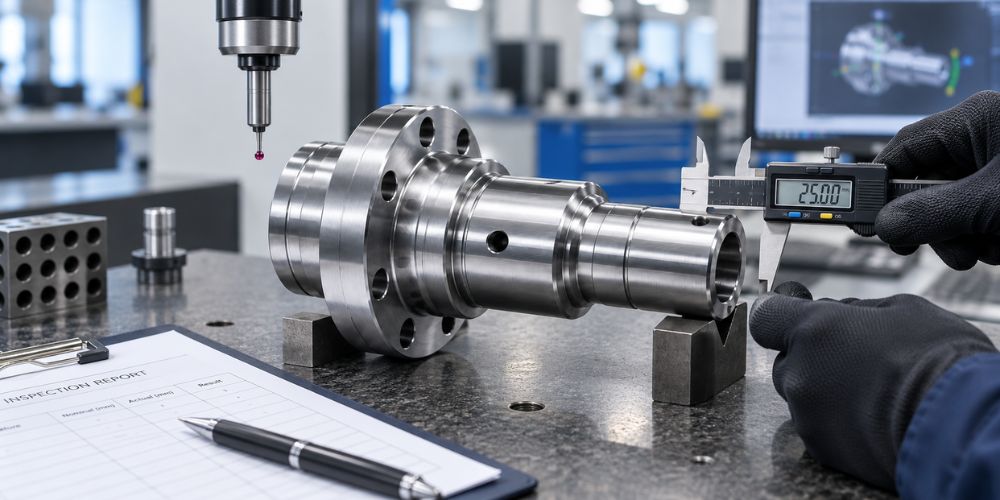
Good machining quality should be measurable. You want evidence that dimensions can be produced, checked, and repeated from the first part to later batches.
I often see buyers ask, “Can you hold ±0.01 mm?” That is useful, but the better question is, “Can you hold it on this feature, in this material, at this volume?”
Check Dimensional Accuracy
Tolerance requirements need context.
A CNC machining design guide from Xometry gives a useful industry reference: general CNC tolerances may start around ±0.1 mm, while ±0.01 mm falls into tight-tolerance machining. The guide also notes that tighter requirements can call for slower cutting, special measurement tools, extra fixtures, and longer inspection time.
That is why tighter is not automatically better.
MachMaster supports precision requirements down to ±0.01 mm for suitable parts and processes. We still ask you to identify critical dimensions clearly because achievable tolerance depends on part geometry, material, feature type, and machining method.
Review Inspection Capability
Ask what tools are used to verify your dimensions. Common equipment can include calipers, micrometers, height gauges, optical systems, and coordinate measuring machines.
Measurement traceability also matters for demanding work. The U.S. National Institute of Standards and Technology dimensional measurement program describes dimensional calibration and traceability to the SI unit of length as part of supporting process control and quality in manufacturing.
You should also ask when inspection occurs.
A useful process may include incoming material checks, first-piece verification, in-process inspection, and final inspection. If something fails, the supplier should be able to explain how the nonconforming part is identified and handled.
Ask for Quality Records
Do not rely only on a sample that looks good.
Ask whether the supplier can provide first article reports, dimensional inspection records, material documentation, or production samples when your project calls for them.
These records become especially useful for repeat orders. You have a measurable baseline instead of starting the quality discussion again every time.
4. Review Certifications and Quality Standards
A certificate does not replace part inspection. It does, however, tell you whether a supplier works within a defined management system that can be audited.
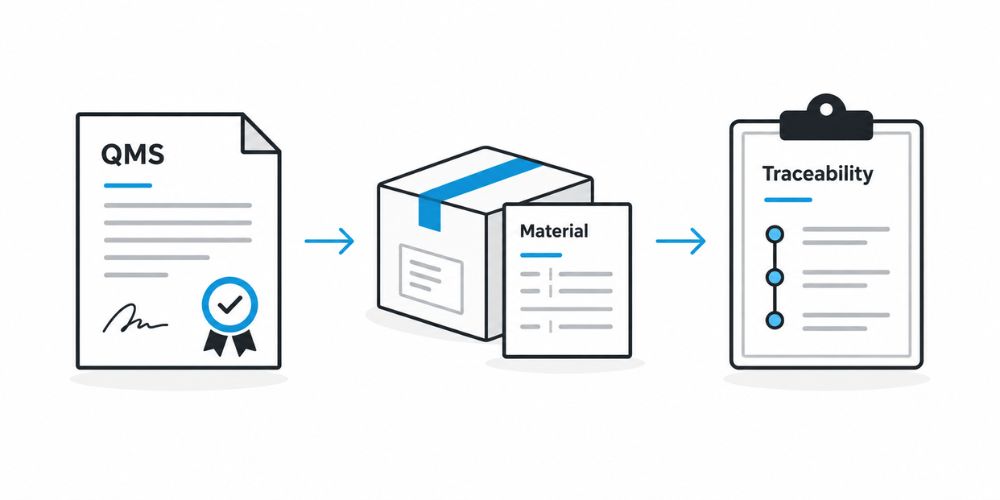
- ISO 9001 Certification: ISO 9001:2015 sets requirements for establishing, maintaining, and improving a quality management system. ISO reports that more than one million certificates have been issued across 189 countries, which helps explain why buyers commonly use the standard during supplier qualification.
- Material Documentation: Ask whether material certificates or supporting records are available for your order. This becomes more important when the specified alloy, plastic grade, heat treatment, or source affects product performance.
- Inspection and Traceability Records: Ask whether batch details, inspection results, and production records can be connected to your order. That makes repeat purchasing and root-cause investigation much easier.
One simple question can reveal a lot: Can the supplier show you the records, or do they only say they have them?
Documentation should be available when the project requires it.
5. Compare CNC Lathe Service Pricing
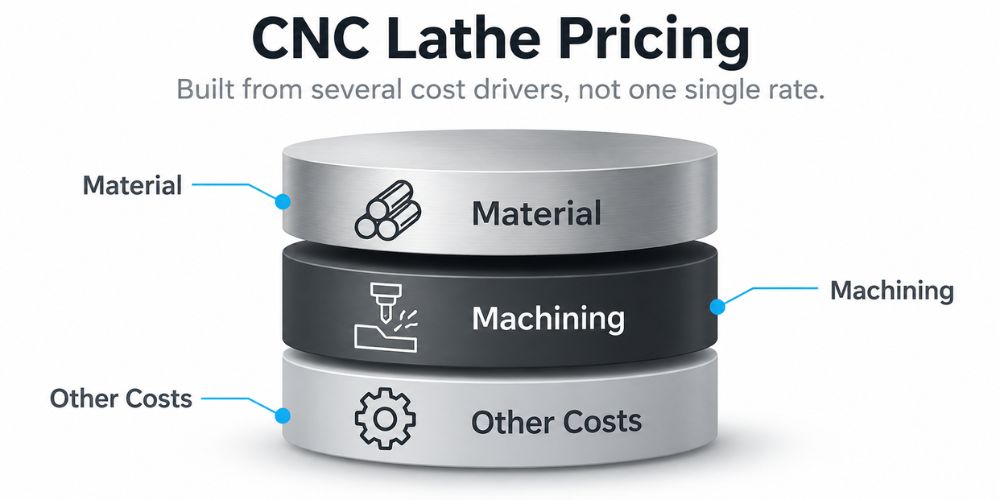
Why can two factories quote very different prices for the same drawing? Because a CNC quote is a combination of several costs, not one fixed machine rate.
Protolabs’ overview of CNC manufacturing costs groups the main cost areas into raw material, manufacturing time, and fixed or other costs.
In practice, your price can also move with setup time, programming, tooling, tolerance, inspection, surface finishing, and quantity.
| Cost Driver | What Can Raise the Price | What to Ask |
| Material | Expensive alloy, large stock size, poor machinability | Is standard stock available? |
| Setup | Multiple setups or special fixtures | How many setups are required? |
| Cycle time | Complex geometry or long cutting paths | Which feature drives machine time? |
| Tolerance | Tight or geometric tolerances | Which dimensions add inspection work? |
| Quantity | Setup spread across very few parts | Are there volume price breaks? |
| Finishing | Plating, anodizing, polishing, coating | Is finishing included in lead time? |
| Inspection | CMM reports or detailed documentation | What inspection level is included? |
A prototype often has a higher unit price because setup and programming costs are divided across fewer parts. As quantity rises, those fixed costs can be spread across more units.
Compare suppliers using the same drawing revision, material, quantity, finish, inspection level, and delivery terms. Otherwise, you may be comparing different scopes rather than different prices.
Want a real number to benchmark? Submit your CNC turning drawing with material, quantity, and tolerance requirements so the quotation reflects the actual project rather than a rough estimate.
6. Understand What Is Included in the Quote
The lowest figure on the page may not be the lowest total purchasing cost. You need to know what sits behind that number.
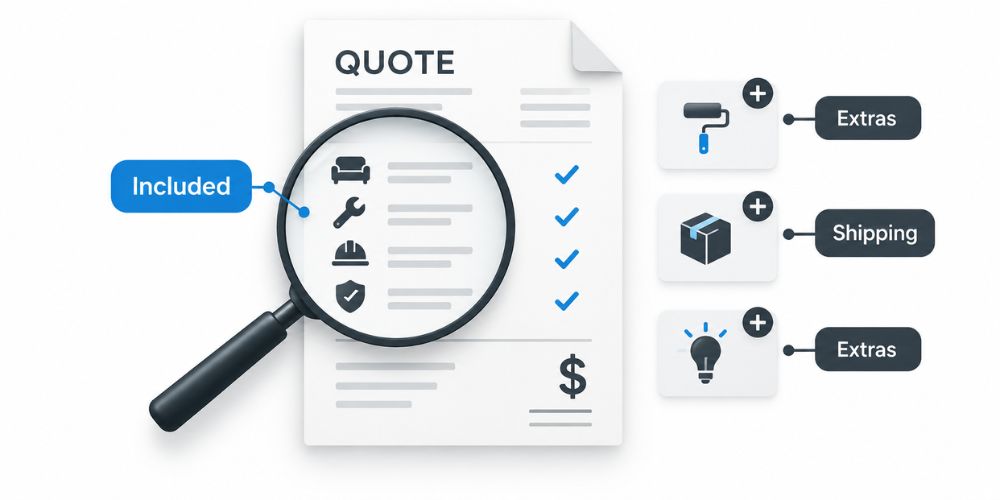
Check whether the quotation includes material, programming, setup, machining, inspection, surface finishing, packaging, and shipping.
Also look for separate tooling or fixture charges. For international purchasing, ask whether freight, duties, taxes, or special inspection documents sit outside the quoted price.
I have seen projects become difficult simply because the buyer and supplier interpreted “unit price” differently. A clear quote avoids that conversation later.
Quick test: Could you explain every major line in the quote to your own manager or client?
If not, ask for clarification before placing the order.
7. Check Production Capacity and Lead Times
A supplier may have the technical ability to machine your component but still lack room in the schedule. That becomes a bigger risk when your project moves from prototypes into regular orders.
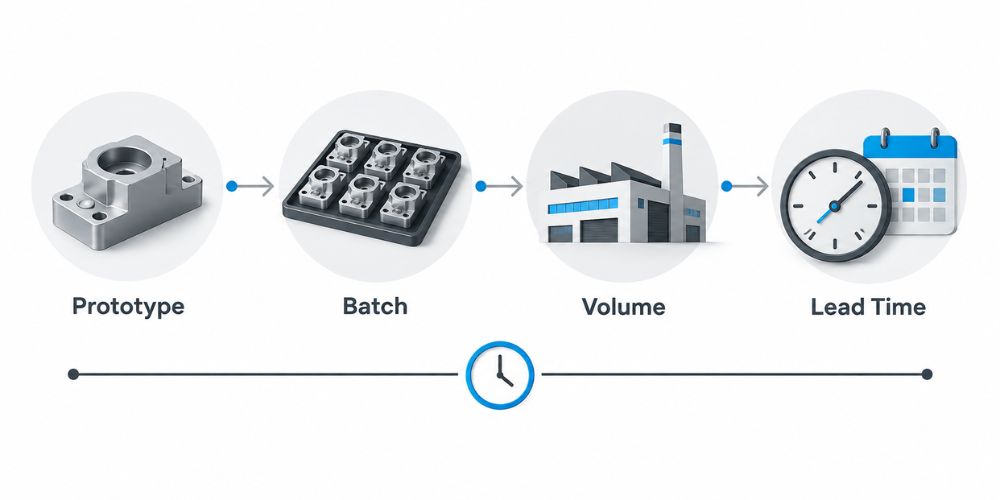
- Prototype Turnaround: Ask how quickly one-off parts or small prototype batches can enter production. Faster prototypes help you test fit, dimensions, and design changes before committing to more units.
- Small-Batch Production: Check how the supplier handles lower quantities. This is useful for product development, spare parts, market testing, and specialized equipment.
- Volume Production Capacity: Ask how many machines could realistically support your job and what happens if monthly demand increases. You want a practical production plan, not just a statement that high volume is possible.
- Delivery Planning: Confirm whether lead time includes material purchasing, machining, surface treatment, inspection, packing, and other outside processes. Ask how urgent changes are handled before you rely on a promised date.
Also separate machining time from total lead time.
A part may need only a short time on the lathe but spend much longer waiting for raw material, finishing, inspection, or shipment.
8. Evaluate Engineering and DFM Support
A CNC supplier can either follow your drawing blindly or help you find manufacturing problems before cutting metal. The second approach is usually more useful for new products and cost-sensitive production.
Good DFM review looks at geometry, material, tolerance, wall thickness, threads, tool access, surface finish, and inspection requirements.
The earlier Xometry design guide gives a simple example of why this matters: tighter tolerances can require extra fixtures, special measurement tools, and longer cycle times, and the cost for a feature can in some cases rise to more than double a standard-tolerance version.
That does not mean you should loosen an important tolerance. It means you should spend precision where the function needs it.
In more than 15 years of manufacturing work, I have seen small drawing changes remove unnecessary setups or make inspection much simpler. At MachMaster, we use DFM review to discuss manufacturability, process choices, and possible cost improvements before production rather than after a problem appears.
Already have a 2D drawing or 3D model? You can send the project for CNC turning review and use the feedback to check feasibility before committing to production.

9. Review Communication and Project Management
Technical skill matters, but you still need to know what is happening with your order. Clear communication becomes especially important when a design changes, a dimension is unclear, or a delivery date moves.
- Technical Response Quality: Look at the supplier’s answers to questions about tolerances, materials, machining methods, and drawings. A detailed explanation of a manufacturing risk is much more useful than a quick “yes, we can make it.”
- Production Updates: Ask what updates you will receive after ordering. Useful milestones can include material preparation, machining, finishing, inspection, and shipment.
- Problem Resolution: Ask what happens if a drawing conflict, dimensional issue, or schedule problem appears. A good supplier should identify the issue, share relevant information, and give you practical options.
Here is a simple test.
Does the supplier ask technical questions before quoting? If a complex drawing receives an instant “no problem” response without any questions, look more closely.
Good communication starts during the RFQ stage, not after the deposit is paid.

Conclusion
Choosing a CNC lathe supplier is about more than comparing prices. Look at machining capability, quality control, lead time, engineering support, and communication before making your decision.
For a new supplier, start with a prototype or small trial order when possible. This gives you a simple way to check part quality, documentation, packaging, and actual delivery performance.
If you have a CNC turning project ready, MachMaster can review your drawing, material, tolerance, and production needs. Explore our CNC Turning Services and submit your project for a quote to see whether our capabilities fit your requirements.
Dive Deeper Into Our Resources
Not quite what you’re looking for? Explore our wider product range for more choices:
Curious for more? These additional articles offer even more insights and advice:
- 10 Leading Metal CNC Machining Manufacturers for Custom Industrial Components
- ABS vs ASA for CNC Machined Parts: Machinability, Durability and Cost
Still haven’t found what you’re looking for? Don’t hesitate to contact us. We’re available around the clock to assist you.