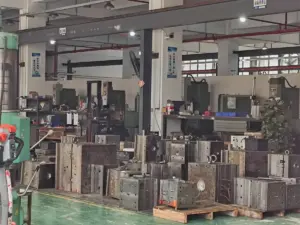

Are you choosing between aluminum and titanium for an outdoor gear component? The right choice comes down to weight, strength, environment, and budget.
Choose aluminum for lower weight by volume, easier machining, and lower cost. Choose titanium when higher strength, corrosion resistance, and fatigue performance matter more.
As Founder and Chief Designer of MachMaster, I have spent years working with precision metal parts from prototypes to production. That hands-on manufacturing experience helps me judge materials by how they perform in both design and real production.
In this guide, you will compare aluminum and titanium by strength, corrosion resistance, machining, cost, and weight. You will also see which material fits different outdoor gear applications.
1. Why Choose Aluminum for Outdoor Gear Components?
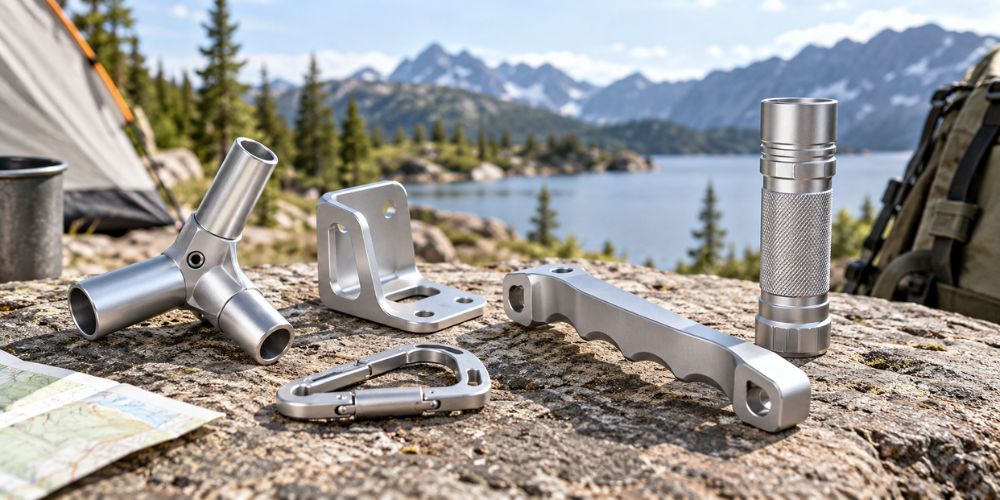
Aluminum makes sense when you want a light component without pushing manufacturing costs too high. It works well for housings, frames, brackets, clips, handles, lighting parts, and many other outdoor components.
At MachMaster, we often consider aluminum early in a project when customers need a practical balance of weight, machining speed, and cost. It can work for one-off prototypes, small batches, and larger CNC production runs.
For example, 6061-T6 aluminum has a nominal density of 2.70 g/cm³, while its typical ultimate tensile strength is about 310 MPa. Kaiser Aluminum also rates the alloy well for corrosion resistance, which helps explain why 6061 is common in outdoor and structural applications.
You also have plenty of finishing options. Anodizing, for example, converts the aluminum surface into a durable oxide finish that can improve corrosion resistance and add color. The Aluminum Anodizers Council describes anodizing as a corrosion-resistant finish that becomes part of the aluminum surface rather than sitting on top like paint.
2. Why Choose Titanium for Outdoor Gear Components?
Titanium costs more and is heavier than aluminum at the same volume, but it gives you far higher strength. That can make it a better fit for compact parts exposed to high loads or repeated stress.
Ti-6Al-4V is also known for good fatigue strength and strong corrosion resistance. TIMET’s Ti-6Al-4V technical data lists uses including fasteners, automotive components, sports equipment, pressure vessels, and aerospace parts.
Why does that matter for outdoor gear? A small connector, fastener, pin, or load-bearing component may need more strength than a standard aluminum design can provide within the available space.
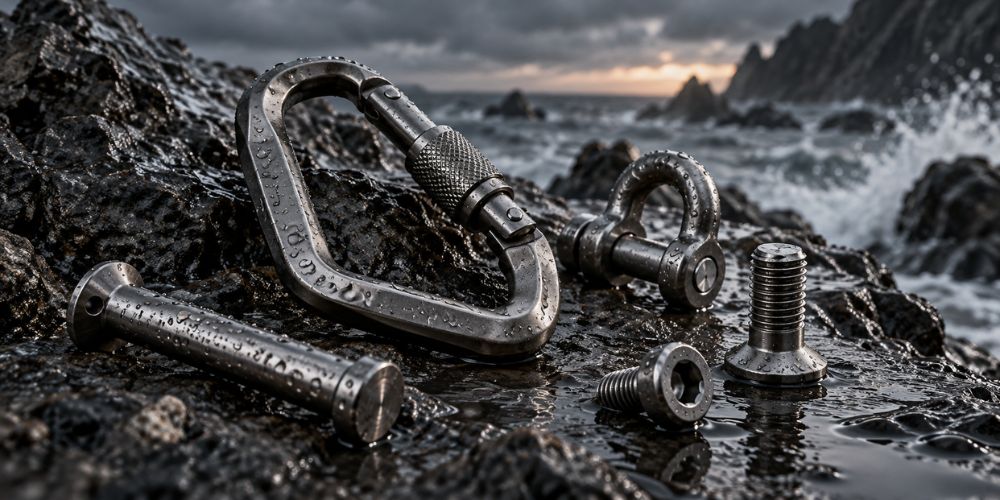
Titanium also performs well around water. TIMET specifically reports that Ti-6Al-4V is highly resistant to general corrosion in seawater, making it worth considering for marine gear and products used in wet or coastal environments.
3. Strength and Durability
Strength is one of the biggest differences between aluminum and titanium. If your component carries high loads or needs to stay compact, the numbers can change your design quickly.
I often see product teams ask, “Which metal is stronger?” A better question is: How much strength does this specific part actually need?
Aluminum
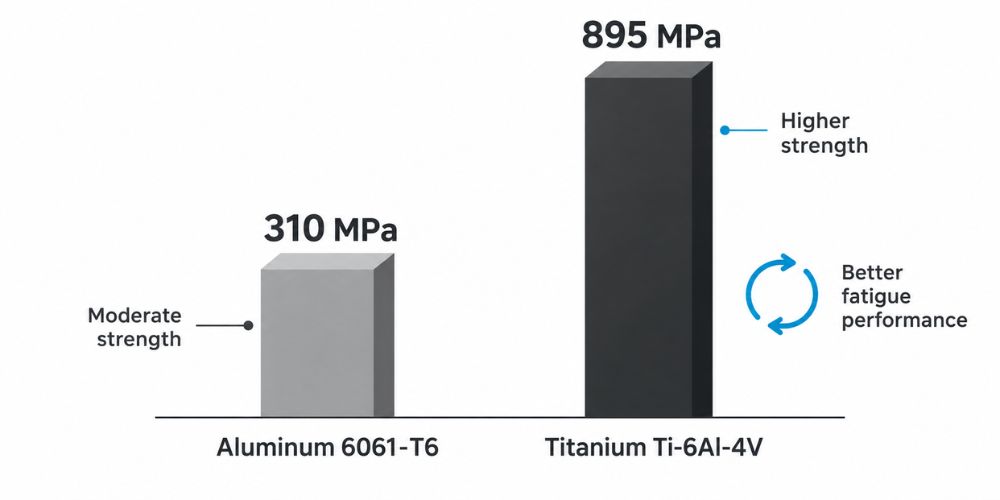
- Moderate Strength: According to the Kaiser Aluminum 6061 data sheet, 6061-T6 has a typical ultimate tensile strength of about 310 MPa and a yield strength of about 276 MPa. Those values can be suitable for frames, housings, handles, brackets, and many supporting outdoor components.
- Good Strength at Low Weight: You do not always need the strongest metal available. If an aluminum component already meets the expected load with a reasonable safety margin, moving to titanium may add cost without giving the customer a meaningful benefit.
Titanium
- Much Higher Strength: For specified annealed Ti-6Al-4V product forms, TIMET lists minimum ultimate tensile strength around 895 MPa and minimum yield strength around 828 MPa. That is roughly 2.9 times the ultimate tensile strength and 3 times the yield strength of the typical 6061-T6 values above, though specifications and product forms must be compared carefully.
- Strong Strength-to-Weight Performance: Ti-6Al-4V has a density of about 4.42 g/cm³, compared with 2.70 g/cm³ for 6061 aluminum. Using the published tensile and density figures as a simple comparison, Ti-6Al-4V offers about 1.76 times the ultimate tensile strength per unit density of 6061-T6.
- Good Under Repeated Loading: TIMET describes Ti-6Al-4V as having good fatigue strength and publishes axial fatigue data extending to millions of load cycles. This matters for components that repeatedly flex, pull, rotate, or carry changing loads during use.
So, is titanium automatically better? No.
If an aluminum design already meets your load requirements, titanium’s added strength may be unnecessary. Titanium becomes more attractive when space, load, fatigue, or product positioning gives that extra strength real value.
4. Corrosion Resistance
Outdoor gear may face rain, sweat, mud, humidity, saltwater, and repeated temperature changes. That means corrosion is more than an appearance issue because it can affect long-term part performance.
Both materials resist corrosion, but their behavior is different. The environment should be part of your material decision from the start.
Aluminum
- Good General Corrosion Resistance: Kaiser lists corrosion resistance as a major characteristic of 6061 aluminum. Its technical data rates T6 and T651 6061 favorably for general corrosion resistance and notes that alloys with the relevant ratings can be used in industrial and seacoast atmospheres without general surface protection.
- Anodizing Adds Another Option: Anodized aluminum develops an aluminum oxide surface that is integrated with the base metal. The process can provide a more durable and weather-resistant finish while also giving product designers a wide choice of colors.
- Good for Many Outdoor Products: Camping equipment, bicycle accessories, portable lighting, brackets, handles, and equipment housings can all make good use of aluminum. You still need to match the alloy and finish to the actual service environment.
Titanium
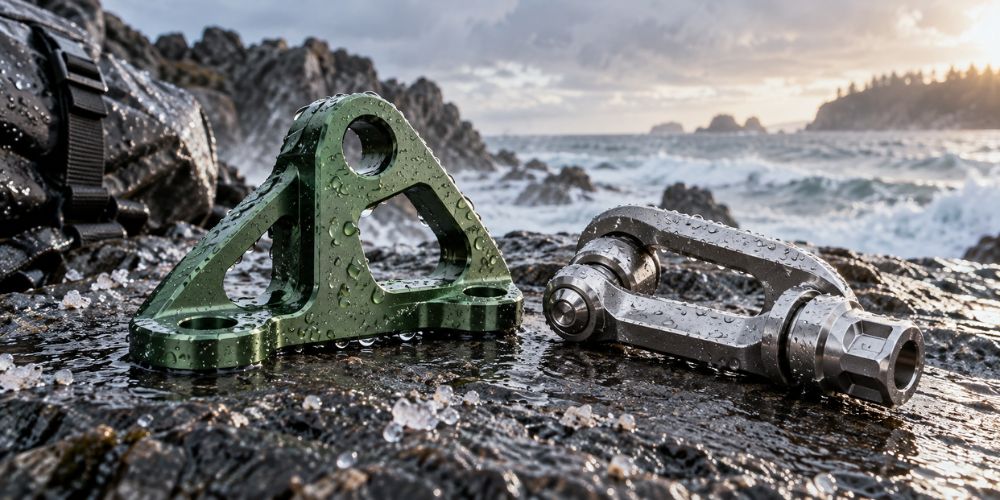
- Very Strong Corrosion Resistance: Ti-6Al-4V forms a protective oxide film and performs well in many aggressive environments. TIMET specifically identifies the alloy as highly resistant to general corrosion in seawater.
- Useful Around Water and Salt: That seawater resistance makes titanium interesting for marine accessories, coastal equipment, wet-weather hardware, and components regularly exposed to sweat. A small premium fastener or connector may benefit more from titanium than an entire large frame.
Will your product spend most of its life dry? If yes, aluminum may already offer all the corrosion resistance you need.
On the other hand, repeated saltwater or harsh environmental exposure can make titanium easier to justify.
5. Machining and Manufacturing
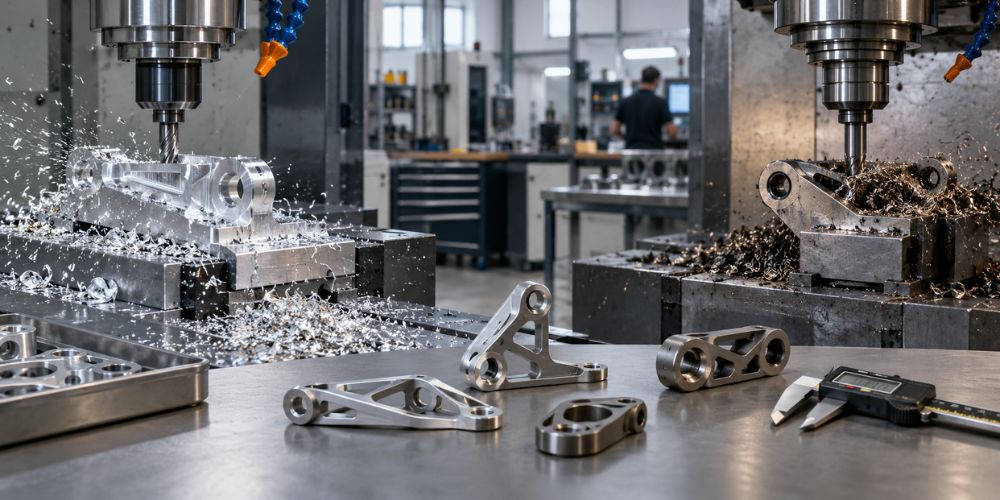
A material can look perfect on a specification sheet and still create problems on the production floor. Machining time, heat, cutting tools, geometry, and tolerances all affect the cost of the finished component.
This is where aluminum and titanium move further apart. Aluminum is generally easier to machine, while titanium needs more controlled cutting conditions.
Aluminum
- Faster Material Removal: Aluminum can generally be machined at higher cutting speeds than titanium. Faster cutting and easier chip removal can shorten CNC cycle times, especially on parts with large pockets or significant material removal.
- Lower Tooling Demands: Aluminum typically puts less stress on cutting tools. That matters as production volume rises because tool changes and machine downtime contribute to the real cost of every part.
- Good for Detailed Geometry: Holes, pockets, threads, contours, slots, and complex surfaces can all be machined into aluminum. Multi-axis machining can also reduce setups when several faces of an outdoor component need machining.
Titanium
- Heat Is a Bigger Issue: TIMET lists the thermal conductivity of Ti-6Al-4V at about 6.6 W/m·K at 20°C, while Kaiser’s data for 6061-T6 lists about 167 W/m·K at 20°C. That means the published thermal conductivity of 6061-T6 is roughly 25 times higher, which helps explain why heat management deserves more attention during titanium machining.
- Machining Is More Demanding: Titanium’s strength and thermal behavior call for careful control of cutting speed, feeds, coolant, chip evacuation, and tool selection. Deep pockets, thin walls, and hard-to-reach features can make the process even more demanding.
- Design Choices Affect Machine Time: At MachMaster, we review corner radii, tool access, wall thickness, geometry, and tolerances before titanium parts reach production. A small CAD change can sometimes remove an extra setup or allow a stronger cutting tool without changing how the product works.
Here is why this matters for buyers: you are paying for the finished part, not just the block of metal.
If you already have a 3D model, you can review our CNC machining service for aluminum and titanium. Comparing manufacturability before ordering a larger batch can expose expensive features while they are still easy to change.
6. Cost
For most projects, aluminum has a clear cost advantage. Titanium costs more at the raw-material stage and usually requires more machining time to produce the same type of component.
But how much more? The ranges below give you a practical 2026 budgeting reference, not a fixed quotation. Stock form, dimensions, order quantity, certification, tolerances, geometry, finishing, and supplier location can all change the final number.
| Cost Factor | 6061 Aluminum | Ti-6Al-4V Titanium | What It Means for You |
| Raw Material | About $4–$13/kg | About $22–$42/kg | Titanium can cost several times more before machining even starts |
| Typical CNC Machining Rate | About $50–$100/hour | About $100–$200/hour | Titanium commonly requires slower cutting and more demanding tooling |
| Standard 3-Axis CNC Work | About $55–$85/hour* | About $55–$85/hour* | The machine rate may be similar, but titanium often needs more machine time |
| Complex 5-Axis CNC Work | About $110–$165/hour* | About $110–$165/hour* | Complex geometry increases cost for either material |
| Prototype Production | Generally lower | Generally higher | Aluminum is usually more economical for early testing and design changes |
| High-Volume Production | Lower per-part cost potential | Higher per-part cost potential | Longer titanium cycle times become more important as volume rises |
| Overall Finished Part | Usually lower | Usually higher | Titanium needs a clear performance benefit to justify the added cost |
*The 3-axis and 5-axis ranges are general 2026 CNC shop-rate benchmarks rather than material-specific prices. The bigger difference is often how many machining hours the part requires, not simply the hourly machine rate.
At MachMaster, we review geometry, tool access, tolerance requirements, and machining strategy before production. Our production CNC machining service can help you compare aluminum and titanium based on the finished component rather than raw stock price alone.
Titanium can still be worth the added expense. If it allows you to make a smaller high-load component, improve service life in a harsh environment, or meet a premium product specification, the higher production cost may have a clear business reason.
7. Weight
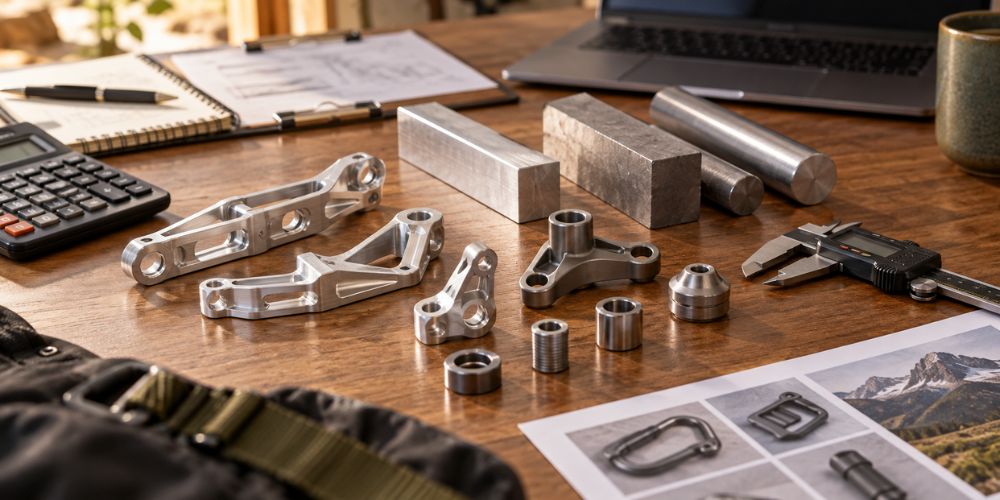
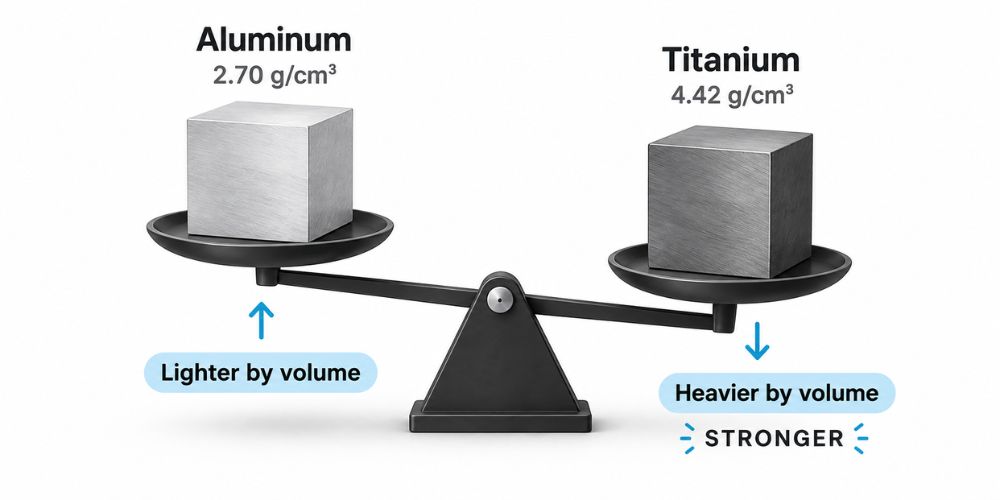
For hiking, climbing, cycling, camping, and other portable products, every gram can matter. But there is a common misunderstanding here: titanium is not lighter than aluminum by volume.
The numbers make this easy to see. 6061 aluminum has a nominal density of 2.70 g/cm³, while Ti-6Al-4V is about 4.42 g/cm³.
Aluminum
- Lower Density: If you make the same component with exactly the same dimensions, aluminum will be lighter. Based on the published densities, titanium is about 64% heavier by volume than 6061 aluminum.
- Good for Larger Components: This matters for frames, housings, poles, handles, structural sections, and large equipment bodies. As part volume increases, aluminum’s density advantage becomes increasingly noticeable.
- More Material May Be Needed: There is a trade-off. Because 6061-T6 has much lower strength than Ti-6Al-4V, some aluminum designs need thicker walls or larger cross-sections to carry the same load.
Titanium
- Higher Density: Replace an aluminum part with titanium while keeping the geometry identical, and the titanium version will normally weigh more. For example, an aluminum geometry that contains 100 grams of 6061 material would contain roughly 164 grams of Ti-6Al-4V at the same volume.
- Strength Can Reduce Part Size: Titanium changes conversation because of its much higher strength. In some load-driven parts, you may be able to reduce wall thickness, diameter, or section size and recover part of the weight difference.
Want the lightest material? Aluminum wins on density.
Want high strength from a smaller section? Titanium deserves a closer look.
8. Which One Should You Choose?
There is no single winner between aluminum and titanium. The better material is the one that solves your product’s actual engineering problem without adding unnecessary cost.
Start with six questions: What load will the part carry? How much space do you have? How much can it weigh? Where will it be used? How many will you make? What can the finished product sell for?
Choose Aluminum for Cost-Effective, Lightweight Products
Choose aluminum if low density, manageable manufacturing cost, and efficient CNC machining are your main priorities. It is a strong candidate for housings, frames, handles, brackets, clips, equipment bodies, lighting components, and other medium-load outdoor parts.
It is also practical when you expect medium or large production quantities. Lower machining effort becomes more valuable as the number of parts increases.
For many general outdoor products, I would start the design review with aluminum. I would move away from it only if the required load, environment, size, fatigue life, or product positioning gives you a clear reason.
Choose Titanium for High-Load or Premium Components
Choose titanium if the component needs to handle high stress within limited space. It is also worth considering for repeated loading, demanding environments, and premium products where material performance supports the selling price.
The published data shows why. Ti-6Al-4V has much higher tensile and yield strength than 6061-T6, while TIMET also documents good fatigue performance and resistance to general corrosion in seawater.
That makes titanium a logical candidate for high-load connectors, bicycle hardware, climbing components, marine parts, and similar applications. Use it because the properties solve a real problem, not simply because titanium sounds premium.
Compare the Complete Part, Not Just the Material
Your CAD model can change the final answer. A thicker aluminum component may cost less and weigh less than an overly conservative titanium design, while a properly optimized titanium component may work better where load and available space are tightly limited.
Look at wall thickness, tolerances, finishing, machine time, production quantity, service environment, expected lifespan, and product price together. Procurement teams should compare finished-part cost, not raw-material price alone.
If you are still comparing both options, submit the same CAD design through our CNC manufacturing service and compare the production routes. A manufacturing review before volume production can give you a much clearer answer than choosing from material specifications alone.
Conclusion
Aluminum is a practical choice when you need low weight, easier machining, and lower production costs. Titanium is better suited to parts that need higher strength, better fatigue performance, or strong corrosion resistance.
The best material depends on how your component will be used and what your budget allows. Compare strength, weight, machining requirements, production volume, and finished-part cost before making the final choice.
At MachMaster, we help turn material decisions into production-ready parts through CNC machining, DFM support, and surface finishing. If you already have a drawing or 3D model, explore our CNC machining services and submit your project for a manufacturing review.
Learn More: Recommended Reads
Want to see more products? We’ve got plenty of options that might just be the perfect fit for you:
We’ve gathered a few more articles that could help you out. Check them out for more great advice:
- 10 Leading Metal CNC Machining Manufacturers for Custom Industrial Components
- ABS vs ASA for CNC Machined Parts: Machinability, Durability and Cost
Still haven’t found what you’re looking for? Don’t hesitate to contact us. We’re available around the clock to assist you.