
Are you deciding between aluminum and steel for a CNC machined part? The right choice depends more on material price.
Aluminum is lighter and usually faster to machine, while steel offers higher stiffness and strength. Your best option depends on performance needs, production cost, and service life.
As Founder and Chief Designer of MachMaster, I bring more than 15 years of hands-on machining experience to this comparison. We have supported prototype and production projects across a wide range of industries, so I know where material choices can affect cost and part performance.
This guide compares machining speed, tool wear, tolerances, production volume, and cost. Use it to quickly see which material fits your part and budget.
1. What Is Aluminum for CNC Machined Parts?
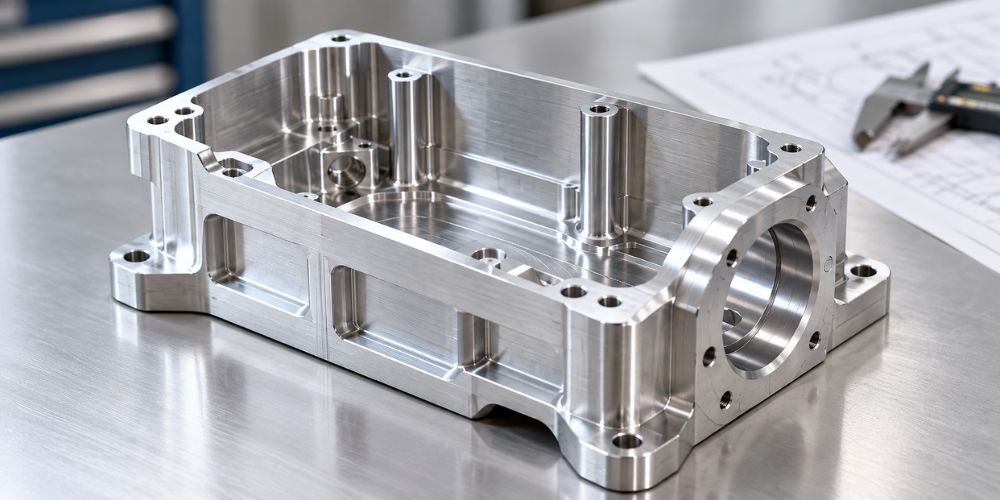
Aluminum is a lightweight metal commonly used for CNC milling and turning. Grades such as 6061 are popular because they combine moderate strength, corrosion resistance, and good machining performance.
According to Kaiser Aluminum’s 6061 technical data, 6061 has a nominal density of 2.70 g/cm³. The same data lists a modulus of elasticity of 68.3 GPa for 6061-T6/T651.
That lower density matters if you are making housings, brackets, moving assemblies, or parts that need to ship internationally. A solid 1,000 cm³ volume would weigh about 2.70 kg in aluminum.
2. What Is Steel for CNC Machined Parts?
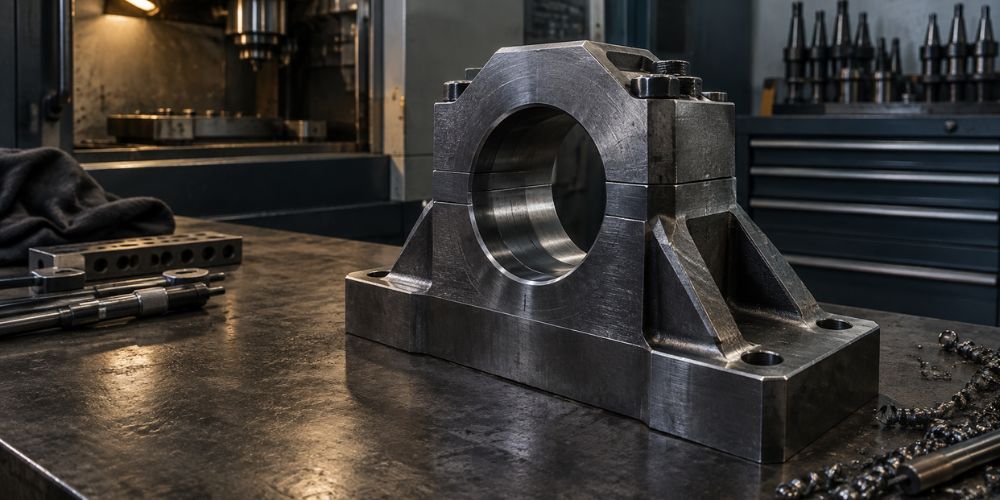
Steel is often chosen for CNC parts that need higher stiffness, load capacity, wear resistance, or structural strength. Mild steels such as 1018 are widely used for shafts, brackets, fixtures, machine components, and industrial parts.
For comparison, AISI 1018 material data lists a density of 7.87 g/cm³ and an elastic modulus of about 200 GPa. That makes steel close to three times as dense and roughly three times as stiff as 6061 aluminum by elastic modulus.
Using the same 1,000 cm³ example, 1018 steel would weigh about 7.87 kg. That is 5.17 kg more than the aluminum version before you change any geometry.
3. Machining Speed
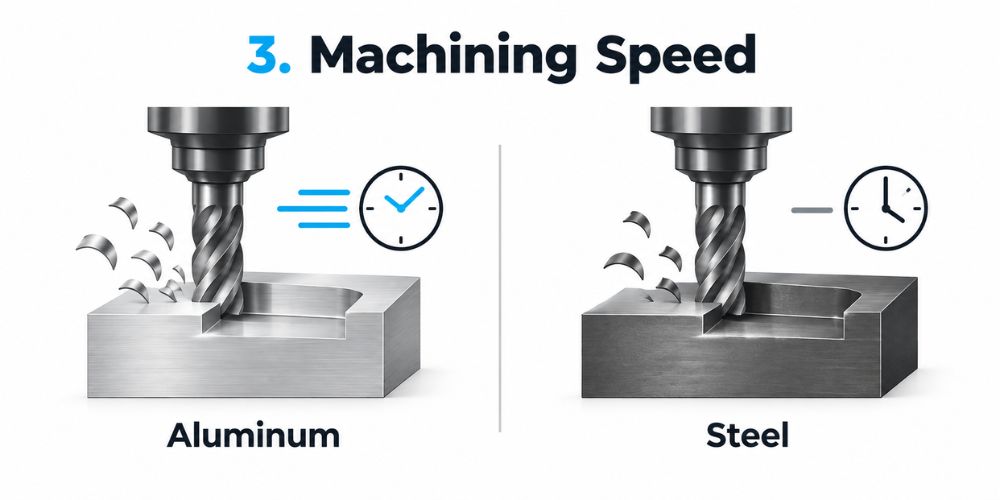
Does faster machining really make much difference? It can, especially when your part has deep pockets, large stock removal, or hundreds of repeat units.
Aluminum
- Higher Cutting Speeds: Aluminum can usually run at much higher cutting speeds than ordinary carbon steel. In one Sandvik Coromant CoroMill Dura cutting-data chart, one aluminum-based alloy group is listed at 680 m/min, compared with 145 m/min for unalloyed steel under the listed tool configuration.
- Faster Material Removal: That speed gap can shorten roughing cycles for housings, plates, pockets, and brackets. The exact result still depends on your machine, tool diameter, alloy, depth of cut, fixturing, and coolant strategy.
- Better Production Efficiency: Shorter cycle times become more valuable as order quantities increase. At MachMaster, we look at machining time alongside material cost because our CNC production work may involve anything from prototypes to repeat manufacturing.
Steel
- Slower Cutting Speeds: Carbon steel normally uses lower cutting speeds than common machinable aluminum grades. The Sandvik data above shows how large the difference can become with a suitable tool and application.
- Higher Cutting Forces: Steel generally places greater loads on cutting tools and machine spindles. Shops may need more conservative parameters depending on steel hardness, grade, cutter engagement, and machine rigidity.
- Longer Cycles Can Raise Cost: A cheaper steel bar does not automatically produce a cheaper CNC part. Extra machine minutes add up quickly across a production run.
Here is why this matters: imagine saving only two minutes per part on a 5,000-piece order. That represents more than 166 machine hours before you even consider tool changes or secondary operations.
4. Tool Wear
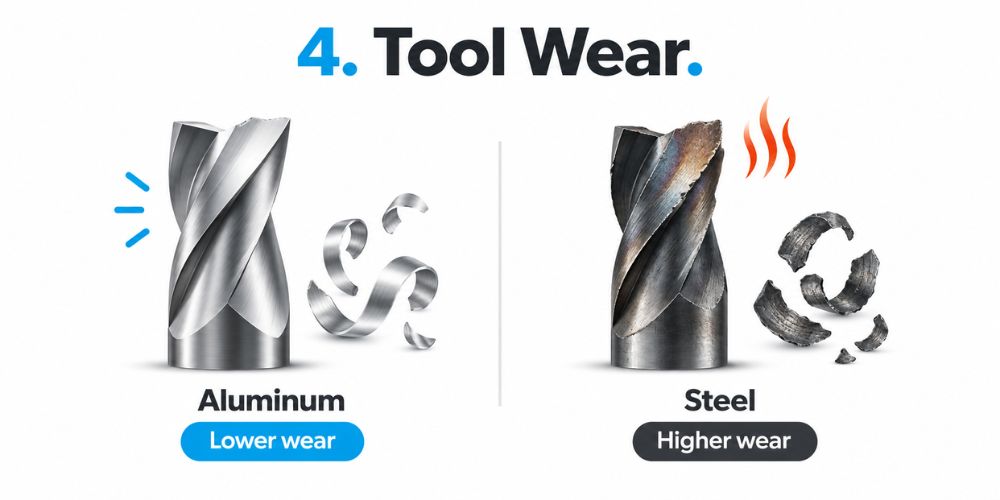
Tool wear affects far more than the price of an insert or end mill. It can influence downtime, cycle stability, surface quality, and the cost of keeping a production job running.
Aluminum
- Lower Cutting Load: Many common aluminum alloys can be machined with aggressive cutting parameters. That makes aluminum attractive where fast material removal is a major part of the cycle.
- Built-Up Edge Can Be a Problem: Aluminum can stick to the cutting edge, especially when the material is relatively soft or cutting conditions are poor. Kennametal’s aluminum machining guidance notes that sharp cutting edges help reduce built-up edge and gumming.
- Tool Choice Matters: PCD tooling is one option for demanding aluminum production. Kennametal states that its PCD tooling can deliver up to 10 times higher productivity than carbide solutions in suitable aluminum machining applications, although your actual gain will depend on the job.
Steel
- Higher Tooling Demand: Steel commonly generates more cutting resistance and heat at the cutting edge. As hardness rises, tool life can become a larger cost factor.
- Steel Grade Changes Everything: 1018 mild steel does not machine like hardened 4140 or stainless steel. You should never take the tool-life expectation from one steel and apply it to every other grade.
- Tool Changes Cost Time: Every planned or unexpected tool change interrupts production. Across hundreds or thousands of parts, those interruptions can become part of the unit price.
I often see buyers compare two material quotations down to a few cents per kilogram while overlooking hours of machining time. In practice, cost per finished part is the number worth watching.
5. Surface Finish and Tolerances
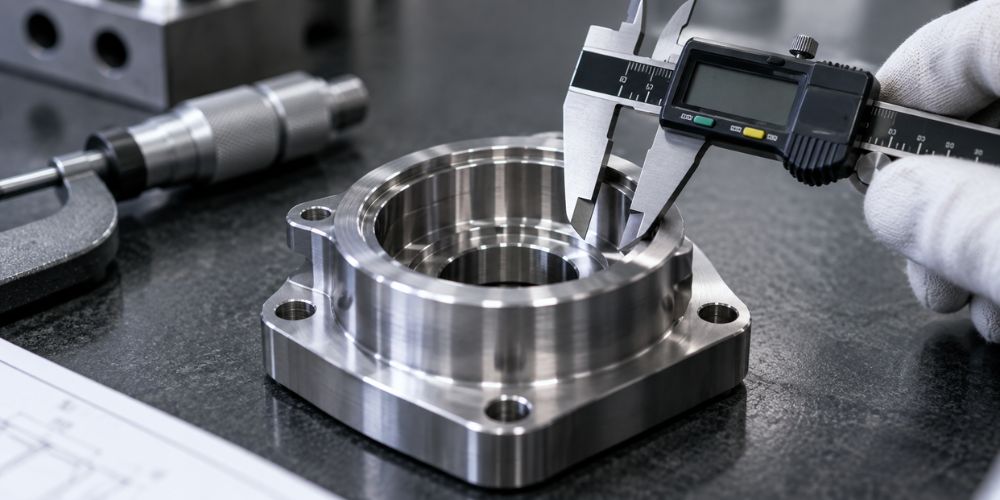
Can both metals hold tight tolerances? Yes, but geometry, material condition, wall thickness, workholding, tools, and finishing all affect how practical those tolerances are.
Aluminum
- Clean Machined Surfaces: Aluminum can produce very smooth surfaces with sharp tools and stable cutting conditions. PCD tooling is also used for applications that need high cutting speeds, dimensional accuracy, and good surface quality.
- Tight Tolerances Are Possible: Precision aluminum parts can meet demanding dimensional requirements with proper process control. At MachMaster, our CNC machining service supports tolerances down to ±0.01 mm for suitable parts and specifications.
- Anodizing Is Common: 6061 is frequently selected where corrosion resistance and anodizing response matter. Kaiser rates 6061-T6/T651 highly for anodizing response and reports good general corrosion performance.
Steel
- Higher Stiffness Helps: With an elastic modulus around 200 GPa for 1018 versus 68.3 GPa for 6061, steel resists elastic deflection more strongly for the same geometry. This can matter on shafts, supports, machine components, and loaded mounting parts.
- Fine Finishes Are Possible: Turning, milling, grinding, and secondary finishing can all produce accurate steel surfaces. Each added operation, however, adds machine or processing cost.
- Surface Protection May Add Cost: Plain carbon steel is often plated, painted, black-oxided, or powder-coated where moisture or appearance is a concern. That extra process should be part of your finished-part comparison.
One practical tip: do you really need ±0.01 mm on every dimension? If a feature can work at a wider tolerance, changing the drawing may save more money than changing the material.
6. Production Volume
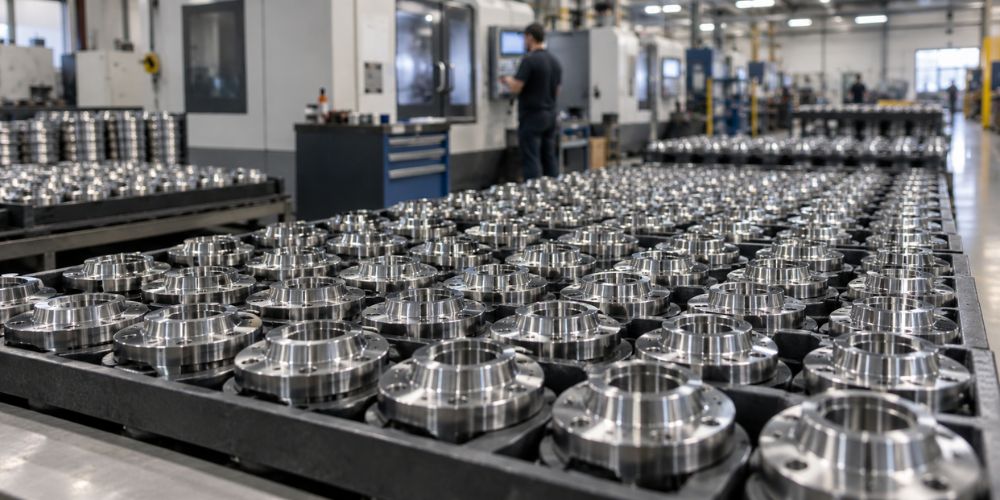
A material that makes sense for 10 prototypes may not give you the same economics at 10,000 parts. Volume changes how cycle time, purchasing quantity, setup, tool life, inspection, and freight affect the unit price.
Aluminum
- Useful for Fast Prototypes: 6061 is widely available and can be machined efficiently for functional prototypes. You can test the design before committing to a large production run.
- Cycle-Time Savings Scale: Saving two minutes across five parts means ten minutes. Saving two minutes across 5,000 parts means more than 166 hours of machine time.
- Lower Shipping Weight: A same-volume 1018 steel part weighs about 2.9 times as much as one made from 6061 based on the published density values. That difference can matter for air freight, international shipments, portable equipment, and moving assemblies.
Steel
- Raw Material Can Cost Less: Common mild steel often starts with a lower stock cost than 6061 aluminum. That can be attractive on high-volume parts where machining is simple and the steel does not require expensive finishing.
- Machine Time Still Counts: A low stock price can be offset by longer cycle times, more tooling demand, or added coating processes. This is why procurement teams should compare finished-part quotations.
- Long Service Life Can Change the Math: If steel’s stiffness or wear resistance lets a component remain in use longer, its higher manufacturing or freight cost may still make financial sense.
For repeat production, give your supplier the actual CAD file, grade, quantity, tolerances, and finish. You can also submit your CNC machining project here to compare production options using the real design.
7. Aluminum vs Steel Cost Comparison
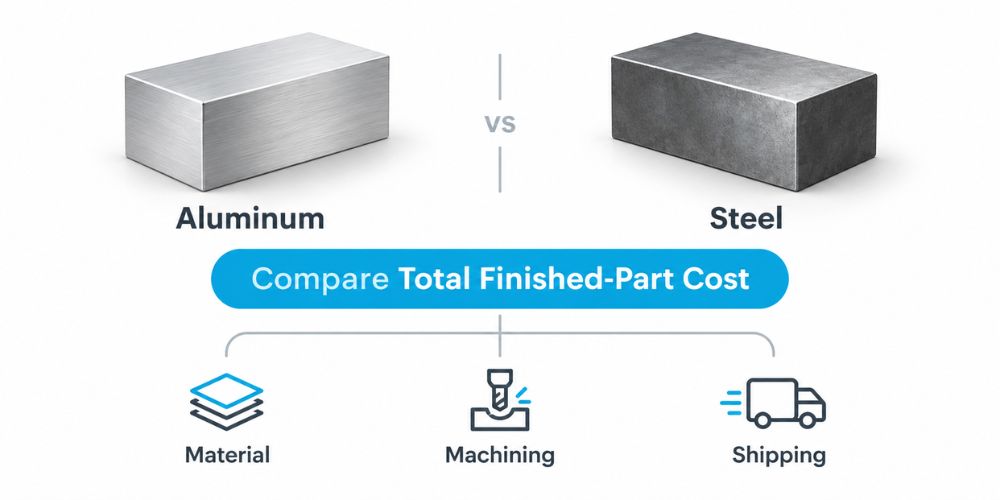
So, which one is cheaper? Look at the complete part cost first, because metal markets, stock form, order size, machining time, and finishing can all move the final price.
Aluminum pricing is tied partly to global primary-metal markets, with the London Metal Exchange aluminum price serving as a global reference benchmark. Steel buyers also track markets such as the CME U.S. Midwest Hot-Rolled Coil Steel Index, so neither material should be treated as having a fixed long-term price.
| Cost Factor | Aluminum 6061 | Mild Steel 1018 | Cost Impact |
| Indicative Raw Material Range | USD 3.5 to 7.0/kg | USD 1.0 to 5.0/kg | Steel often starts with a lower material cost. |
| Density | About 2.70 g/cm³ | About 7.87 g/cm³ | Steel parts of equal volume weigh about 2.9 times more. |
| Machining Time | Usually shorter | Usually longer | Aluminum can reduce machine-hour cost on parts with heavy material removal. |
| Tooling Cost | Usually lower to moderate | Usually moderate to higher | Steel may create higher tooling demand, depending on grade and hardness. |
| Surface Protection | Anodizing commonly used | Plating or coating may be needed | Finish requirements can change total price. |
| International Shipping | Lower weight | Higher weight | Aluminum can reduce freight weight for large orders. |
| Maintenance Cost | Often favorable in corrosive environments | Depends on coating and environment | Operating conditions affect lifecycle cost. |
Steel may cost less as raw stock, but aluminum can be cheaper to machine and ship. Compare the finished-part cost and expected service life before making your final choice.
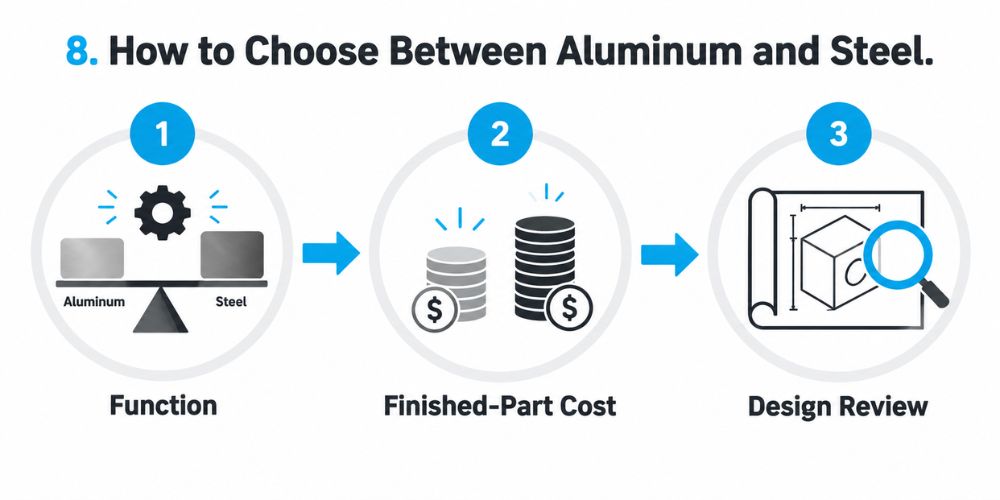
8. How to Choose Between Aluminum and Steel
You do not need to make the decision from one material property. Work through function, finished cost, and design in that order.
Start With Functional Requirements
What does the part actually need to survive? Check the load, stiffness, impact, temperature, corrosion exposure, wear, weight limit, and expected service life.
If low weight matters, aluminum deserves close consideration. If stiffness and mechanical load matter more, steel may give you a better starting point.
For example, steel’s elastic modulus is roughly three times that of 6061 in the data compared above. That does not automatically make steel the better design, but it tells you that geometry and deflection need to be considered if you switch from steel to aluminum.
Compare Finished-Part Cost, Not Material Price
A raw-metal price tells you very little about what will appear on the final invoice. Machine hours, setups, tools, inspection, finishing, scrap, packaging, and freight all matter.
Two CNC shops can start with similar material costs and still quote very different prices. Equipment, fixtures, programming, automation, tooling strategy, and batch planning all affect production efficiency.
So ask a better question: What will one inspected, finished, usable part cost at my required volume?
Review the Design Before Production
Your CAD design can sometimes save more money than switching from aluminum to steel or back again. Deep pockets, thin walls, sharp internal corners, hard-to-reach features, and unnecessary tolerances all add machining work.
At MachMaster, we use our CNC machining and DFM capabilities to review geometry, material, tolerances, machining strategy, and finishing before production. Our goal is to help you see where a design change may reduce machining effort without changing what the part needs to do.
I have seen relatively small drawing changes remove machining operations or simplify workholding. Those changes can be more valuable than negotiating a small discount on the raw metal.
If you already have a 3D model or drawing, review the CNC machining service and submit your project specifications. A part-specific comparison gives you far better information than a general aluminum-versus-steel estimate.
Conclusion
Aluminum is often the better choice when you need lower weight, faster machining, and good corrosion resistance. Steel can make more sense when stiffness, strength, and wear life matter more.
The right material depends on your design, production volume, tolerances, finishing needs, and service conditions. Looking at the complete part cost will help you avoid choosing based on raw material price alone.
At MachMaster, we help you compare materials and machining options based on your actual part requirements. Send us your CAD file through our CNC machining service page to review the best production approach for your project.
Discover More Options
There’s so much more to discover! Check out our other products and find what fits your needs:
We’ve got more for you! These articles provide more tips and guidance to keep you on track:
- 10 Leading Metal CNC Machining Manufacturers for Custom Industrial Components
- ABS vs ASA for CNC Machined Parts: Machinability, Durability and Cost
Still haven’t found what you’re looking for? Don’t hesitate to contact us. We’re available around the clock to assist you.