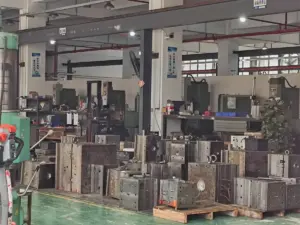

Are you choosing between aluminum and stainless steel for a precision instrument housing? The right material affects weight, strength, heat control, and cost.
In short, aluminum is better for low weight, heat transfer, and easier machining. Stainless steel is better for stiffness, wear resistance, and harsher environments.
As the Founder and Chief Designer of MachMaster, I bring more than 15 years of hands-on machining experience. I supported precision projects across electronics, lighting, agriculture, and commercial machinery.
This guide compares both materials across strength, corrosion resistance, heat management, machining, and surface finish. You can use it to choose the option that best fits your housing design and production needs.
1. Aluminum for Precision Instrument Housings
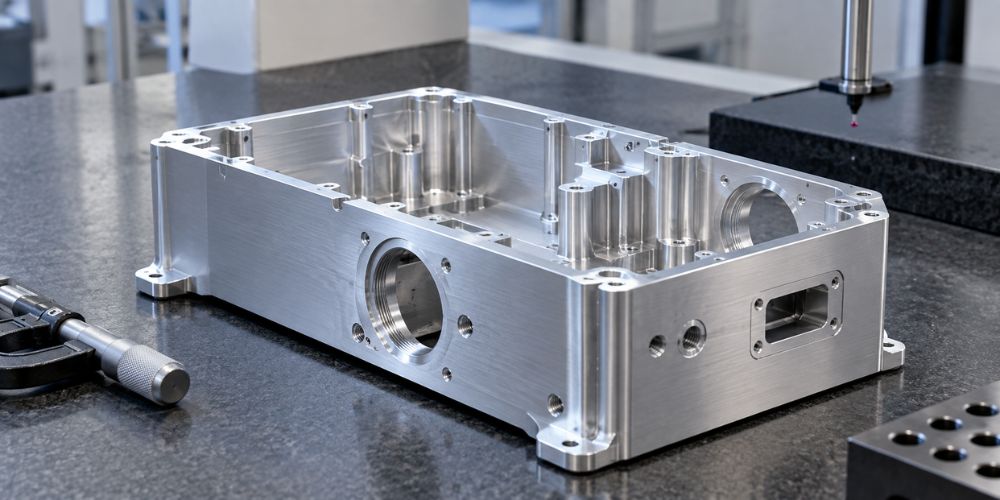
Aluminum is a practical choice when you need a lightweight housing with good heat transfer. Hydro’s technical data for 6061 aluminum lists a density of just 0.098 lb/in³, about 2.7 g/cm³, along with good general corrosion resistance and machinability.
It also works well for housings with pockets, threads, mounting holes, connector openings, and thin sections. If weight, machining speed, and production cost matter to your project, aluminum is often the more practical starting point.
2. Stainless Steel for Precision Instrument Housings
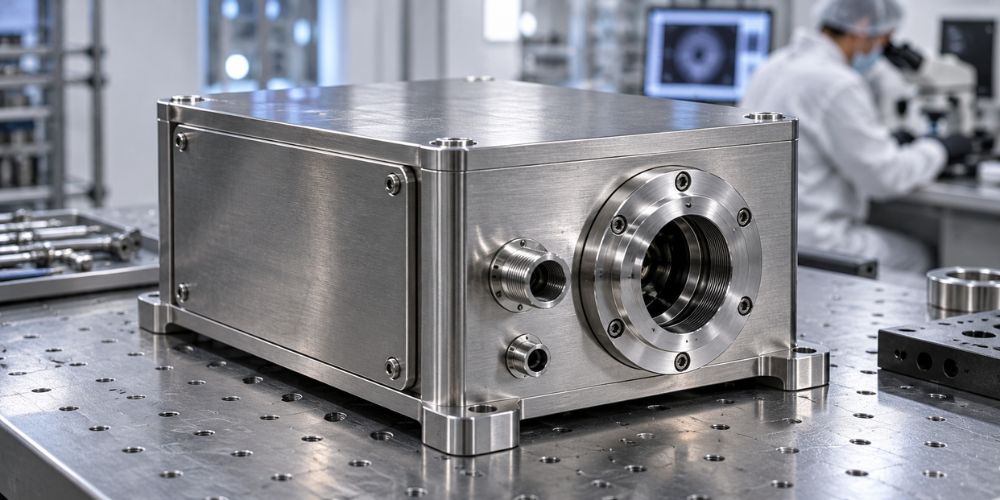
Stainless steel makes more sense when your housing needs greater stiffness, wear resistance, or better performance in demanding environments. Common grades such as 304, 316, and 316L are widely used across industrial, medical, chemical, food, and other equipment applications.
The tradeoff is simple: stainless steel is much heavier and more demanding for machines. Its lower thermal conductivity and tendency to work harden can also increase tool wear and machining difficulty.
3. Mechanical Strength
Your housing may protect sensors, optics, circuit boards, measuring components, or other sensitive parts. So, how much does the material itself matter?
Quite a lot. Stiffness, strength, weight, wall thickness, mounting loads, vibration, and impact should all be considered together.
Quick Mechanical Property Comparison
| Property | 6061-T6 Aluminum | 304 Stainless Steel | 316 Stainless Steel |
| Density | 2.70 g/cm³ | 7.9 g/cm³ | 8.0 g/cm³ |
| Elastic Modulus | About 70 GPa at room temperature | 200 GPa | 200 GPa |
| Minimum Yield Strength* | 240 MPa | 170 MPa | 205 MPa |
| Minimum Tensile Strength* | 260 MPa | 485 MPa | 515 MPa |
| Typical/Minimum Elongation* | 8 to 10% | 40% | 40% |
The 6061-T6 values shown are based on Hydro extrusion data, while stainless values are based on ASTM A240 data published by Outokumpu. NIST also provides temperature-dependent 6061-T6 modulus data.
Aluminum
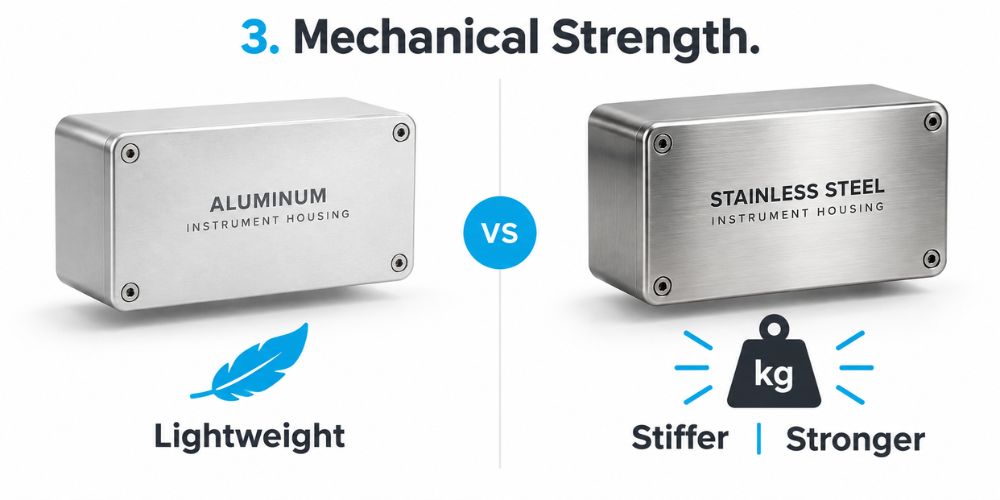
- Good Strength-to-Weight Ratio: Aluminum gives you useful mechanical performance without adding much mass. At roughly 2.7 g/cm³, 6061 is about one-third the density of 304 or 316 stainless steel.
- Suitable for Structural Housings: Hydro lists a minimum tensile strength of 260 MPa and yield strength of 240 MPa for standard 6061-T6 extrusions in the thickness ranges shown in its data sheet. You can also add ribs, thicker mounting areas, or local reinforcement if certain sections need more stiffness.
- Better for Weight-Sensitive Designs: Aluminum becomes attractive when every gram affects portability or equipment movement. A housing made from equal volumes of 304 stainless steel would weigh close to three times as much based on the published density values.
Stainless Steel
- Better Stiffness: Outokumpu lists an elastic modulus of 200 GPa for both 304 and 316-series austenitic stainless steels, compared with roughly 70 GPa for 6061-T6 near room temperature. If controlling deflection matters, stainless steel gives you a major stiffness advantage.
- Higher Tensile Strength: ASTM A240 values published by Outokumpu show minimum tensile strengths of 485 MPa for 304 and 515 MPa for 316, compared with 260 MPa for the 6061-T6 extrusion data above. Keep in mind that the exact comparison changes with temper, product form, and processing route.
- More Ductility in These Conditions: The cited stainless data lists 40% minimum elongation for 304 and 316, while Hydro lists 8 to 10% for the standard 6061-T6 extrusion thicknesses shown. This can matter where a housing may experience deformation or mechanical abuse before fracture.
At MachMaster, we review wall thickness, tolerances, and expected loading before suggesting a material. I often see buyers specify stainless steel because it sounds stronger, even though a properly supported aluminum housing may already meet the functional requirement at much lower weight.
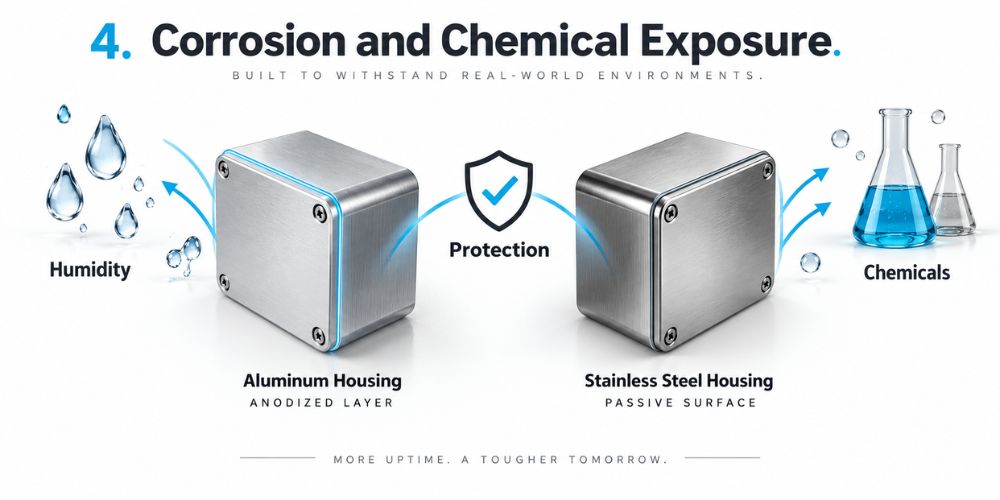
4. Corrosion and Chemical Exposure
Where will the instrument actually work? That question can quickly change your material choice.
Humidity, chloride exposure, cleaning chemicals, process fluids, and outdoor use can all affect the housing. The exact alloy matters just as much as the words “aluminum” or “stainless steel.”
Aluminum
- Good General Corrosion Resistance: Aluminum forms a natural oxide film, and Hydro rates 6061 well for general corrosion resistance. Hydro also lists atmospheric and seawater corrosion resistance among the useful properties of the alloy.
- Anodizing Adds Surface Protection: 6061 responds well to anodizing, and anodized surfaces can add wear resistance, corrosion protection, and cosmetic color. Hydro’s 6061 data specifically includes anodizing response as one of its comparative material characteristics.
- Chemical Exposure Still Needs Review: Aluminum is not the answer for every chemical environment. Acids, alkaline solutions, salt-rich environments, temperature, and exposure time all need to be considered before you finalize the alloy and finish.
Stainless Steel
- Strong Passive Corrosion Protection: Stainless steel gets much of its corrosion resistance from a naturally forming chromium-rich passive oxide film. worldstainless explains this self-passivating mechanism and notes that stainless steels contain at least 10.5% chromium.
- 316 Handles More Demanding Conditions: Outokumpu lists a Pitting Resistance Equivalent, or PRE, of 18 for 304 and 24 for 316 and 316L in the grades shown. The molybdenum content in 316-series stainless steel raises resistance to localized corrosion, especially where chlorides are part of the environment.
- Good for Frequent Cleaning: 316L stainless steel is used in chemical, food and beverage, pharmaceutical, and medical applications. That makes it a practical material to evaluate for instrument housings exposed to regular cleaning or more aggressive service conditions.
Does that mean 316L can handle anything? No.
Outokumpu notes that chloride concentration, temperature, pH, surface condition, and crevice geometry all affect corrosion behavior.
If corrosion is one of your main concerns, compare the actual grades before locking the CAD model. You can also review our CNC machining materials to compare common aluminum and stainless steel options available for production.
5. Temperature and Heat Management
Does your instrument generate heat? If it contains processors, lasers, power electronics, motors, or high-output sensors, the housing can become part of the thermal design.
This is one area where the numbers show a very clear difference between aluminum and stainless steel.
Thermal Property Comparison
| Property | 6061-T6 Aluminum | 304 Stainless Steel | 316/316L Stainless Steel |
| Thermal Conductivity | 167 W/m·K | 15 W/m·K | 15 W/m·K |
| Thermal Expansion, 20 to 100°C | 23.6 × 10⁻⁶/K | 16.0 × 10⁻⁶/K | 16.0 × 10⁻⁶/K |
| Density | 2.70 g/cm³ | 7.9 g/cm³ | 8.0 g/cm³ |
| Main Thermal Advantage | Fast heat spreading | Lower heat transfer | Lower heat transfer |
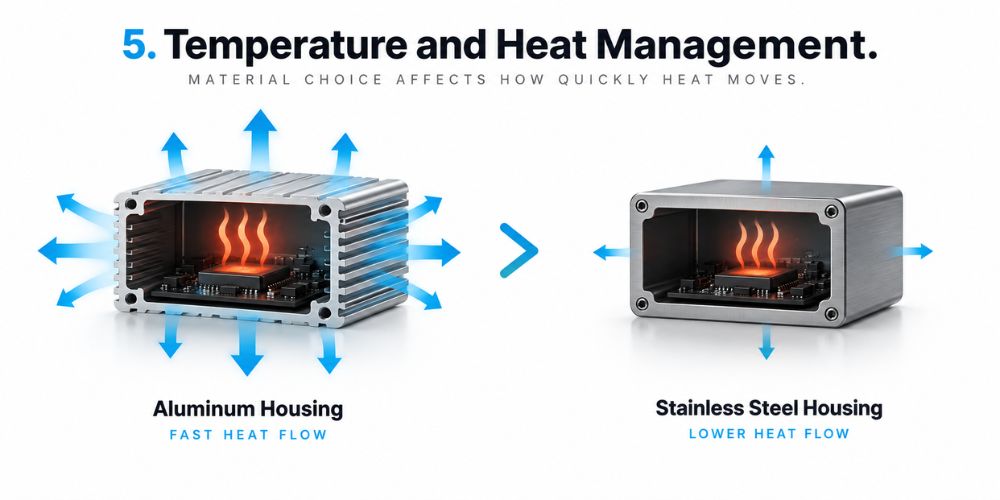
Here is why this matters. Based on these published values, 6061-T6 conducts heat about 11 times faster than 304 or 316 stainless steel.
Aluminum
- Much Higher Thermal Conductivity: 6061-T6 is listed at about 167 W/m·K, compared with 15 W/m·K for the austenitic stainless grades above. This gives aluminum a clear advantage when the housing needs to spread heat away from internal components.
- Useful for Passive Cooling: A machined aluminum housing can function as part of the cooling system. Fins, thick heat-spreading areas, and direct contact surfaces can help transfer heat away from electronics without adding a separate heat sink in some designs.
- Higher Thermal Expansion: The same data lists a thermal expansion coefficient of 23.6 × 10⁻⁶/K for 6061 and 16.0 × 10⁻⁶/K for 304 and 316. That means aluminum expands roughly 48% more over the same temperature change, so optical alignment and precision sensor positioning deserve extra attention.
Stainless Steel
- Much Lower Heat Conductivity: Austenitic 304 and 316 stainless steels are listed at about 15 W/m·K at 20°C. This makes them poor heat spreaders compared with 6061 aluminum.
- Useful for Heat Isolation: Lower conductivity can work in your favor if you want to slow heat transfer between two areas of an instrument. Stainless steel may therefore make sense for supports, barriers, or housings where thermal isolation matters more than heat dissipation.
- Temperature Movement Still Matters: Stainless steel also expands as temperature changes. Its expansion is lower than 6061 in the cited range, but very small dimensional changes can still matter for optical, measuring, and alignment-sensitive assemblies.
Need housing that doubles as a heat spreader? Aluminum usually gets the first look.
Need to limit heat transfer between zones? Stainless steel may be the better starting point.
6. Machining Complexity
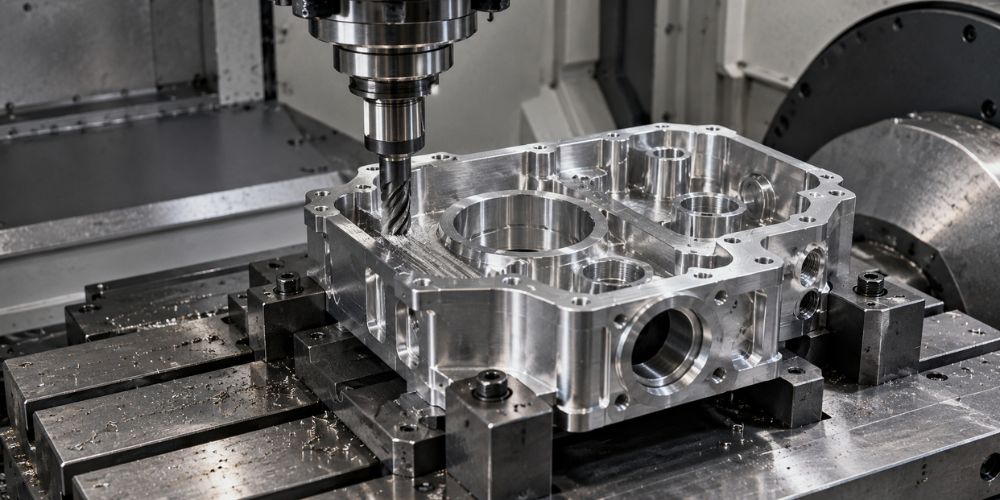
A housing can look simple in CAD and still be difficult to machine. Deep pockets, thin walls, small internal radii, sealing grooves, threaded holes, and several precision interfaces can quickly add production time.
Material choice changes how difficult those features are to produce. It also affects cutting parameters, heat generation, tool life, and cycle time.
Aluminum
- Faster Material Removal: 6061 is widely used for machined components partly because of its good machinability. Hydro specifically lists machinability among the useful characteristics of 6061 aluminum.
- Good for Complex Geometry: Aluminum works well for multi-sided housings, internal pockets, connector openings, mounting features, and detailed profiles. Its machining behavior makes it practical where a large amount of stock must be removed.
- Practical for Prototyping: Faster cutting and easier material removal can help when a design is still changing. You can machine a housing, test it, revise the model, and produce the next version without committing as much machine time as many stainless steel parts require.
Stainless Steel
- More Demanding Cutting Conditions: Austenitic stainless steels have a high work-hardening rate, according to Outokumpu’s fabrication data. This means material ahead of or around the cutting zone can become harder as it is deformed.
- Heat and Tool Wear Need Attention: Seco Tools’ stainless steel machining guidance explains that poor heat dissipation and work hardening contribute to tool wear. Cutting strategy, coolant, feed, speed, tool geometry, and carbide selection therefore matter more.
- Complex Features Can Add Cost: Deep pockets, thin walls, small radii, and tight tolerances can increase machining time further. A stable machining sequence also becomes important where multiple precision surfaces must maintain their relationship after material removal.
At MachMaster, we use DFM review to spot geometry that may add machining time without improving the housing’s function. In my experience, changing a deep pocket or tolerance callout early can save more money than simply searching for a lower material price.
Our CNC machining capabilities cover prototypes through repeat production, with CNC milling, turning, inspection support, ISO 9001-certified processes, and listed machining tolerances down to ±0.01 mm for applicable operations.
7. Surface Finish and Appearance
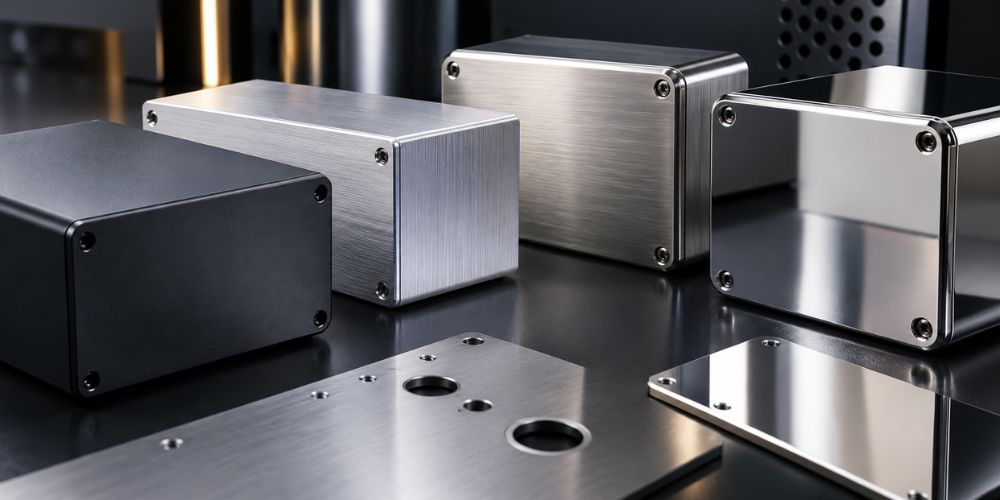
A precision housing often needs to look as good as it performs. Surface finish can influence corrosion behavior, wear, cleaning, branding, glare, and the way customers perceive the finished instrument.
The good news is that both material families give you several finish options. They simply achieve the final appearance in different ways.
Aluminum
- Good Anodizing Options: Aluminum works especially well with anodizing. The process can improve surface protection while providing black, clear, or other specified colors.
- Easy to Create Cosmetic Textures: Bead blasting, brushing, polishing, painting, and powder coating can create very different visual and tactile results. This gives product designers plenty of flexibility for exposed housings.
- Good for Branded Products: Aluminum housings can support engraving, laser marking, serial numbers, control labels, measurement markings, and logos. These features can often be added without changing the main housing material.
Stainless Steel
- Clean Metal Appearance: Stainless steel can provide a finished industrial appearance without a colored coating. Brushed and polished surfaces are common where the metal itself is part of the product design.
- Surface Condition Affects Corrosion: Surface finish can affect corrosion performance, particularly where deposits, atmospheric exposure, or splashing are involved. Smoother stainless surfaces can make cleaning easier and reduce places where deposits collect.
- Several Finishing Choices: Stainless steel can be brushed, polished, blasted, or passivated depending on the application. worldstainless describes passivation as a chemical treatment used to support the formation of the protective chromium-oxide surface film.
MachMaster combines CNC machining with finishing options such as anodizing, polishing, brushing, blasting, powder coating, and plating. We can therefore review the machining and cosmetic requirements together, rather than treating the finish as an afterthought.
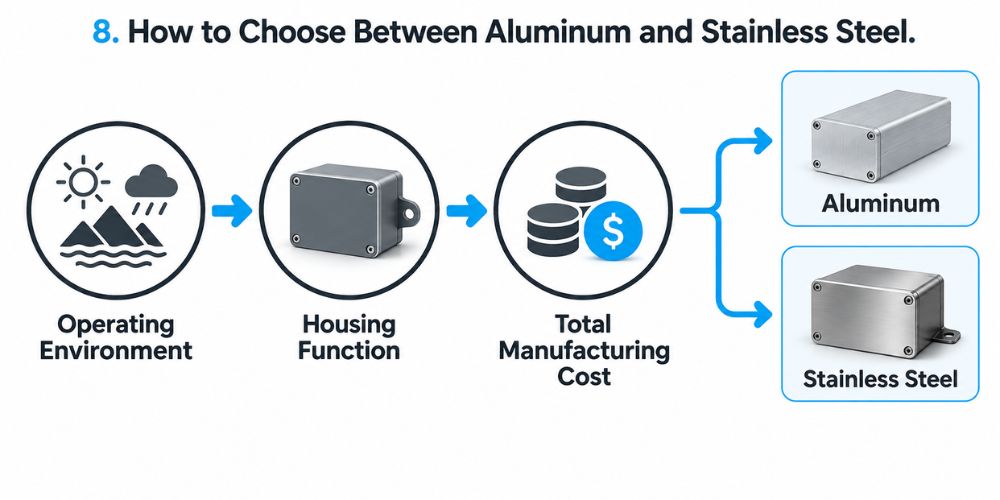
8. How to Choose Between Aluminum and Stainless Steel
There is no single winner for every precision instrument housing. The best material is the one that matches the operating environment, housing function, manufacturing process, and budget.
A simple three-step check can make the decision much faster.
Start With the Operating Environment
Ask what the housing will actually face every day. Will it stay inside a controlled laboratory, or will it deal with salt, chemicals, humidity, repeated cleaning, impact, or large temperature swings?
Write down the temperature range, moisture, chemicals, vibration, impact, and cleaning process. That list can remove unsuitable options before you spend time comparing quotes.
Match the Material to the Housing Function
Next, ask what housing needs to do. Does it carry loads, hold optical alignment, spread heat, protect electronics, provide precision mounting surfaces, or simply cover internal parts?
Choose aluminum when low weight, faster heat transfer, and easier machining lead the decision. Consider stainless steel when higher stiffness, corrosion performance, wear resistance, or repeated cleaning carry more weight.
Compare Total Manufacturing Cost
Do not stop at raw stock prices. Machining time, tool wear, tolerance requirements, setup count, surface finish, inspection, assembly, production quantity, and service life all affect the real cost.
I recommend quoting the same CAD design in both materials when the decision is close. That gives you an actual manufacturing comparison instead of an assumption.
Still undecided? Use this quick check:
- Choose aluminum if: Your instrument needs to stay light, move heat quickly, use complex CNC geometry, or go through several prototype iterations.
- Choose 304 stainless steel if: You need high stiffness and good general corrosion resistance, but chloride exposure is not the main problem.
- Choose 316 or 316L stainless steel if: Corrosion exposure is more demanding, especially where chlorides, frequent cleaning, medical use, pharmaceutical use, or process environments are involved.
Conclusion
Aluminum is a smart choice when you need a lightweight housing with good heat transfer and easier machining. Stainless steel is better when stiffness, corrosion resistance, and demanding service conditions matter more.
The best material depends on how your instrument will be used, not just the raw material price. Compare strength, temperature, machining needs, finish, and long-term performance before making your decision.
At MachMaster, we help you review material choices, DFM, machining, finishing, and production requirements in one process. Send us your drawings and project details to get practical manufacturing feedback before you move into prototyping or production.
Explore More Helpful Resources
There’s more to explore! Check out our additional product selections to find exactly what you’re looking for:
Interested in more? Here are some additional articles with insights and tips to keep you informed:
- 10 Leading Metal CNC Machining Manufacturers for Custom Industrial Components
- ABS vs ASA for CNC Machined Parts: Machinability, Durability and Cost
Still haven’t found what you’re looking for? Don’t hesitate to contact us. We’re available around the clock to assist you.