

Are you choosing between aluminum and steel for an automotive machined part? The right material can affect weight, strength, machining time, and cost.
In short, aluminum is better for low weight, corrosion resistance, and faster machining, while steel is better for high strength, stiffness, and wear resistance. Your final choice should match the part’s real working conditions.
As Founder and Chief Designer of MachMaster, I bring more than 15 years of machining experience to material and production decisions. Our team has supported precision parts from prototypes to repeat production.
This guide compares aluminum and steel by strength, machinability, corrosion resistance, cost, and automotive use. You can use it to make a faster and more practical material decision.
1. What Are Aluminum Automotive Machined Parts?
Aluminum automotive machined parts are components produced from aluminum alloys through CNC milling, turning, drilling, and related processes. Common choices include 6061, 6082, 7075, and other grades selected based on strength, weight, machining, and operating conditions.
Different alloying elements can change aluminum’s strength, workability, density, and corrosion behavior, according to the Aluminum Association’s alloy standards guidance. That is why you should look at the actual alloy grade rather than simply writing “aluminum” on a drawing.
Aluminum is especially useful where reducing mass has real value. The Aluminum Association’s automotive data projects aluminum content in North American light-duty vehicles to reach 556 pounds per vehicle by 2030, showing how widely the material is being adopted in modern vehicle programs.
It is also important for electric vehicles because less mass can help offset the weight of batteries and electric motors. The U.S. Department of Energy says lightweight materials can improve EV efficiency and extend all-electric range.
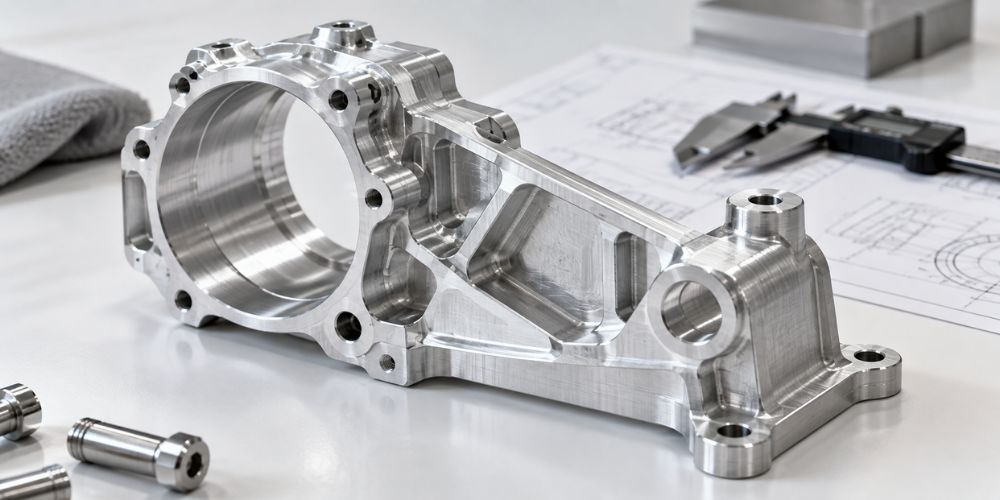
2. What Is Steel for Automotive Machined Parts?
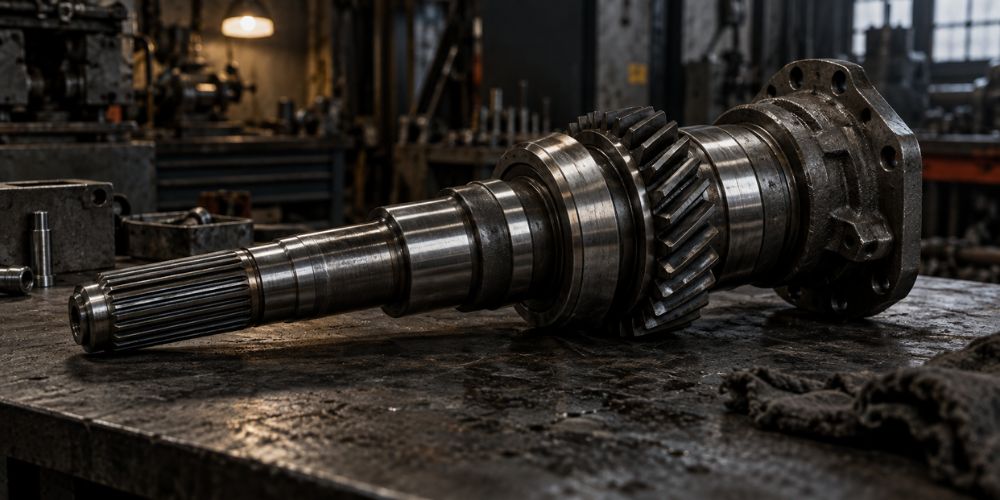
Steel automotive machined parts are precision components made from carbon steel, alloy steel, stainless steel, and other automotive steel grades. You will often see steel used where parts carry heavy loads, experience repeated stress, or need good wear resistance.
There is no single “steel” performance level either. Grade, carbon content, alloying elements, heat treatment, and hardness can all change how a steel part behaves.
Automotive steel technology also continues to expand. WorldAutoSteel reported in 2025 that the advanced high-strength steel portfolio had grown from 38 commercially available grades in 2017 to nearly 70 grades, giving automotive engineers a much wider set of strength and manufacturing options.
So, is steel simply the “heavy option”? Not really. Advanced grades can let engineers use less material while still meeting demanding strength and crash-performance targets.
3. Strength
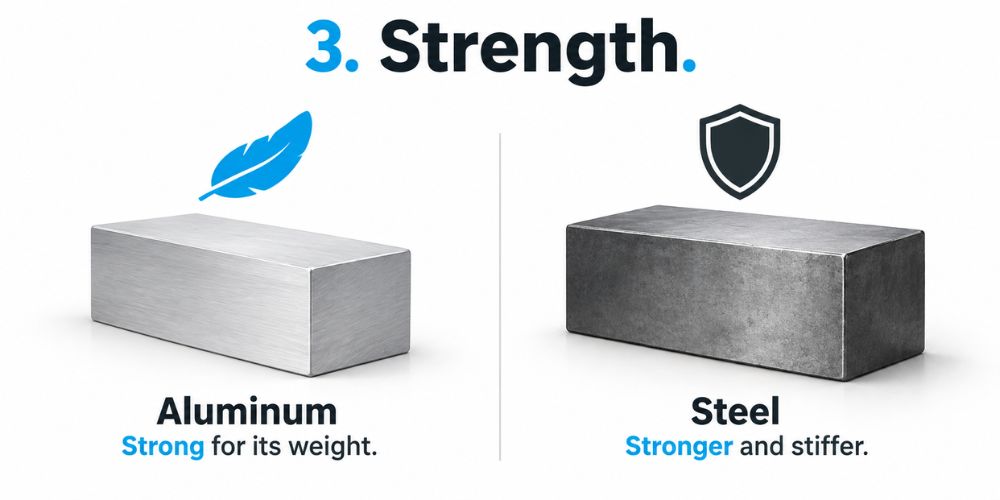
Strength is usually the first comparison people make, but it should not be the only one. Steel normally wins on absolute strength and stiffness, while aluminum has a major advantage in weight.
Aluminum
- Good Strength-to-Weight Ratio: Aluminum gives you useful mechanical strength at much lower mass than steel. The Department of Energy describes aluminum as roughly one-third the density of steel, which explains why it is attractive for weight-sensitive vehicle parts.
- Strength Depends on the Alloy: A 6061 part and a 7075 part should not be treated as equivalent. Alloy chemistry and temper change mechanical properties, which is why the Aluminum Association maintains detailed standards and property references for commercial grades.
Steel
- Higher Strength for Heavy Loads: Steel is often the better starting point for shafts, gears, pins, axles, and similar load-bearing components. Advanced automotive steels are specifically developed to combine high strength with useful ductility and manufacturing performance.
- Better Stiffness: Automotive steel has an elastic modulus of about 210 GPa, while automotive aluminum alloys are around 70 GPa, according to the Advanced High-Strength Steel Application Guidelines. In simple terms, steel is roughly three times as stiff, so it resists elastic deflection more strongly at the same geometry.
- Strong Fatigue Options: Alloy steels can work well for components exposed to repeated loads, particularly when the grade and heat treatment match the duty cycle. Heat treatment can also change hardness, wear behavior, and strength, so the machining sequence may need to account for it.
I often see buyers ask us at MachMaster which metal has the higher tensile strength and stop there. We prefer to look at load direction, wall thickness, stiffness, geometry, fatigue, and service conditions together because a stronger material does not automatically create the better part.
Aluminum vs Steel: Key Engineering Data
| Property | Aluminum | Steel | Why It Matters |
| Relative Density | About one-third of steel | Roughly 3× aluminum | Aluminum can reduce part and vehicle mass |
| Elastic Modulus | About 70 GPa | About 210 GPa | Steel offers much greater stiffness at similar geometry |
| Weight Reduction Potential | Lightweight material substitutions may reduce component mass by 10% to 60% | AHSS can also reduce mass compared with conventional steel designs | Material choice can affect vehicle efficiency |
| Basic Corrosion Behavior | Naturally corrosion resistant | Carbon steel often needs surface protection | Finishing can affect cost and service life |
| Typical Design Advantage | Low mass and good strength-to-weight performance | High strength, stiffness, and load capacity | Helps narrow material selection early |
The density, stiffness, and lightweighting figures above come from U.S. Department of Energy research and the automotive steel industry’s technical guidance.
What does this mean for your part? If stiffness controls the design, replacing steel with aluminum may require thicker walls, ribs, or another geometry change rather than a simple one-for-one material swap.
4. Machinability
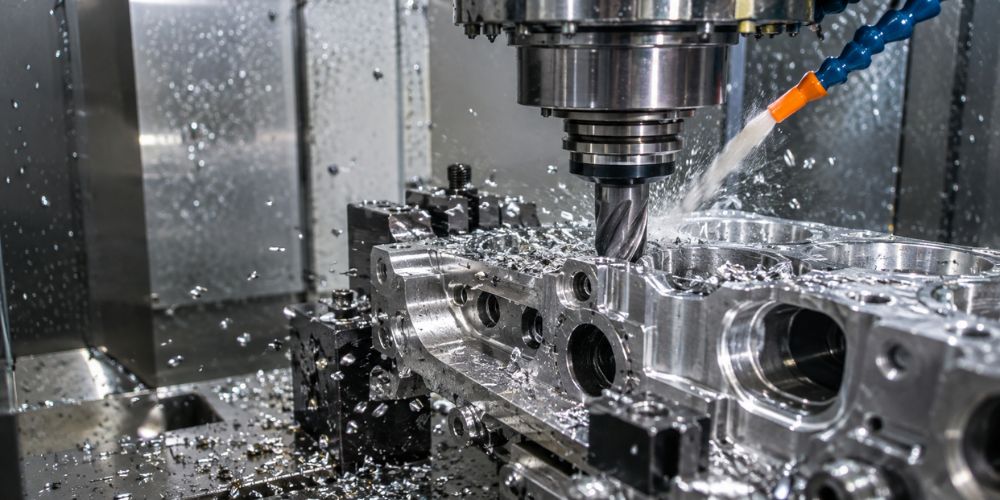
Machinability affects far more than how easily a cutter moves through metal. It influences CNC cycle time, power demand, tool wear, chip control, surface finish, and ultimately your cost per finished part.
Aluminum
- Faster Cutting: Many aluminum alloys can be machined at high cutting speeds with suitable tooling. Sandvik Coromant’s automotive aluminum machining guidance cites specialized applications reaching cutting speeds as high as 6,000 m/min and feed rates as high as 20,000 mm/min.
- Lower Cutting Forces: Aluminum machining can support aggressive material removal with relatively light cutting action. Seco Tools notes that modern aluminum tooling is developed specifically around high metal-removal rates, reduced cutting forces, and lower power requirements.
- Good Surface Results: With the right alloy, cutter geometry, feeds, and speeds, aluminum can produce clean machined surfaces. Anodizing can then add surface protection and cosmetic color where the design calls for it.
There is a catch. Aluminum can build up on cutting edges if tooling and chip control are poor, so “easy to machine” does not mean the process can be ignored.
Steel
- Grade Makes a Big Difference: Mild steel, stainless steel, tool steel, and hardened alloy steel behave differently under a cutter. Tool geometry, carbide grade, feeds, speeds, coolant, and workholding all need to match the actual material.
- Higher Tool Load: Harder materials and hard inclusions can accelerate abrasion, chipping, and other tool-wear patterns. Seco Tools’ machining guidance explains how hard particles, heat, cutting speed, and workpiece condition can change tool wear significantly.
So which material is faster to machine? For many common CNC applications, aluminum has the advantage, but your actual cycle time depends on alloy, geometry, tolerance, tooling, and machine capability.
At MachMaster, we review those factors together instead of judging cost from material name alone. If you have a drawing, you can compare the material, tolerance, and production route through our CNC machining services, which cover milling, turning, prototypes, and repeat production.
5. Corrosion Resistance
Will the part see road salt, rain, humidity, chemicals, or repeated temperature changes? If yes, corrosion should be part of the material decision from the beginning.
Aluminum
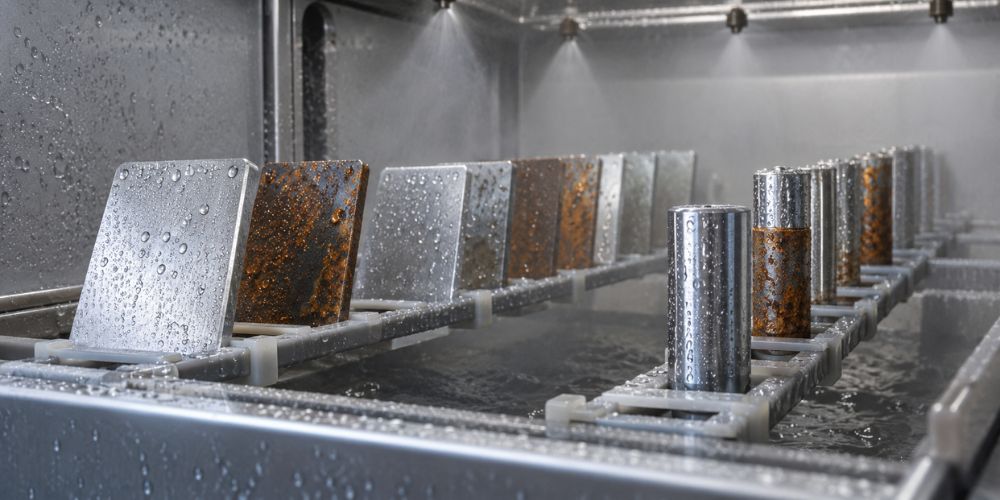
- Natural Corrosion Resistance: Aluminum naturally offers useful corrosion resistance, which is one reason it appears in transportation and other exposed applications. The Aluminum Association specifically describes aluminum as naturally corrosion resistant.
- Good Choice for Exposed Parts: Housings, covers, brackets, and other components exposed to moisture can benefit from aluminum’s corrosion behavior. The exact alloy still matters because alloying additions can change corrosion performance.
- Anodizing Adds Protection: Anodizing creates a protective oxide surface and can also provide decorative color. Our current CNC process options include anodizing for aluminum components where added wear or corrosion protection is required.
Steel
- Carbon Steel Needs Protection: Ordinary carbon steel can corrode in wet environments, so zinc plating, paint, coatings, black oxide, or another finish may be specified. The right choice depends on exposure, appearance requirements, and service life.
- Stainless Steel Performs Differently: Stainless steel gives you much better corrosion resistance than ordinary carbon steel while keeping the general strength advantages associated with steel. Different stainless grades still behave differently, so the grade should match the current environment.
A common mistake? Corrosion protection gets discussed after the part has already been quoted.
That can change price, tolerance planning, and lead time. Define exposure conditions early, especially for parts used underneath a vehicle or near moisture, road chemicals, or outdoor equipment.
6. Cost
Which material is cheaper? There is no honest one-word answer because material price is only one part of CNC component cost.
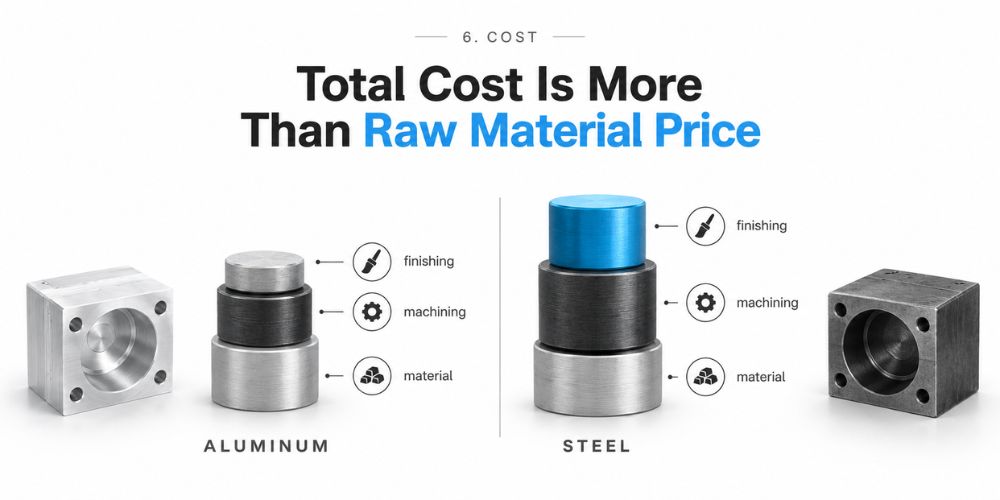
You also need to look at part weight, cycle time, cutting tools, finishing, heat treatment, inspection, scrap, order quantity, and freight. The Department of Energy also describes aluminum as a lighter but more expensive alternative to conventional steel, highlighting the basic tradeoff between material cost and weight.
Aluminum
- Higher Material Price Can Be Offset: Aluminum may carry a higher raw-material price than common carbon steel. Its much lower density means the same physical volume weighs far less, so price per kilogram alone can give you the wrong impression.
- Faster Machining Can Reduce Cost: High cutting speeds and high material-removal rates can reduce machine time on suitable aluminum parts. In volume production, even a modest reduction in cycle time can matter because that saving is repeated across every part.
- Finishing Requirements Matter: A basic machined aluminum component may need little secondary processing, while a cosmetic anodized component requires another operation. Add that process before comparing supplier quotes.
Steel
- Raw Stock Can Be Economical: Common carbon steel can be attractive where raw-material cost matters more than weight. This can make it a sensible choice for high-volume mechanical parts where additional mass is acceptable.
- Machining Can Cost More: More cutting force, lower practical cutting speeds for some grades, and higher tool wear can raise machining cost. Hardened steels and difficult stainless grades can widen that gap further.
- Secondary Processes Add Up: Grinding, hardening, plating, and corrosion-protection processes can all add cost. Sometimes steel still wins after those steps, but you need to calculate the complete route first.
I often tell buyers to forget price per kilogram for a moment and ask, “What does one accepted finished part cost me?” At MachMaster, our material review looks at machining and finishing together, and you can compare available options through our CNC machining materials page.
7. Typical Automotive Applications
The application usually makes the decision clearer. A lightweight electronics housing and a heavily loaded axle may both be machined on CNC equipment, but they ask very different things from the material.
Aluminum
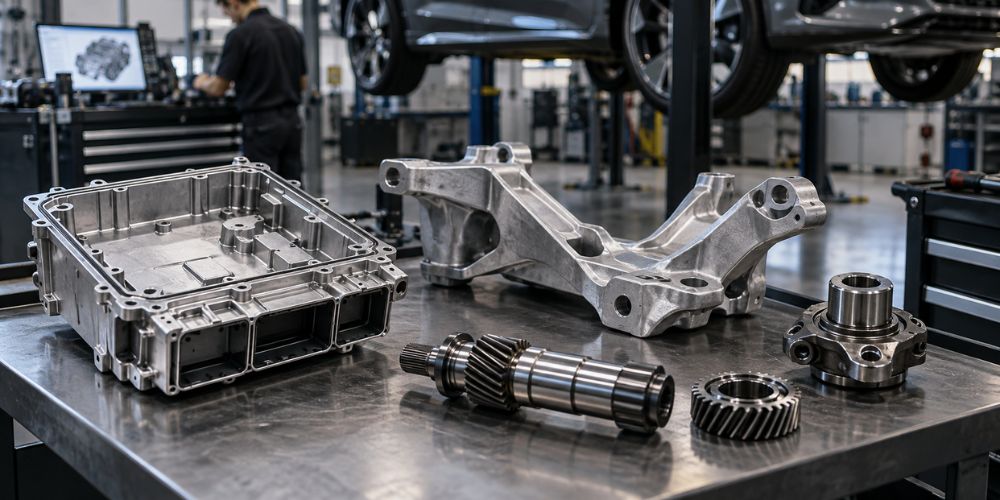
- Engine and Powertrain Housings: Aluminum is widely associated with automotive engine and powertrain machining because low mass and thermal performance can be useful.
- EV Components: Aluminum is increasingly relevant to battery-related structures, electronic housings, motor components, brackets, and cooling-related parts. The Department of Energy notes that lightweight materials can offset battery and motor mass and support better electric-vehicle efficiency and range.
- Brackets and Supports: CNC-machined aluminum is practical for many mounts and supports where maximum steel-level stiffness is unnecessary. Designers can use ribs, thicker sections, and geometry changes to increase stiffness while still keeping weight under control.
Steel
- Shafts and Axles: Steel is a natural candidate for rotating and load-bearing components where high stiffness and fatigue performance matter. Heat treatment can further improve the performance of alloy-steel parts used under demanding loads.
- Gears and Wear Components: Gears, pins, and contact surfaces often benefit from steel because hardening can provide high surface hardness and wear resistance. The ability to modify mechanical performance through alloy and heat-treatment selection gives designers many options.
- Suspension and Drivetrain Parts: Steel remains important for highly loaded vehicle structures and mechanical systems.
Still unsure? Ask one simple question: What is the part’s main job?
If its main job is saving weight while supporting moderate loads, aluminum often moves up the list. If its main job is carrying heavy forces, resisting bending, or surviving repeated mechanical contact, steel usually deserves the first look.
8. How to Choose Between Aluminum and Steel
There is no universal winner. Your best material is the one that meets the mechanical requirements while keeping production practical and total part cost under control.
Start With the Part’s Performance Requirements
Begin with load, stiffness, fatigue life, wear, temperature, corrosion exposure, and target weight. If high load capacity, stiffness, or wear resistance sits near the top of your list, steel often has the advantage.
If weight reduction and corrosion resistance matter more, aluminum deserves closer consideration. Remember that steel’s modulus is roughly 210 GPa versus about 70 GPa for automotive aluminum alloys, so changing from steel to aluminum may also require a geometry change.
Do this work before locking the CAD file. Changing materials late can force you to rethink wall thicknesses, threads, bearing seats, ribs, and mating surfaces.
Compare the Complete Manufacturing Cost
Look beyond the stock price. Add machining time, tool consumption, heat treatment, coatings, finishing, inspection, scrap, shipping weight, and production quantity.
For procurement teams, cost per accepted finished component is a much better comparison than cost per kilogram. This is especially true if one option needs grinding, hardening, plating, or a slower CNC cycle.
Also consider volume. A few extra minutes of machining may barely matter on five prototypes but can become a major cost driver across tens of thousands of production parts.
Review the Design Before Production
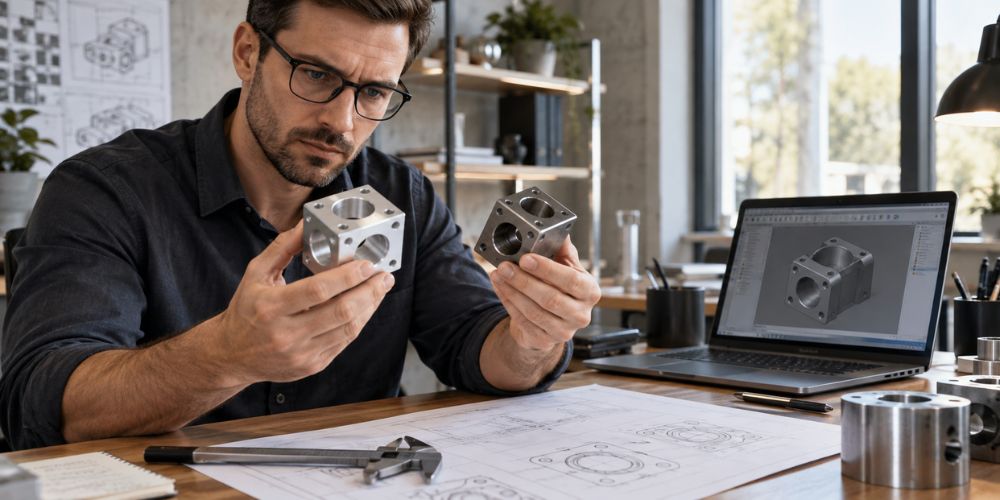
Your CAD model and material specification should be reviewed together. Deep pockets, thin walls, small threads, tight tolerances, difficult tool access, and large amounts of material removal can change the economics of aluminum and steel in different ways.
A DFM review can identify dimensions or tolerances that add cost without adding useful performance. It can also flag areas where a material change requires thicker walls, different radii, another machining sequence, or a new surface treatment.
This becomes even more valuable as you move from prototype quantities into repeat manufacturing. Small design changes made early are usually much easier to manage than production changes made after tooling, inspection methods, and supplier processes are already established.
Conclusion
Aluminum is a practical choice when lower weight, corrosion resistance, and easier machining matter most. Steel is often better when your part needs higher strength, stiffness, and wear resistance.
The best material still depends on the part itself, including its load, geometry, environment, tolerance, and production volume. Looking at the complete manufacturing cost can also help you avoid choosing a material based on raw price alone.
At MachMaster, we can review your drawing, material options, and machining requirements before production. If you already have a CAD file, explore our CNC machining services and submit your project for a practical manufacturing review.