

Are you choosing titanium for an automotive or motorsport part and wondering if the higher cost is worth it? The answer depends on where weight, strength, and durability matter most.
Titanium offers high strength, low weight, corrosion resistance, and strong fatigue performance. The tradeoff is higher material cost and more demanding machining.
As the Founder and Chief Designer of MachMaster, I work with a team that has more than 15 years of machining experience. That experience helps us understand where titanium adds real value and where another material may be the better choice.
In this guide, you will learn the best titanium grades, common applications, CNC machining methods, cost factors, and key design considerations. You will also see how titanium compares with aluminum and steel.
1. Best Titanium Grades for Automotive and Motorsport Parts
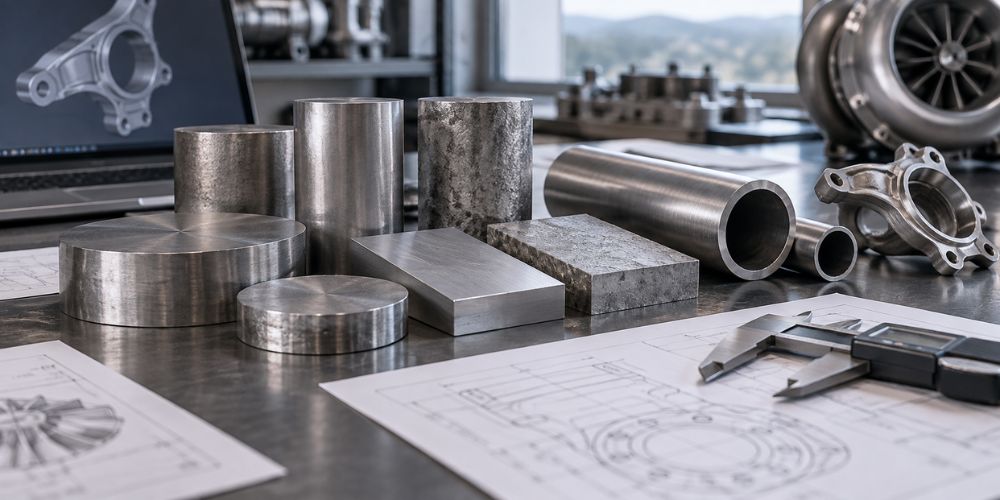
The grade you choose affects strength, weight, formability, machining, and price. Here are the four grades you are most likely to compare for performance-oriented components.
- Grade 5 Titanium, Ti-6Al-4V: Grade 5 is one of the main choices for high-strength titanium parts, including fasteners, automotive components, structural parts, and sports equipment. TIMET’s Grade 5 data lists a density of 4.42 g/cm³ and a minimum tensile strength of 895 MPa for annealed sheet and plate, with a minimum 0.2% yield strength of 828 MPa.
- Grade 2 Titanium: Grade 2 is commercially pure titanium with lower strength than Grade 5, but it has good ductility, formability, weldability, and corrosion resistance. According to the TIMET Grade 2 datasheet, it has a density of about 4.51 g/cm³, a guaranteed minimum yield strength of 275 MPa, and typical tensile strength around 485 MPa.
- Grade 9 Titanium, Ti-3Al-2.5V: Grade 9 sits between commercially pure titanium and Grade 5 and gives you good formability with higher strength than Grade 2. TIMET’s Grade 9 data lists a density of 4.48 g/cm³, minimum annealed tensile strength of 620 MPa, and availability in billet, bar, plate, sheet, strip, tubing, and pipe.
- Grade 23 Titanium, Ti-6Al-4V ELI: Grade 23 is the extra-low-interstitial version of Grade 5 and is used where fracture performance deserves more attention. TIMET identifies Grade 23 as an option for fracture-critical applications, while standard Grade 5 remains the more common general-purpose alloy.
Which one should you start with? For many high-performance CNC automotive parts, Grade 5 is the logical first material to evaluate.
That does not mean it should automatically be your final choice. If the component does not need its strength level, another grade may make more sense.
Technical reference: You can view the full property tables and temperature data in the TIMET Ti-6Al-4V technical datasheet.
2. Common Automotive Applications of CNC Machined Titanium
Titanium works best where its performance benefits justify the extra material and machining expense. This is why manufacturers tend to use it selectively rather than replacing every aluminum or steel component.
- Engine and Valvetrain Components: Titanium is used in engine components and high-performance valve systems where lower moving mass can be useful. Racing supplier Ferrea, for example, lists titanium competition valves for high-RPM racing applications, while TIMET also identifies engine components as an automotive titanium market.
- Exhaust Components: Titanium can be used for exhaust tubing, tips, flanges, mounts, and related performance hardware. A particularly useful real-world figure comes from TIMET’s automotive exhaust alloy data, which reports weight savings above 40% compared with stainless steel in automotive and motorcycle exhaust applications.
- Fasteners and Bolts: CNC machined titanium bolts, nuts, studs, and specialty fasteners can reduce mass while retaining high mechanical strength. TIMET specifically lists fasteners and automotive components among applications for Ti-6Al-4V.
- Suspension and Chassis Parts: Titanium can also fit selected brackets, mounts, suspension hardware, and other weight-sensitive structural components. The business case is strongest where removing weight or improving corrosion performance has a measurable effect on the vehicle.
Here is the question I would ask before specifying it: What does titanium actually improve on this part?
If the answer is meaningful weight reduction, high strength, corrosion resistance, or performance under demanding service conditions, the extra cost may be justified. If you cannot identify a clear benefit, aluminum or steel may be the better buy.
3. Titanium CNC Machining in Motorsport
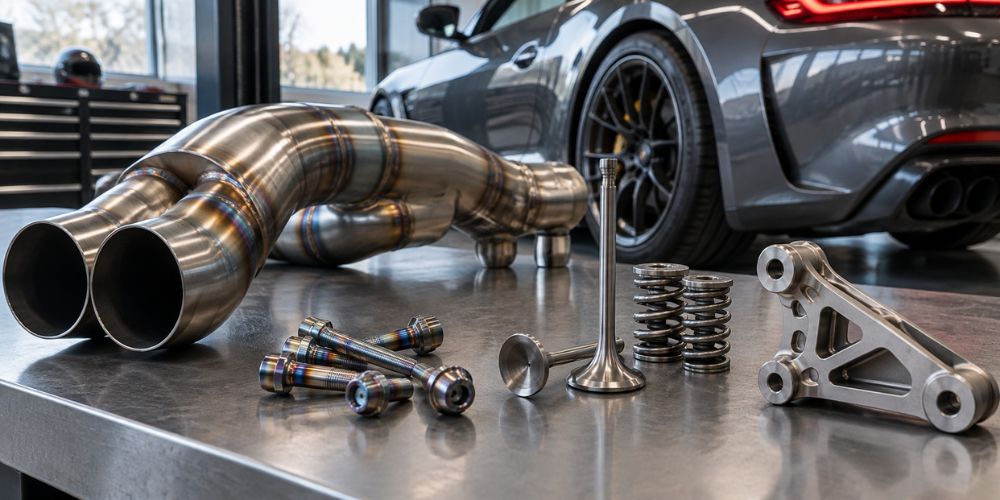
Motorsport puts extra pressure on weight, strength, heat, fatigue performance, and packaging. Titanium therefore appears in racing valves, fasteners, exhaust hardware, brackets, engine components, motorcycle parts, and selected suspension hardware. Ferrea, for example, specifies titanium valves for professionally built high-RPM racing engines, including drag racing, NASCAR, road racing, and motorcycles.
I treat titanium as a strategic material, not a default one. If removing weight improves component response, handling, acceleration, or packaging, the higher price may make sense.
If it does not, steel or aluminum can be the smarter choice.

4. Titanium vs Aluminum vs Steel for Automotive Parts
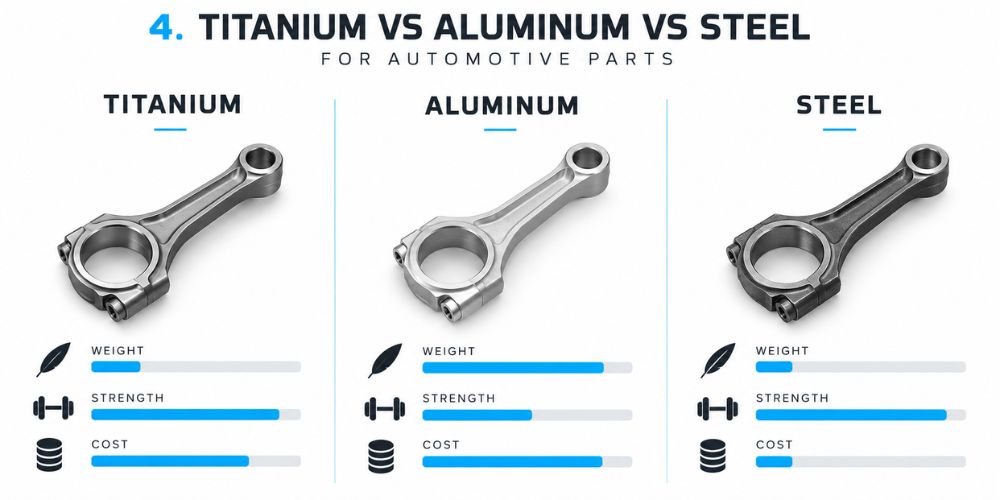
No single metal wins every comparison. Your choice needs to reflect load, temperature, weight targets, geometry, machining requirements, budget, and service conditions.
Want the quick version? Use this table first, then look at the demands of the actual component.
| Factor | Titanium | Aluminum | Steel |
| Relative Weight | Medium | Low | High |
| Strength Potential | High | Medium to High | High |
| Strength-to-Weight | Very High | Good | Moderate |
| Corrosion Resistance | Very High | Good | Depends on grade |
| Machining Difficulty | High | Low | Medium |
| Relative Cost | High | Low | Low to Medium |
| Best Fit | Performance parts | Lightweight general parts | Cost-sensitive high-load parts |
Titanium is generally more demanding to machine because of its high strength, low thermal conductivity, chemical reactivity, and tendency to generate significant heat around the cutting zone. Kennametal also notes that these conditions contribute to tool wear and can affect surface quality if machining parameters are poorly controlled.
So, when does each material make sense?
Aluminum is often attractive when low weight, lower material cost, and fast machining are priorities. Steel works well where high load capacity and lower material cost are more important than reducing mass.
Titanium sits between them in weight, but its strength-to-weight performance makes it attractive for high-value components where every gram matters.
5. CNC Machining Methods for Titanium Automotive Parts
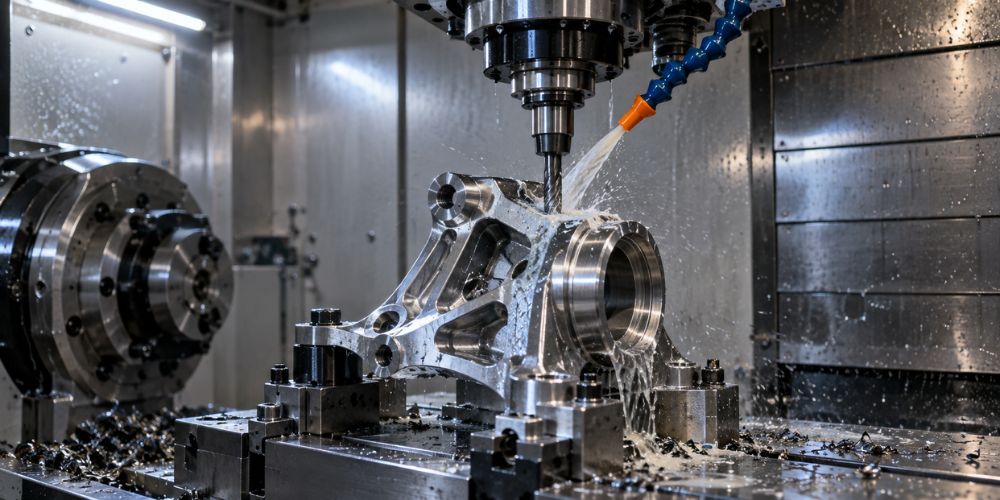
The right CNC process depends on geometry, tolerance, accessibility, and production quantity. A good process plan can remove unnecessary setups and keep expensive titanium machining time under control.
In my experience, you should start with the CAD model and ask what the part actually needs. The machine should follow the geometry, rather than making the geometry fit an inefficient process.
3-Axis CNC Milling
3-axis milling works well for titanium brackets, plates, mounts, flanges, housings, and parts with accessible features. For relatively simple geometry, it is usually more economical than using a 5-axis machine.
Titanium needs careful control of heat and chip evacuation. Kennametal recommends strategies such as controlled radial engagement, proper feeds and speeds, suitable carbide tooling, and high-pressure coolant to manage cutting conditions.
For straightforward automotive parts, 3-axis machining can give you a practical balance between accuracy and price.
CNC Turning
CNC turning fits round titanium parts such as shafts, pins, spacers, bushings, threaded parts, and cylindrical fasteners. It can support both one-off prototypes and repeat production.
Keep the profile as simple as the function allows. Extra shoulders, grooves, threads, or decorative details can add cutting passes and tool changes.
Why does that matter? With titanium, added machine time can become expensive quickly because cutting conditions and tool life are less forgiving than with aluminum.
5-Axis CNC Machining
5-axis machining is useful for complex surfaces, angled holes, deep features, and parts that would otherwise require several setups. Haas states that simultaneous 5-axis machining can reduce operations, cycle time, and setup count while improving accuracy across a part run.
That does not mean every complex-looking titanium part needs five axes. You should use the process where better tool access or fewer setups offset the higher machine rate.
Complex motorsport brackets and multi-sided performance components are good examples.
Visual reference: Haas also includes videos and machine demonstrations in its 5-axis machining guide, which can help you see why multi-sided components benefit from fewer setups.
Mill-Turn Machining
Mill-turn machining combines turning and milling within one machine setup. It works particularly well when a titanium component has cylindrical geometry plus flats, slots, cross holes, or other milled features.
Fewer transfers between separate machines can simplify the production route. It can also reduce repeated workholding and handling on medium-volume automotive components.
At MachMaster, we use CNC milling, turning, and multi-axis machining based on the geometry rather than pushing every titanium component through the same process. If you already have a CAD model, you can review our titanium CNC machining service and send the part for a manufacturability review.
6. What Affects Titanium CNC Machining Costs?
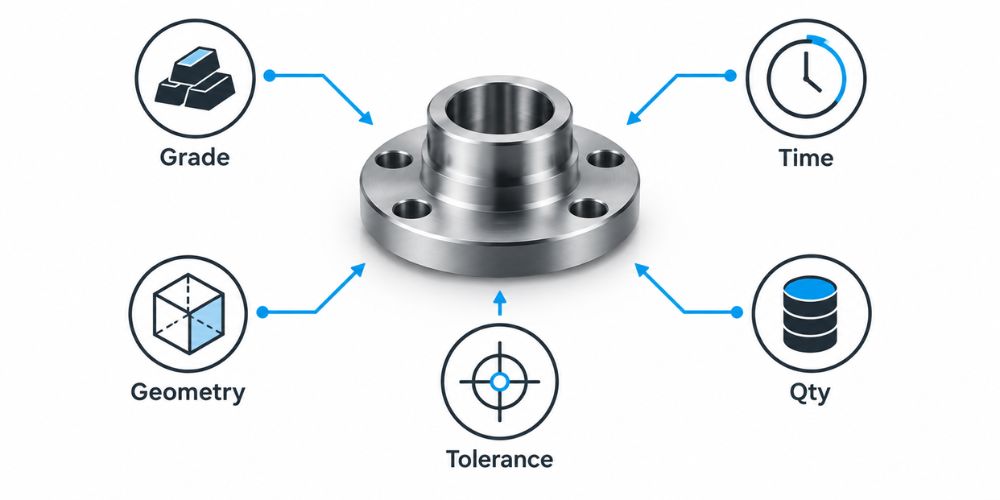
Titanium pricing depends on grade, stock size, machining time, geometry, tolerances, tooling, finishing, inspection, and quantity. Xometry’s CNC cost guide also notes that complex designs, tighter tolerances, long machining times, tooling, and small batches can increase unit cost.
At MachMaster, we treat early figures as planning estimates. A simple small titanium prototype may be around US$50 to $150, a moderate part around $150 to $500, while a complex 5-axis or tight-tolerance component may reach $500 to $1,500+ per piece.
These are budgeting ranges, not fixed market prices. Your CAD file and quantity tell the real story.
7. Key Design Considerations for Titanium Parts
Good titanium design uses the material where it adds value without adding unnecessary machining. Small CAD decisions can affect tool access, cycle time, inspection work, and your final quote.
I often see parts become expensive because every feature has been given maximum precision instead of the precision the function actually requires. A cleaner drawing can save more money than people expect.
Keep Wall Thickness Practical
Thin walls can move or flex under cutting forces. That makes dimensional control harder and can force the machinist to use lighter cuts.
Give the wall enough thickness for the actual mechanical load and machining method. Removing material simply to make a component look lightweight can add hours of machining without giving you a useful performance gain.
Thin sections are sometimes necessary in racing parts. In that case, plan them with the machining process in mind from the start.
Use Realistic Tolerances
Very tight tolerances usually mean more machining, measurement, setup control, and inspection. Xometry also identifies tight tolerances and complex geometry as factors that can increase CNC machining costs.
I normally place close tolerances on functional areas such as bearing locations, mating surfaces, sealing faces, and alignment features. Less sensitive dimensions can often use standard machining tolerances.
Does every dimension need ±0.01 mm? Usually, no.
Simplify Holes, Threads, And Internal Corners
Deep holes, very small holes, deep threads, and sharp internal corners can make titanium machining slower. Internal pockets also need enough room for a practical cutter.
Standard threads, reasonable hole depths, and larger internal radii can cut machining time. This matters because titanium already puts more stress on cutting tools, while good chip evacuation and coolant delivery play a major role in tool life.
If you are still editing the CAD model, this is the best time to remove features that add little functional value.
Plan Surface Finish And Inspection Early
Surface finish requirements can add machining and post-processing after the main geometry is complete. Tight dimensional specifications may also call for CMM inspection, added measurements, and more production records.
Decide which surfaces really need cosmetic or functional finishing before requesting your quote. There is little value in paying for a high-grade finish on a hidden surface that has no functional role.
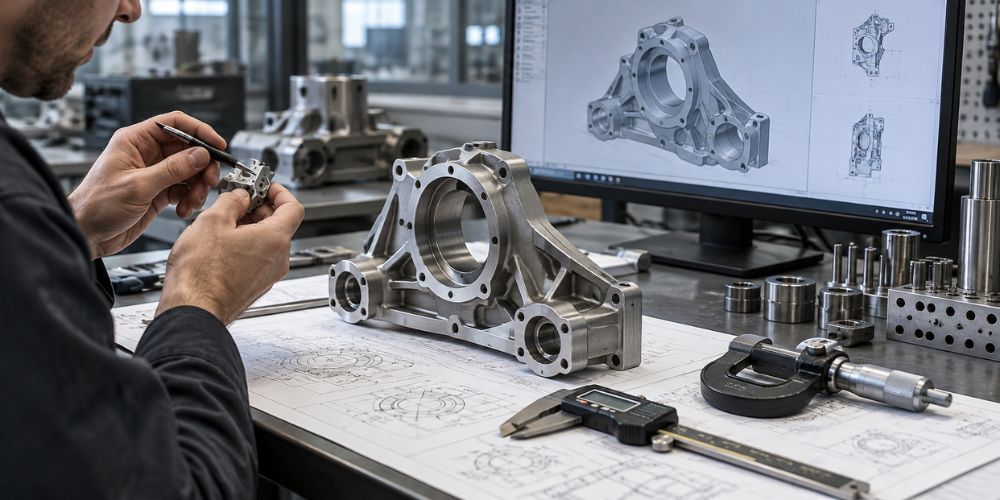
At MachMaster, our engineers can review the drawing before production and flag features that may add cost without helping the part perform. You can use our CNC machining service to submit your files and compare suitable production options.
Conclusion
Titanium can be a strong choice for automotive and motorsport parts where weight, strength, corrosion resistance, and fatigue performance matter. The key is choosing the right grade and using it only where those benefits justify the extra machining cost.
A good result also starts with practical geometry, realistic tolerances, and the right CNC process.
At MachMaster, we support titanium parts from prototypes through production, including automotive and motorsport applications.
If you already have a drawing or CAD model, explore our Titanium CNC Machining Service and submit your project for a manufacturing and pricing review.