
Are you deciding between ABS and ASA for a CNC machined part? The right choice mainly depends on how and where the part will be used.
ABS is usually better for cost-sensitive indoor parts, while ASA is better for outdoor parts exposed to sunlight and weather. Both materials machine well, but ASA offers stronger UV resistance.
With more than 15 years of machining and product development experience, I have worked with many plastic part projects from prototypes to production. I have seen how the right material choice can prevent redesigns, performance issues, and added costs later.
In this guide, you will compare ABS and ASA by machinability, impact resistance, dimensional accuracy, UV resistance, and cost. This will help you choose the better material for your project.
1. What Is ABS for CNC Machined Parts?
ABS stands for acrylonitrile butadiene styrene. According to Ensinger’s ABS material guide, it combines toughness, impact resistance, rigidity, and good machinability.
For CNC work, ABS is available as sheets, plates, and rods. It is commonly used for housings, handles, interior components, fixtures, prototypes, and other general-purpose plastic parts.
Why does this matter to you? ABS gives you a familiar engineering plastic that is relatively easy to source and works well for many indoor applications.
2. What Is ASA for CNC Machined Parts?
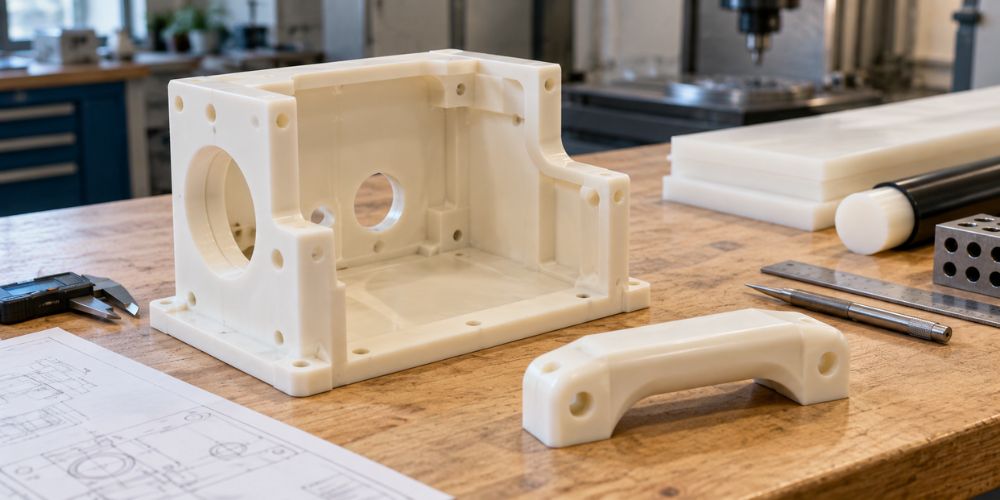
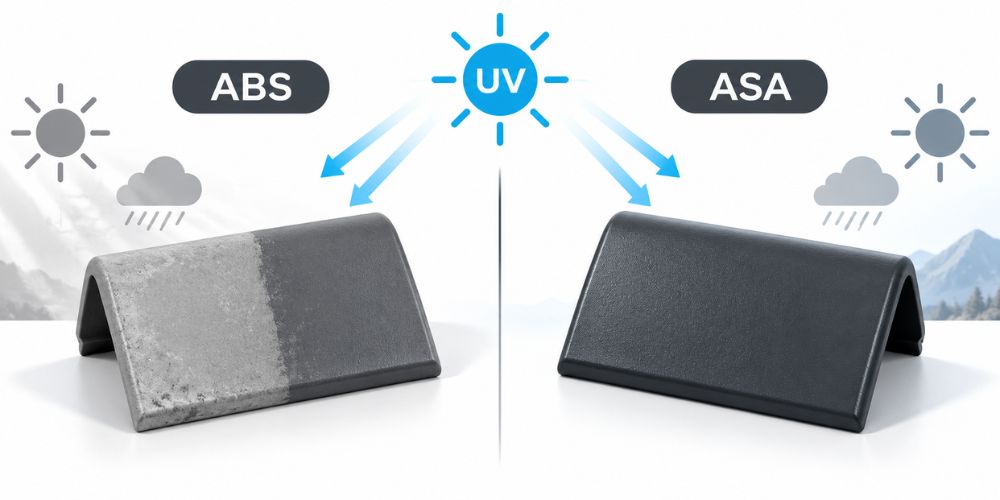
ASA stands for acrylonitrile styrene acrylate. It has mechanical characteristics similar to ABS, but its main advantage is stronger resistance to UV light and long-term outdoor exposure.
For example, INEOS Styrolution’s Luran S ASA is specified for UV resistance, long-term property retention, and exterior uses such as automotive trim and mirror housings.
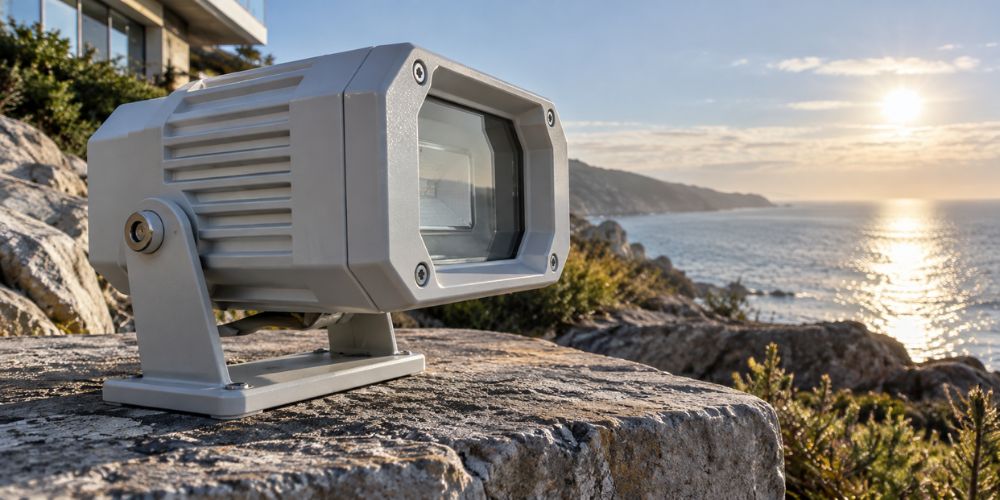
That makes ASA worth considering for outdoor housings, lighting parts, signs, vehicle components, covers, and exposed equipment. If the part may sit in sunlight for years, this difference matters.
3. Machinability
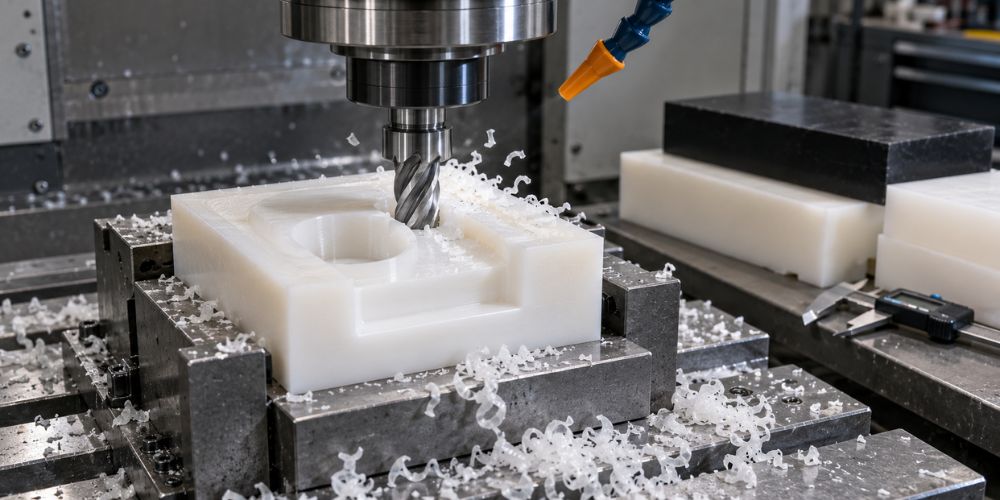
Both ABS and ASA can be milled, drilled, turned, and cut with CNC equipment. The main machining issue is heat because engineering plastics do not move heat away from the cutting zone as quickly as metals.
So which one is easier to machine? For most general CNC jobs, ABS has a slight practical advantage because it is widely available and well established as machinable stock.
ABS
- Good CNC Machinability: Ensinger lists ABS as a material with good machinability and supplies it in rod and plate form. You can use it for milling, turning, drilling, and many standard machining operations.
- Clean Surface Potential: Sharp tools and controlled cutting conditions can give ABS clean edges and smooth surfaces. Heat still needs attention because excessive friction can soften thermoplastics near the cutting edge.
- Easy Stock Sourcing: ABS sheets and rods are widely sold as semi-finished engineering plastic stock. That can make prototypes and low-volume runs easier to plan because you have more stock sizes and suppliers to choose from.
I often see ABS used when a designer wants a functional prototype without moving straight into a more expensive engineering polymer. At MachMaster, we review the CAD model, wall thickness, tolerances, stock size, and machining features before cutting, which helps us spot areas where heat or material movement could affect the finished part.
ASA
- Suitable for CNC Work: INEOS states that semi-finished Luran S ASA can be sawed, drilled, milled, and turned using conventional metalworking and woodworking equipment. This makes ASA a practical machining material rather than a plastic limited to molding or extrusion.
- Heat Needs More Attention: INEOS also notes that ASA dissipates heat slowly and that water cooling may be needed even at lower cutting speeds.
- Outdoor Performance Can Offset the Difference: ASA may require a little more thought during sourcing and machining, but the final application can justify it.
What is the takeaway? Choose ABS if you mainly care about straightforward machining and indoor use.
Choose ASA if the part must combine CNC machinability with better outdoor performance.
4. Impact Resistance
What happens if your component is dropped, struck, clamped, or exposed to repeated loads? This is where you need to look beyond the material name and check the specific ABS or ASA grade.
Both families include grades with very different impact values. A statement such as “ABS is stronger” or “ASA is tougher” can therefore be misleading without grade data.
ABS
- Good General Toughness: ABS is widely used because it combines stiffness with useful impact resistance, including at lower temperatures. Typical applications include handles, electronic housings, automotive interior components, and functional parts.
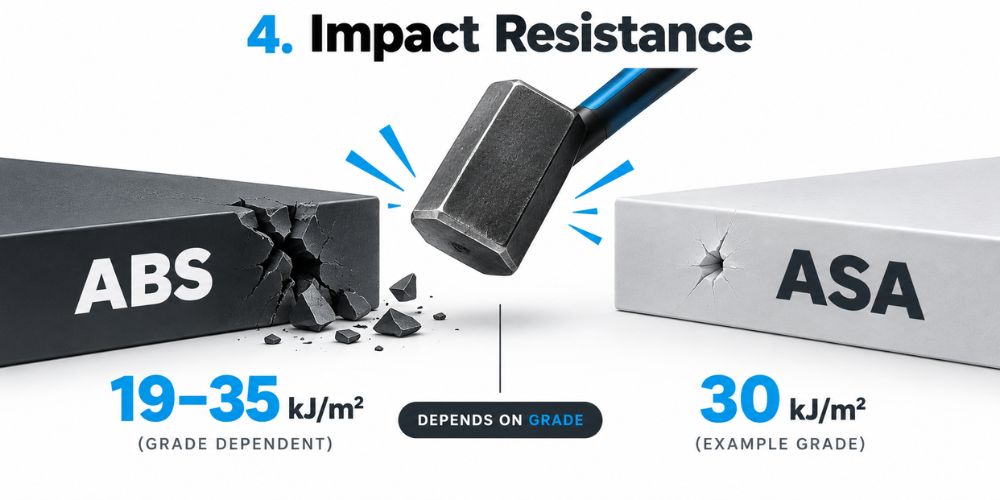
- Impact Strength Changes by Grade: INEOS data shows how wide the range can be. Terluran GP-35 has a Charpy notched impact value of 19 kJ/m² at 23°C, while the high-impact Terluran HI-10 reaches 35 kJ/m².
That 19 to 35 kJ/m² range is useful for buyers because it shows why specifying only “ABS” on an RFQ may not be enough.
A high-impact grade and a high-flow grade may behave differently in service even though both are ABS.
ASA
- Good Impact Performance: ASA can also provide useful impact strength while keeping its outdoor advantages. INEOS Luran S 796M, for example, has a Charpy notched impact value of 30 kJ/m² at 23°C.
- Independent Grade Data Supports the Same Point: Röchling lists Maywosol ASA at 30 kJ/m² notched impact strength under DIN EN ISO 179. The same product page describes the material as UV-resistant with good impact strength.
Does 30 kJ/m² automatically make ASA better than ABS? No.
It means that particular ASA grade has good impact performance. You still need to compare it with the exact ABS grade being considered for your project.
5. Dimensional Accuracy
Can both materials hold accurate CNC dimensions? Yes, but your final accuracy also depends on part geometry, internal stress, stock condition, heat generation, fixturing, wall thickness, and machining sequence.
The material name by itself does not tell you what tolerance the finished component can hold. Ensinger’s CNC plastic machining guidance specifically notes that polymer selection affects machinability, dimensional accuracy, surface quality, and component performance.
ABS
- Good Dimensional Stability: Commercial ABS grades are available with good dimensional stability, making the material suitable for housings, brackets, fixtures, prototypes, and machine components.
- Internal Stress Matters: Removing a lot of material from plastic stock can release residual stress and cause movement after machining. Ensinger notes that targeted stress relief can reduce internal stresses and support dimensional stability in CNC plastic components.
ASA
- Thermal Expansion Is Measurable: Röchling lists a coefficient of linear thermal expansion of approximately 95 × 10⁻⁶/K for Maywosol ASA. That figure matters if your part will experience meaningful temperature changes after machining.
- Other ASA Grades Show a Similar Range: INEOS reports 80 to 110 × 10⁻⁶/°C for Luran S 796M. It also lists processing shrinkage of 0.4% to 0.7%, which shows how much grade and process data can matter during dimensional planning.
What if your ASA component sits outdoors and moves between a cool night and a hot afternoon? You should think about the dimension at operating temperature, not just the measurement taken in an inspection room.
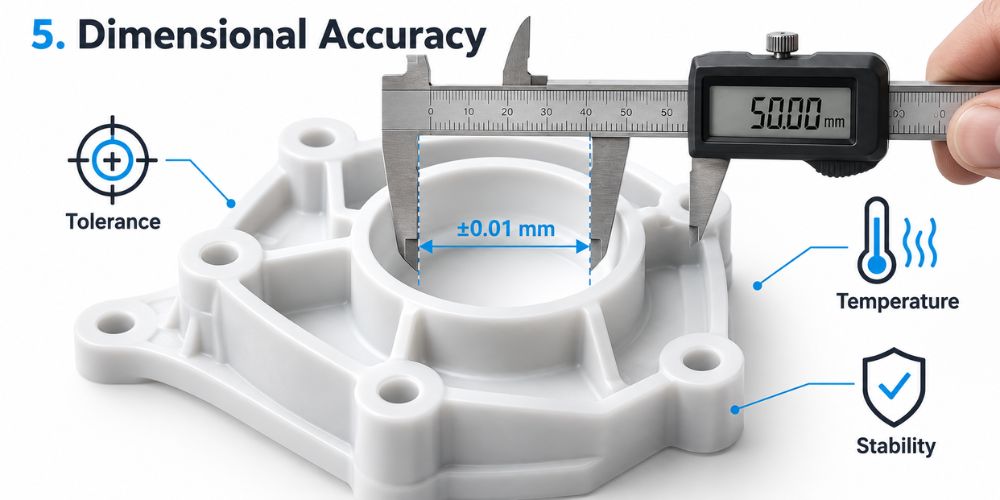
At MachMaster, our CNC capabilities reach tolerances down to ±0.01 mm for suitable parts, while published standard plastic tolerances depend on the machining process and geometry. We therefore look at the drawing, material, feature size, and actual function before recommending a realistic tolerance.
6. UV Resistance
If your part stays indoors, UV performance may have very little influence on the decision. If it sits outdoors every day, UV resistance can become the deciding factor.
This is also the clearest practical difference between standard ABS and ASA.
ABS
- Standard ABS Is Better Suited to Protected Use: ABS works well for interior housings, machine covers, fixtures, prototypes, and other protected components. Its strengths are toughness, machinability, stiffness, and cost rather than long-term exterior weather resistance.
- Outdoor Use Needs More Thought: You may find modified ABS grades, protective coatings, or ABS-based materials with improved UV behavior. But if long outdoor exposure is part of the basic requirement, starting with ASA often makes the material decision simpler.
ASA
- UV Resistance Is a Core ASA Advantage: INEOS describes its Luran S ASA family as having strong long-term performance under UV irradiation, along with color fastness and weather resistance. The company lists exterior automotive parts and other exposed applications among its uses.
- Weathering Data Supports the Use Case: Röchling describes Maywosol ASA as resistant to weathering, ageing, and discoloration. Its published material page specifically identifies UV resistance as a characteristic.
Will your part spend years outside? If yes, ASA deserves serious consideration even if ABS looks cheaper on the first quotation.
I have seen material choices that looked cheaper during prototyping become costly once discoloration or premature outdoor degradation entered the discussion. Looking at service life early is much easier than redesigning an installed product later.
7. Material Cost
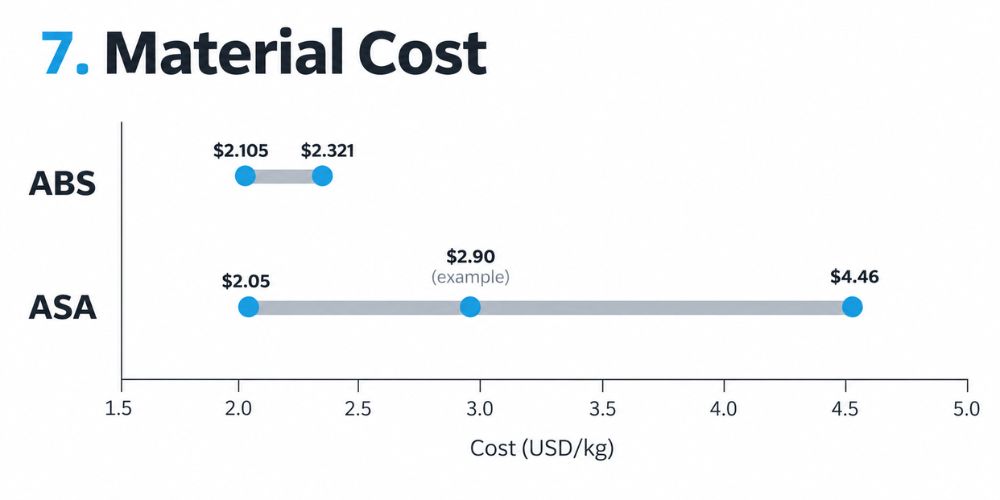
Which one costs more? In general, ABS is the lower-cost option and ASA carries a premium, but the size of that gap can change quickly by grade, supplier, order size, location, and market conditions.
Raw resin price is also different from the price of CNC-ready sheet or rod. Your finished CNC part adds stock conversion, machining time, setup, waste, inspection, and any secondary finishing.
| Cost Factor | ABS | ASA |
| Earlier 2026 Bulk Benchmark | About US$1.83 to US$1.86/kg | About US$2.10 to US$2.63/kg |
| Relative Material Cost | Lower | Higher |
| CNC Stock Availability | Common in rods, plates, and sheets | More dependent on supplier and grade |
| Best Cost Case | Indoor prototypes and general-purpose components | Outdoor parts where service life offsets the premium |
| Main Buying Question | Can ABS meet the operating conditions? | Is UV and weather resistance worth the higher price? |
Prices can move a lot even within the same material family. For example, a live PLAS listing checked in August 2026 showed CHIMEI PA-757 ABS at about US$2,105/MT, or US$2.105/kg, while another supplier on the same listing was at US$2,321/MT.
For ASA, a live INEOS Luran S 777K listing showed US$2,900/MT, or US$2.90/kg, with other listed suppliers ranging from roughly US$2.05 to US$4.46/kg.
Why such a large spread? Grade, branding, UV package, supply quantity, delivery terms, location, certification, and supplier margins can all affect the number you see.
For indoor parts, ABS often wins on upfront cost.
For outdoor parts, ask a different question: Will spending more on ASA reduce replacement, appearance, or warranty problems later?
8. How to Choose Between ABS and ASA
There is no need to make this decision complicated. Start with the environment, then look at mechanical requirements, tolerance, production quantity, and total cost.
A simple rule works surprisingly well: indoor and cost-sensitive often points to ABS; outdoor and UV-exposed often points to ASA.
Choose ABS for Indoor and Cost-Sensitive Parts
Choose ABS if your component will mainly operate indoors and material cost matters. It is a strong candidate for electronic housings, prototypes, covers, fixtures, handles, interior automotive components, and general machine parts.
ABS also makes sense if you expect several prototype revisions. Broad stock availability and good machinability can make it convenient for early design iterations.
Need a functional prototype to check fit before committing to production? ABS is often one of the first plastics I would evaluate.
Choose ASA for Outdoor Parts
Choose ASA if the component will regularly face sunlight, rain, outdoor temperature changes, or long-term weather exposure. Exterior housings, vehicle trim, outdoor lighting components, signs, equipment covers, and gardening products are good examples.
The raw material usually costs more, but the lowest initial price does not always give you the lowest lifetime cost. A part that retains its appearance and properties for longer may be worth the premium.
Does the part stay outside for years rather than weeks? That question should carry more weight than a small difference in material price.
Choose Based on the Complete Part Requirement
Do not make the final decision from one property. Review impact loads, UV exposure, working temperature, tolerance, surface requirements, quantity, expected service life, and material grade together.
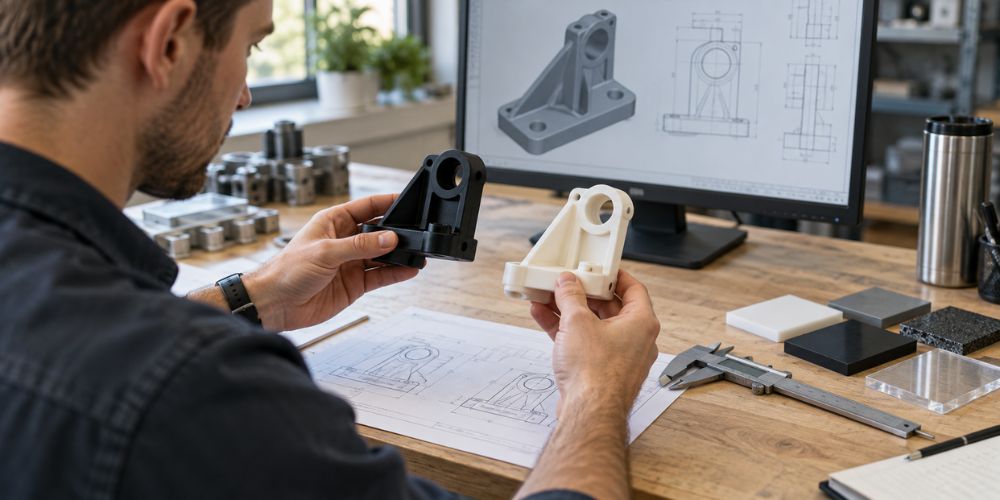
At MachMaster, we use the CAD model and application requirements to review manufacturability before production, rather than treating material selection as a separate purchasing decision. If you have a drawing ready, you can upload your CAD files for CNC machining and DFM review before committing to ABS or ASA.
Conclusion
ABS is usually the better choice for affordable indoor CNC parts, while ASA makes more sense for parts exposed to sunlight and weather. Your final choice should come down to the operating environment, required performance, and total cost.
Still unsure which material fits your part? Compare the exact ABS or ASA grade, impact requirements, tolerances, UV exposure, and expected service life before making the decision.
At MachMaster, we can review your design and help you choose a practical material and machining approach for your project. Explore our CNC machining services or submit your project for a quote when you are ready to move from CAD to finished parts.