
Are you choosing between 6061 and 7075 aluminum? The right choice depends on what your part actually needs.
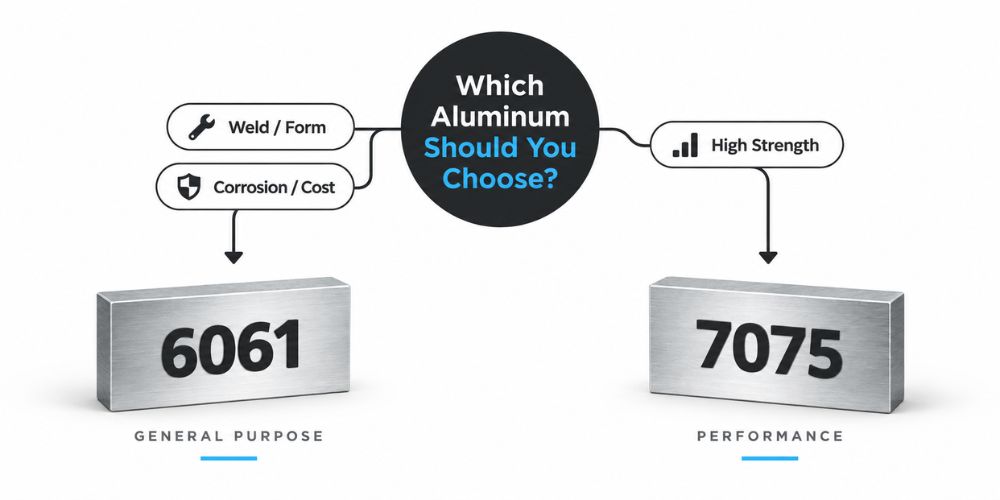
6061 is usually better for general parts, welding, corrosion resistance, and cost. Choose 7075 when higher strength is the main priority.
With years of experience working on prototypes and production parts, I have seen how the wrong alloy can add cost without adding real value. That practical experience helps me compare these materials from both a design and manufacturing point of view.
This guide covers strength, machinability, corrosion resistance, weldability, formability, and cost. Use it to quickly decide which alloy fits your project.
1. What Is 6061 Aluminum?
6061 is a heat-treatable aluminum alloy mainly containing magnesium and silicon. According to Kaiser Aluminum’s 6061 technical data, its composition includes 0.8 to 1.2% magnesium and 0.4 to 0.8% silicon.
It gives you a useful mix of strength, low weight, corrosion resistance, and manufacturability. Hydro’s 6061 alloy guide lists transportation components, machinery, equipment, recreation products, and consumer durables among its typical applications.
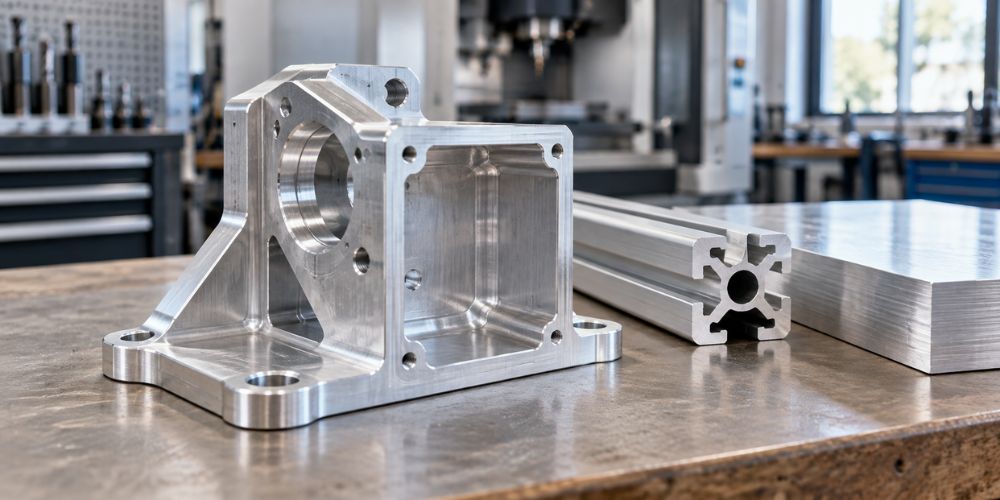
You will also commonly see 6061 used for frames, brackets, housings, fittings, automotive components, and CNC-machined parts. It is especially practical if your product needs welding, anodizing, or further fabrication.
2. What Is 7075 Aluminum?
7075 is a high-strength aluminum alloy built around zinc, magnesium, and copper. Kaiser Aluminum’s 7075 data sheet lists 5.1 to 6.1% zinc, 2.1 to 2.9% magnesium, and 1.2 to 2.0% copper.
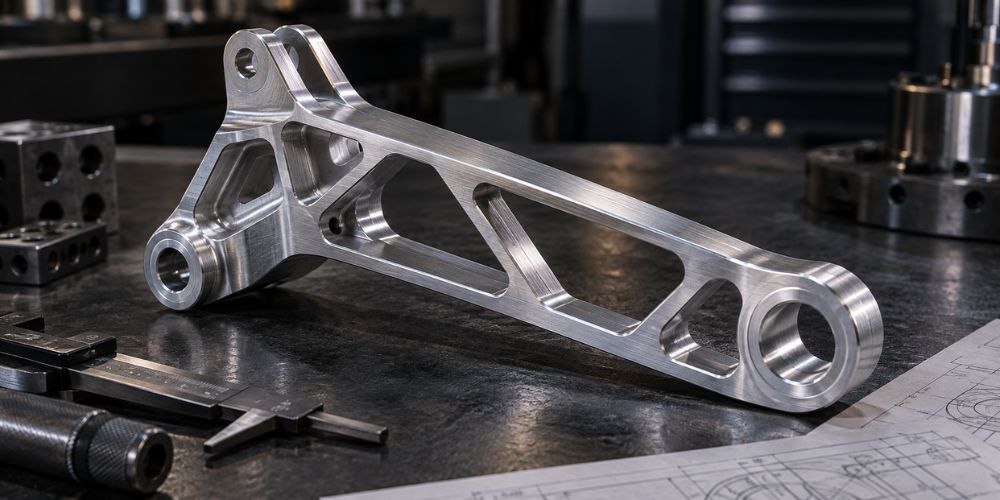
Its much higher strength makes it useful for parts that carry heavier mechanical loads. Kaiser notes that the alloy is heavily used in aircraft and ordnance applications, while Hydro’s 7075 guide also lists gears, shafts, chassis plates, mold tooling, automotive parts, and performance equipment.
The tradeoff is simple. You gain strength, but you usually pay more and give up some corrosion resistance, weldability, and forming flexibility.
3. Strength
Strength is usually the biggest reason people compare these alloys. But does a higher strength number automatically make 7075 the better material?
No. The right question is whether your part actually needs the extra strength.
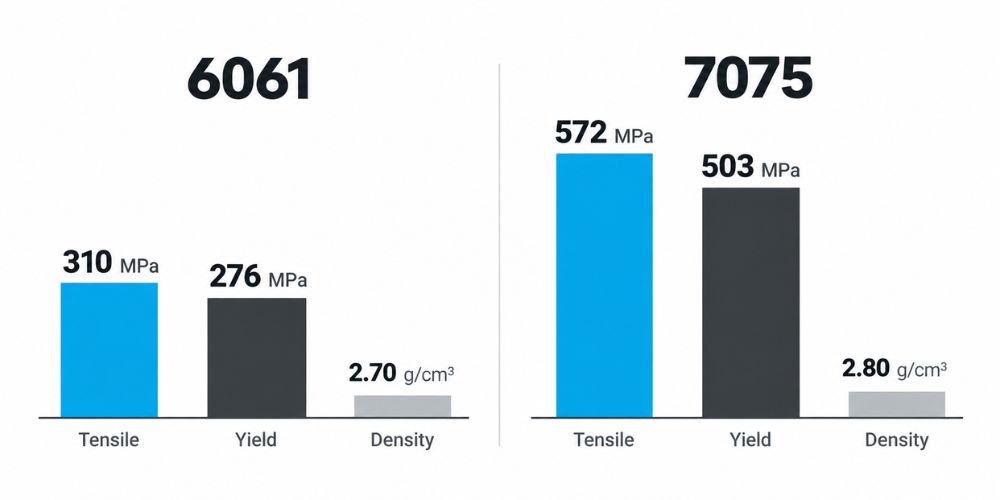
Kaiser’s published values put common 6061-T6/T651 at about 310 MPa tensile strength and 276 MPa yield strength. For 7075-T651, the figures rise to about 572 MPa tensile strength and 503 MPa yield strength.
That is roughly an 85% increase in tensile strength and an 82% increase in yield strength. Yet the density rises from only 2.70 g/cm³ to 2.80 g/cm³.
Here is why this matters.
6061 Aluminum
- Good General Strength: 6061-T6 provides enough strength for many commercial and industrial components. Frames, brackets, housings, fixtures, and structural parts often do not need the much higher strength of 7075.
- Low Weight: 6061 has a nominal density of about 2.70 g/cm³. You get a lightweight material that can work well for automotive components, machinery, electronics, and consumer products.
- Practical Material Choice: Higher material strength has little value if your part never approaches the load limit of 6061. I often start by asking, what load does the part actually see? That question can save more money than simply choosing the highest grade.
7075 Aluminum
- Much Higher Strength: 7075-T651 reaches about 572 MPa tensile strength and 503 MPa yield strength in Kaiser’s typical data. That gives you far more capacity for parts exposed to heavy loading.
- High Strength With Little Added Weight: Its density is about 2.80 g/cm³, compared with 2.70 g/cm³ for 6061. You gain a large amount of strength for a relatively small weight increase.
- Better for Performance-Driven Parts: Shafts, aerospace components, tooling, and heavily loaded mechanical parts are stronger candidates for 7075. At MachMaster, we compare the load, geometry, tolerance requirements, and production volume before recommending that added material cost.
4. Machinability and Manufacturing
Can both materials be CNC machined? Yes.
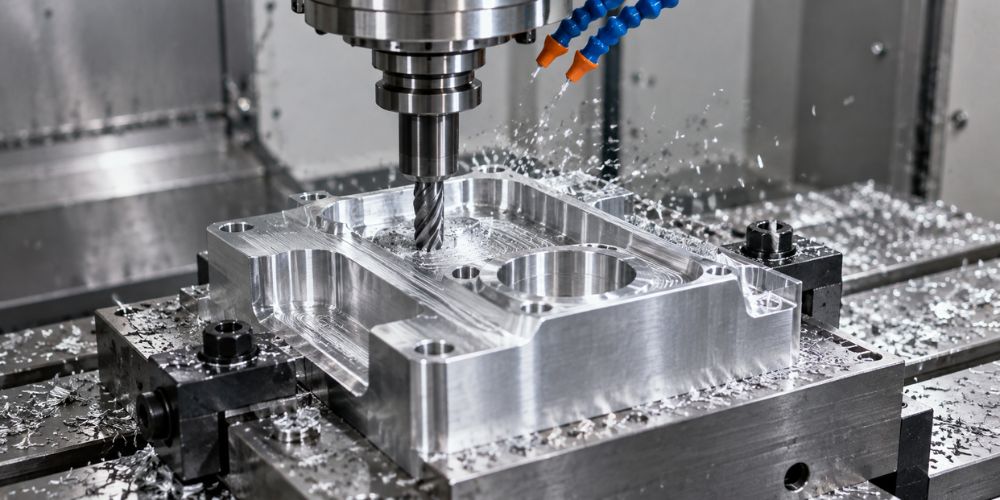
The more useful question is how their machining behavior affects production, scrap, finishing, and total part cost. Both work well with CNC equipment, but they do not behave exactly the same way.
6061 Aluminum
- Good CNC Machinability: 6061-T6/T651 works well for milling, turning, drilling, and other common CNC processes. Hydro notes that chips can be harder to break during turning and drilling, so chip breakers or techniques such as peck drilling may help.
- Easy to Source in Common Forms: 6061 is widely supplied as plate, bar, rod, tube, pipe, and extruded shapes. That gives buyers more options when selecting stock close to the finished part dimensions.
- Good for Surface Finishing: 6061 responds well to anodizing, including clear, dyed, and hardcoat methods. Hydro also describes it as having good finishing characteristics.
7075 Aluminum
- Good Machining Behavior: Hydro rates 7075 at B on the Aluminum Association A-to-F machinability scale, indicating that it machines readily. This makes it practical for precision milling and turning despite its greater hardness.
- Useful for Precision Mechanical Parts: Its strength makes it attractive for shafts, gears, tooling, structural components, and other parts that should resist deformation under load.
- Material Waste Costs More: If you machine a small finished component from a large 7075 block, every kilogram removed as chips comes from more expensive stock. This matters even more as your order quantity grows.
This is one place where design and purchasing decisions meet. At MachMaster, we often review starting stock dimensions along with the CAD model because reducing unnecessary material removal can lower machining time and raw material use.
Already have a part drawing? You can review our CNC milling capabilities and compare the material, tolerance, finishing, and production requirements before committing to an alloy.
5. Corrosion Resistance
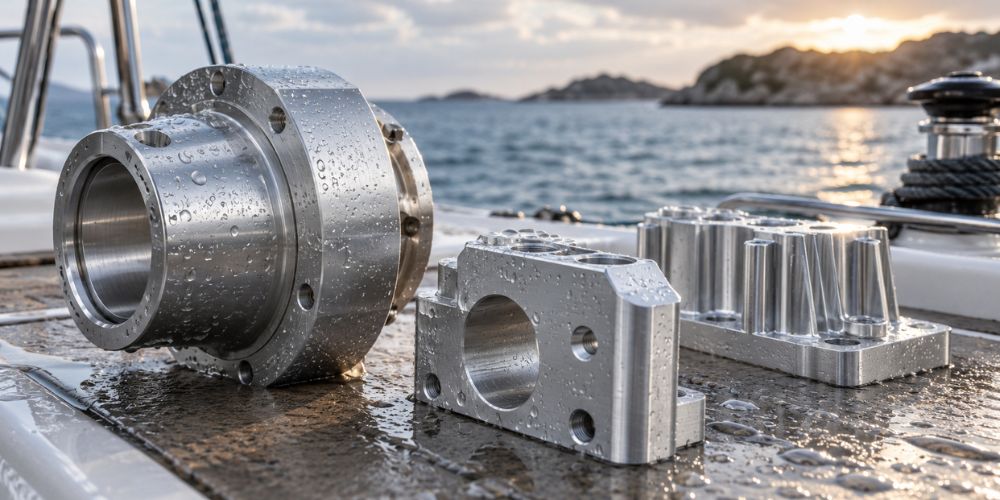
Will your component sit indoors, or will it spend years around rain, humidity, salt, or industrial contaminants? That difference can change the material decision.
6061 generally gives you better natural corrosion resistance. 7075 can still work in exposed applications, but temper and surface protection deserve more attention.
6061 Aluminum
- Good Atmospheric Resistance: Hydro describes 6061 as having excellent corrosion resistance under atmospheric conditions. It also provides good resistance to seawater.
- Practical for Outdoor Parts: This makes 6061 a useful choice for structures, equipment, and components exposed to normal outdoor conditions. Anodizing can add more surface protection while also changing appearance.
7075 Aluminum
- Lower General Corrosion Resistance: Kaiser’s comparison rates 6061-T6/T651 at B for general corrosion resistance, while 7075-T651 receives a C rating. In Kaiser’s system, A and B indicate stronger relative performance than C.
- Temper Makes a Difference: 7075-T7351 receives better stress-corrosion performance than T651 in Kaiser’s comparison. This is why you should specify the temper rather than writing only “7075” on an engineering drawing.
- Surface Protection Can Help: Anodizing and other coatings may improve surface protection in suitable applications. Hydro notes that 7075 has a good anodizing response, which can help with galvanic corrosion concerns.
What if the part is outdoors? If both alloys meet the mechanical requirement, 6061 often gives you the simpler starting point.
6. Weldability and Formability
Need to weld the component after machining? This section may decide the comparison for you.
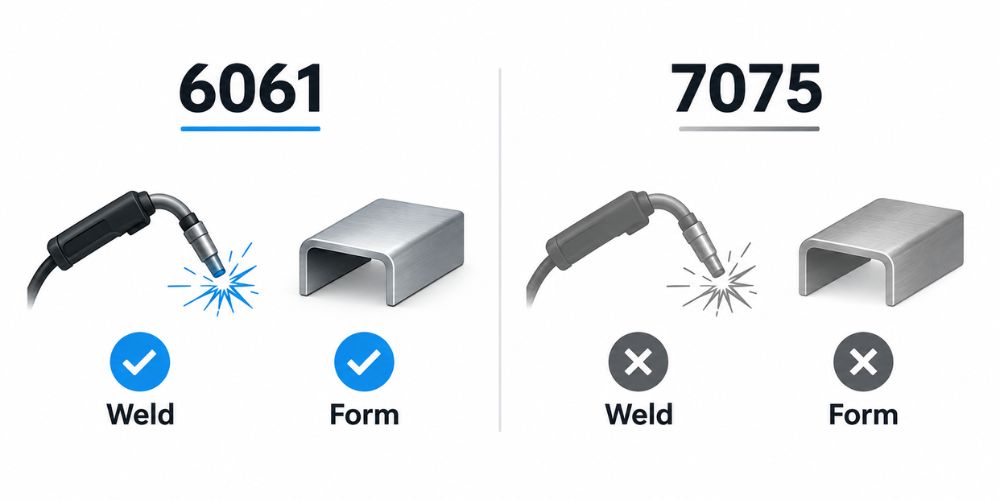
6061 works much better for welded and formed products. 7075 becomes harder to justify once conventional welding is part of the manufacturing plan.
6061 Aluminum
6061 can be welded using common commercial methods. Hydro notes that the alloy is easily welded and joined, although strength in the weld region can drop in the T6 condition.
That heat-affected area matters in structural design. A welded 6061-T6 assembly should not be evaluated as though every section still has the original T6 mechanical properties.
Formability also changes with temper. Kaiser rates 6061’s formability as excellent in O temper and good in T4, while Hydro recommends softer T1, T4, or O conditions for more severe bending.
7075 Aluminum
7075 is a poor choice for conventional welding. Hydro describes it as a poor welding material, though resistance welding may be possible, and Kaiser gives T651 a D rating for gas and arc welding.
Cold forming is also more limited in its high-strength tempers. Kaiser’s data gives 7075-T651 and T7351 a D rating for cold workability.
So, if you need a welded frame or a part with substantial post-processing bends, 6061 is usually the easier material to work with.
7. Cost of 6061 vs. 7075
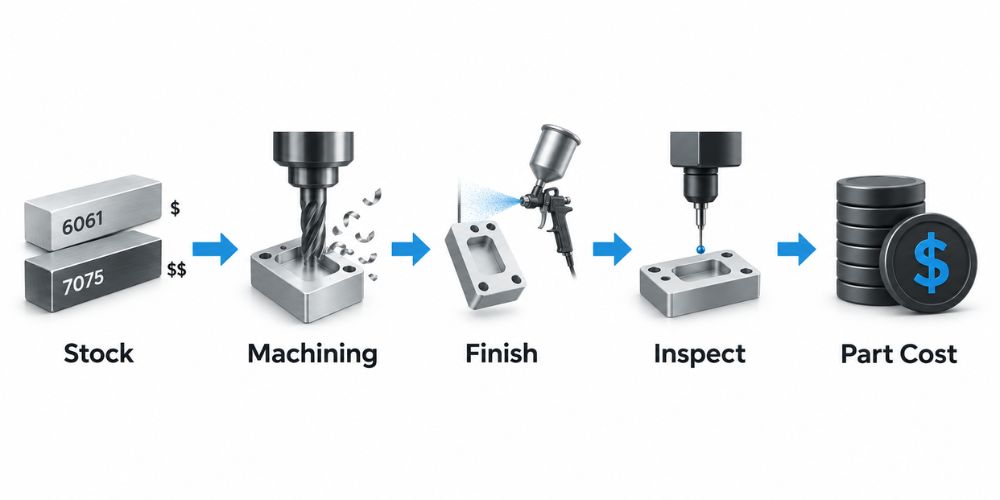
How much more does 7075 cost? There is no fixed answer because aluminum pricing moves with the market, alloy premiums, stock form, quantity, certification, and supplier.
The London Metal Exchange publishes global reference prices for primary aluminum in USD per metric tonne. Its July 2026 official data, for example, showed aluminum around USD 3,100 per metric tonne, before alloying, rolling, heat treatment, distribution, cutting, certification, and other conversion costs are added.
That explains why finished 6061 or 7075 stock costs much more than primary aluminum.
| Cost Factor | 6061-T6/T651 | 7075-T6/T651 | What It Means for You |
| Indicative Raw Material Range | About USD 3.50 to 7.00 per kg | About USD 5.00 to 12.00 per kg | 7075 is about 85% higher |
| Relative Material Cost | Lower | Higher | 7075 handles much higher stress before yielding |
| Availability | Very common | Common, but more specialized | 7075 is only about 3.7% denser |
| CNC Processing Cost | Generally economical | Can cost more due to stock price and project requirements | 6061 is often easier for exposed parts |
| Best Cost Fit | General commercial parts | High-strength parts where performance justifies the premium | 6061 is better for welded assemblies |
| Formability | Better, especially O and T4 | Limited in high-strength tempers | 6061 gives more fabrication flexibility |
| Typical Use | General industrial and commercial parts | High-load and performance parts | Select based on actual load needs |
For comparison, current supplier catalogs such as Online Metals’ 6061-T651 plate listings and 7075-T651 plate listings show how the same alloy can carry very different retail prices depending on dimensions and cut size.
So do not compare material price alone.
At MachMaster, we look at stock dimensions, material removal, machining time, tolerances, surface finishing, inspection, and order quantity together. A slightly cheaper kilogram of aluminum does not always produce a cheaper finished part.
Here is a simple example. If 7075’s higher strength lets you safely reduce section thickness or part mass, its price premium may make sense.
8. Which Aluminum Should You Choose?
There is no single winner. Start with what the finished part must do, then compare manufacturing limits and cost.
Do that before you ask, which alloy is better? A better question is, which alloy solves my actual problem?
Choose 6061 for General-Purpose Parts
Choose 6061 if you want a practical mix of strength, corrosion resistance, machining performance, weldability, and lower material cost. It fits brackets, housings, frames, fixtures, machinery parts, electronics, automotive components, and many commercial products.
It is also a sensible starting point when your design does not require extreme strength. You may get every mechanical property you need without paying the 7075 premium.
For business owners and procurement teams, that can matter a lot during repeat production. Saving even a small amount per part becomes meaningful across hundreds or thousands of units.
Choose 7075 for High-Strength Parts
Choose 7075 if high strength at low weight is a real design requirement. It is better suited to highly loaded components, aerospace-related parts, performance equipment, shafts, gears, tooling, and other demanding mechanical applications.
You should also account for higher raw material costs and poor conventional weldability. Corrosion exposure and temper selection deserve attention as well.
I have found that 7075 earns its price when the design actually uses its strength advantage. If the component never approaches the limits of 6061, the premium becomes harder to defend.
Compare the Whole Part, Not Just the Alloy
Look at load, dimensions, tolerance, surface finish, manufacturing process, environment, quantity, and target price together. One property should not drive the entire material decision.
For a product designer, this means thinking about machining and assembly as well as strength. For procurement teams, it means comparing finished part cost, not just the price per kilogram.
Personal buyers can use the same logic. If you are machining a one-off fixture, bracket, enclosure, or hobby component, 6061 is often enough unless you have a clear mechanical reason to move to 7075.
Conclusion
For most general CNC parts, 6061 is the more practical choice because it balances strength, corrosion resistance, machinability, weldability, and cost. Choose 7075 when your part truly needs much higher strength without adding much weight.
The best choice still depends on your load requirements, operating environment, manufacturing process, and budget. Instead of comparing strength alone, look at how the entire part will be made and used.
At MachMaster, we support aluminum CNC machining from prototypes to production, including material selection and DFM support. Explore our aluminum CNC machining services or submit your CAD files for a project quote to compare 6061 and 7075 for your part.
Discover More Options
There’s so much more to discover! Check out our other products and find what fits your needs:
We’ve got more for you! These articles provide more tips and guidance to keep you on track:
- 10 Leading Metal CNC Machining Manufacturers for Custom Industrial Components
- ABS vs ASA for CNC Machined Parts: Machinability, Durability and Cost
Still haven’t found what you’re looking for? Don’t hesitate to contact us. We’re available around the clock to assist you.